
Key Highlights
- Blue light bursts signal the destruction of stars near black holes.
- Tidal disruption events provide insights into extreme gravitational forces.
- Observations of these phenomena enhance understanding of cosmic evolution.
Recent astronomical research has unveiled a fascinating connection between mysterious blue bursts of light and the violent fate of stars that venture too close to black holes. These fleeting signals, once overlooked, are now recognized as crucial indicators of stellar destruction, offering scientists a unique glimpse into the mechanics of extreme gravity and cosmic events.
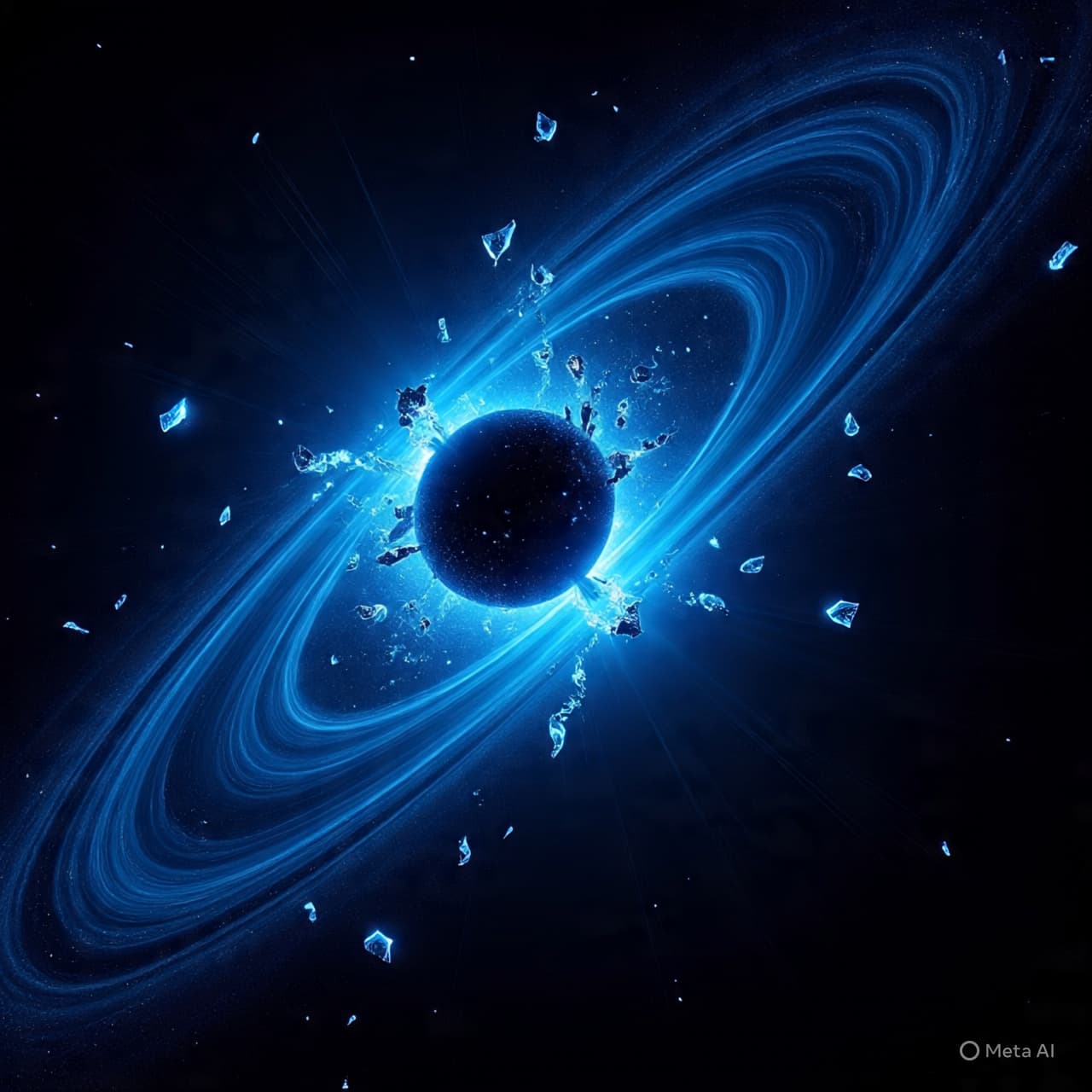
When a star approaches a black hole, the delicate balance of forces that maintain its structure begins to unravel. This process, known as tidal disruption, occurs when the immense gravitational pull of the black hole stretches the star to its breaking point. As the star's material spirals inward, it heats up dramatically, releasing energy across the electromagnetic spectrum. In certain instances, this energy manifests as a brilliant blue flash, a brief yet intense signal that marks the moment a star crosses the threshold into destruction.
The rarity and clarity of these blue light emissions make them particularly valuable to astronomers. The presence of blue light indicates extraordinarily high temperatures, suggesting that matter is being accelerated and compressed under conditions that challenge our understanding of physics. Unlike longer-lasting emissions, these flashes are transient, requiring precise observation and coordination among telescopes to capture them. Their detection allows researchers to trace the sequence of destruction almost in real time, transforming theoretical concepts into observable phenomena.
The implications of studying these blue bursts extend far beyond the spectacle of stellar death. By examining how light behaves in the vicinity of black holes, scientists can gain deeper insights into the movement of matter under extreme gravitational forces, the redistribution of energy, and the growth of black holes themselves. Each blue flash contributes to a broader understanding of cosmic evolution, refining models that explain not only the behavior of distant galaxies but also the fundamental nature of space and time.
Moreover, these discoveries resonate on a philosophical level. Stars, often seen as symbols of permanence and stability, are revealed to be vulnerable when confronted with the overwhelming forces of the universe. Their destruction is not random; it adheres to the laws of physics that govern the cosmos. The blue flashes serve not as mournful signals but as informative beacons, illuminating the processes that shape our universe.
As observational techniques improve and surveys expand, scientists anticipate the emergence of more blue light signals from the depths of space. Each signal will be brief, destructive, and enlightening. In their glow, the universe imparts a profound lesson: even in the face of annihilation, there is knowledge to be gleaned — if one is attentive enough to witness it.
Published by Banx Network. This article is part of the Banx decentralized media programme, powered by the BXE token on the XRP Ledger.



