Somewhere in the deep past of the solar system, long before forests or oceans took their familiar shapes, the young planets lived in a restless era. Asteroids crossed the inner solar system like wandering travelers, and the surfaces of worlds were frequently shaken by impacts that reshaped landscapes in moments.
From those collisions, pieces of planets were sometimes thrown into space.
These fragments—rocky shards blasted free by violent impacts—did not always remain near their home worlds. Instead, some drifted outward into the vast quiet between planets, carried by gravity and time along unpredictable paths. Occasionally, after years or centuries of wandering, they found a new destination.
In that long journey between worlds, scientists now suggest, something else might travel as well.
A recent study exploring the movement of impact debris raises a thought that has fascinated planetary scientists for decades: the possibility that life on Earth may not have begun here at all. Instead, its earliest microbial ancestors might have originated on Mars and reached Earth through asteroid impacts that launched rocks across space.
The idea belongs to a scientific hypothesis known as panspermia, which proposes that life—or at least microscopic organisms capable of surviving extreme conditions—can spread naturally between planets.
Researchers have long known that Mars and Earth occasionally exchange material. Meteorites discovered on our planet have been traced chemically to the Red Planet, confirming that powerful impacts on Mars can eject rocks into space with enough velocity to escape the planet’s gravity.
Over time, a small fraction of those fragments eventually intersect Earth’s orbit.
The new study examines whether microbes embedded inside such rocks might survive the journey.
At first glance, the notion may sound improbable. Space is a hostile environment: freezing temperatures, intense radiation, and the near-perfect vacuum pose enormous challenges to living organisms. Yet life on Earth has repeatedly demonstrated an ability to endure conditions once thought impossible.
Some microbes can survive extreme radiation, dehydration, and long periods without nutrients. Certain bacterial spores remain dormant for years, even centuries, waiting for conditions to improve.
If such organisms were shielded within rock fragments blasted from a planetary surface, researchers suggest they might remain protected during the long transit between planets.
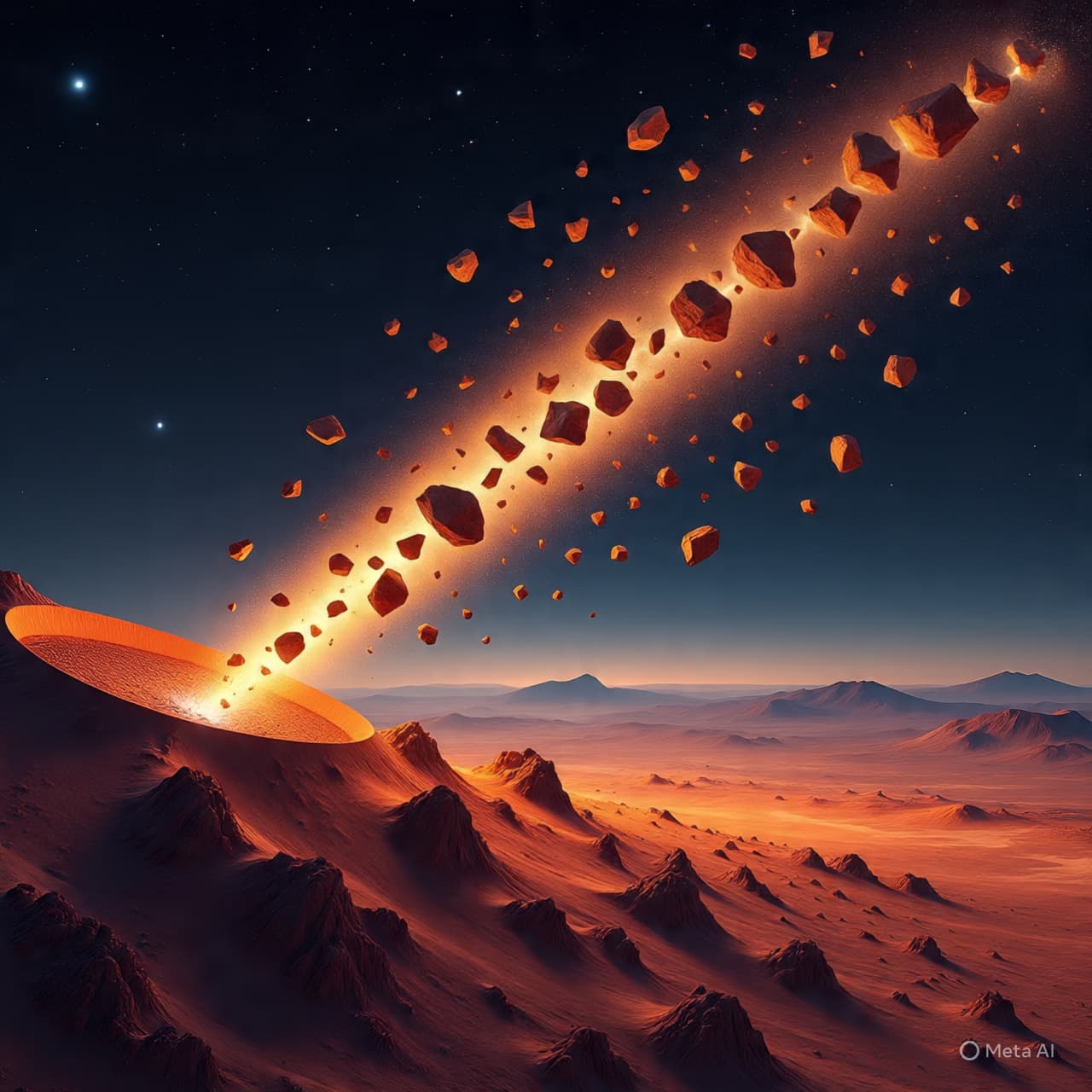
The process begins with an asteroid impact powerful enough to launch surface material into space. When a large asteroid strikes Mars, for instance, shock waves travel through the ground, accelerating fragments of rock outward at tremendous speeds. Some of those fragments escape the planet’s gravity and begin drifting through the solar system.
Inside these fragments could be tiny pockets of rock and dust capable of sheltering microbes from radiation.
Computer simulations in the study suggest that the transfer of such material between Mars and Earth may have been especially common billions of years ago. During the early history of the solar system, both planets endured a period of heavy bombardment when asteroid impacts occurred far more frequently than they do today.
At the same time, Mars itself may have been a very different world.
Geological evidence suggests that ancient Mars once hosted flowing rivers, lakes, and possibly even shallow seas. Its atmosphere was likely thicker, and its climate warmer. Under those conditions, the planet may have offered environments where microbial life could emerge.
Early Earth, meanwhile, experienced repeated impacts that might have periodically disrupted its young biosphere.
In that ancient context, some scientists speculate that Mars may have provided a stable environment where life developed earlier than it did on Earth. If so, asteroid impacts could have scattered pieces of that Martian environment into space, sending fragments toward neighboring worlds.
Eventually, some of those fragments could have landed on Earth.
The journey between the planets, while long on human timescales, is not impossibly slow in cosmic terms. Previous studies have shown that meteorites can travel from Mars to Earth in less than a million years, and sometimes far faster.
Whether any living organisms survived such journeys remains uncertain. The hypothesis does not claim definitive proof that Earth life began on Mars, only that the physical process allowing such transfer appears plausible.
Scientists continue studying meteorites, microbial resilience, and the conditions of early planetary environments to understand whether life could truly migrate between worlds.
Future missions may provide new clues. Planned sample-return missions from Mars could allow researchers to study pristine material from the Red Planet in laboratories on Earth. If evidence of ancient life were ever found in Martian rocks, it would open new questions about whether that life remained confined to Mars—or once traveled farther.
For now, the idea remains an intriguing possibility rather than a settled answer.
Yet it gently reshapes the way scientists think about life in the solar system. Instead of isolated worlds evolving entirely on their own, planets may share fragments of their history through the quiet exchange of cosmic debris.
In that sense, the origins of life might not belong entirely to one planet.
They might belong, in some small way, to the solar system itself.
Recent research continues to explore how asteroid impacts could transfer material between Mars and Earth and whether microbial life could survive the journey. While no definitive evidence yet proves that Earth life originated on Mars, scientists say the possibility remains scientifically plausible and worthy of further study.
AI Image Disclaimer Illustrations were produced with AI and serve as conceptual depictions.
Sources Space.com Live Science New Scientist Phys.org Universe Today
Published by Banx Network. This article is part of the Banx decentralized media programme, powered by the BXE token on the XRP Ledger.