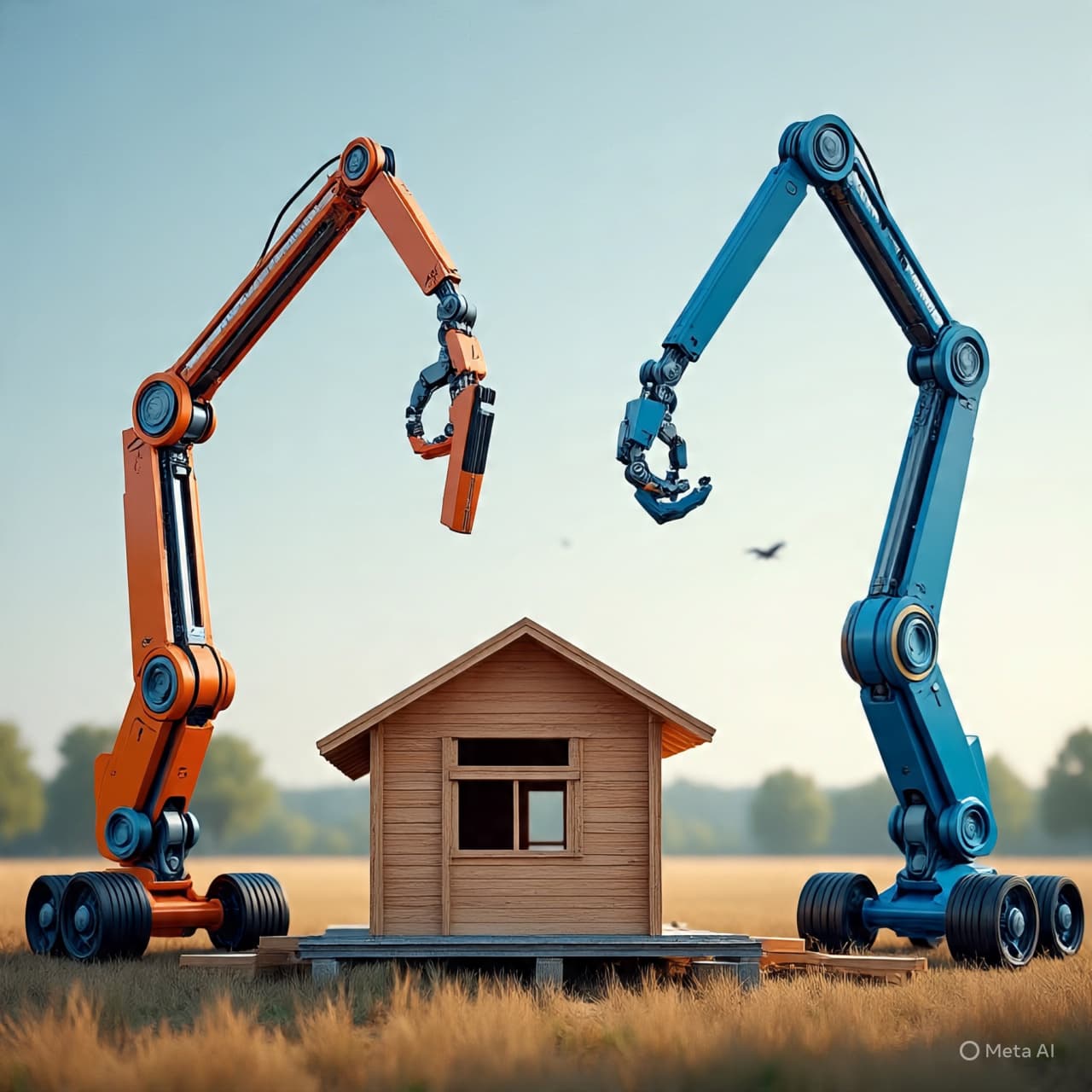
At first glance, the site looks familiar. Open land, a clearing cut into the soil, the beginnings of a structure taking shape against the horizon. But there are no crews calling out measurements, no ladders shifting in the dust. Instead, four robotic arms move in deliberate silence, tracing patterns that exist first as data, then as walls.
Together, they built a farmhouse.
The project brings construction into a different rhythm—one governed not by muscle or routine, but by coordination and computation. Each robotic arm performs a specific task, depositing material, shaping forms, and responding in real time to the actions of the others. What emerges is not a prefabricated shell dropped into place, but a house assembled layer by layer, decision by decision.
The structure itself reflects this process. Rather than relying on standardized components, the design is optimized for printing and assembly by machines. Curved surfaces replace sharp angles. Materials are placed only where needed, reducing waste while maintaining strength. The farmhouse becomes less a product of repetition and more a response to its environment and purpose.
This approach hints at a shift in how buildings might be made. Traditional construction favors uniformity—parts repeated until efficiency is achieved. Robotic construction allows variation without penalty. Walls can change thickness. Openings can adapt. Each structure can be tuned to climate, use, and location without slowing the process.
The farmhouse stands as both shelter and experiment. It suggests a future where construction sites are quieter, safer, and less dependent on large crews. Labor does not disappear, but it changes shape—moving upstream into design, programming, and oversight. The act of building becomes less about endurance and more about intention.
There is something fitting about this technology appearing first in a rural setting. Farms have always been places of innovation, where tools evolve to meet the demands of land and time. Here, the tools simply happen to think, coordinate, and learn.
As the robotic arms complete their final passes, the house remains—solid, inhabitable, and unmistakably real. It does not announce the future loudly. It simply stands there, printed into existence, waiting for someone to walk inside.
AI Image Disclaimer
Images are AI-generated and serve as conceptual representations.
Sources
Academic robotics research publications University architecture laboratories Construction automation studies Industry robotics demonstrations
Published by Banx Network. This article is part of the Banx decentralized media programme, powered by the BXE token on the XRP Ledger.