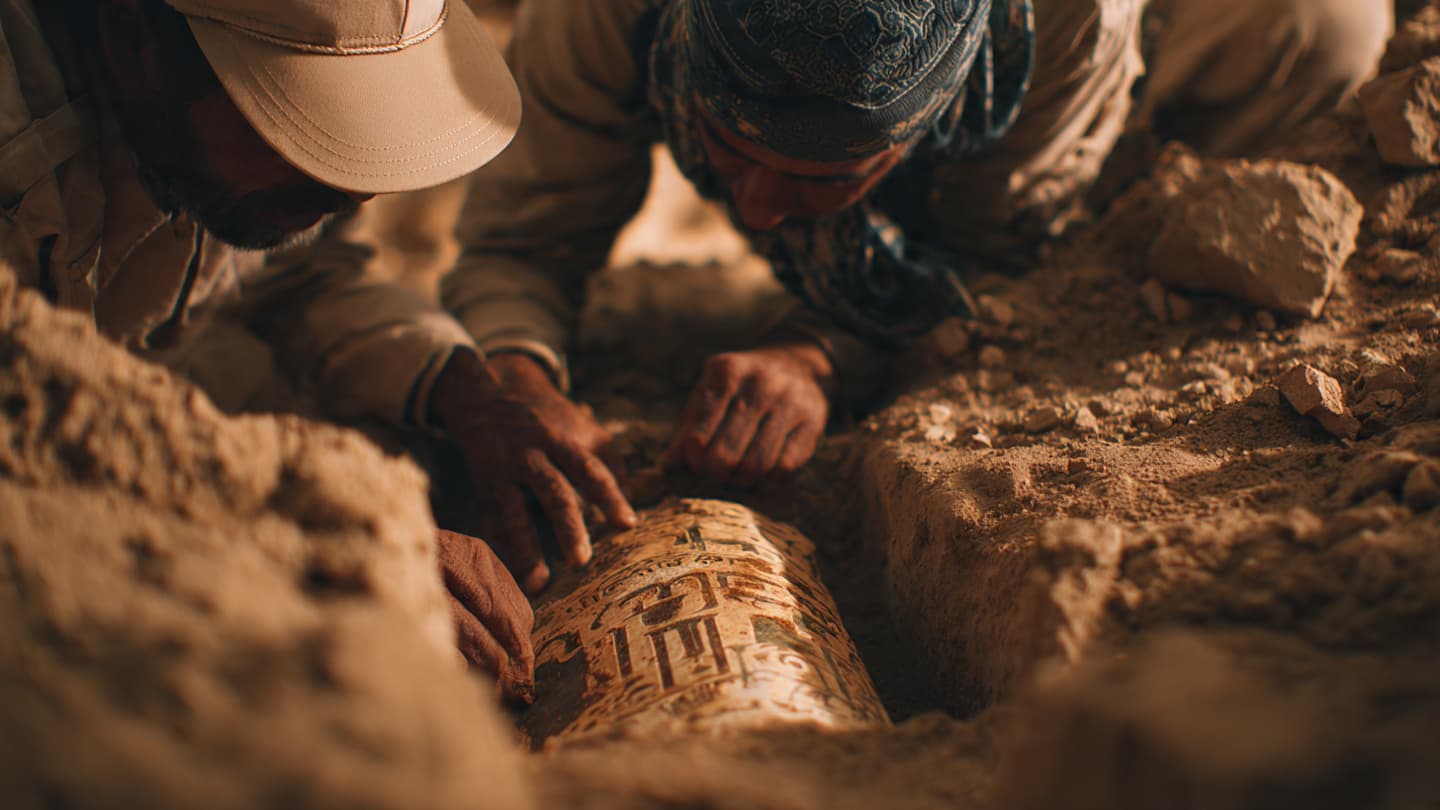
Archaeology often reveals that history is less isolated than it appears in textbooks. Civilizations that once seemed distant in culture and geography frequently interacted in ways that modern discoveries continue to uncover. Recent archaeological findings reportedly involve an Egyptian mummy buried alongside fragments of the Iliad, suggesting a deeper level of cultural exchange between ancient Egypt and Greece than previously understood.
The Iliad, attributed to Homer, is one of the foundational texts of ancient Greek literature, centered on myth, heroism, and the legendary Trojan War. Finding its presence in an Egyptian burial context introduces intriguing questions about how literary works traveled across regions in antiquity.
Egypt, known for its complex burial traditions and rich symbolic systems, has long been recognized as a hub of cultural and intellectual exchange in the ancient Mediterranean world. Trade routes and political interactions with Greek city-states created opportunities for shared knowledge, religious influence, and artistic exchange.
Researchers involved in the discovery suggest that the presence of Greek literary material in a burial context may reflect the status or education of the individual, or possibly the blending of cultural identities during later periods of Egyptian history. Such findings challenge simplified narratives of isolated civilizations.
Scholars caution that interpretation requires careful analysis, including dating methods, material composition studies, and contextual excavation records. Archaeology often moves slowly, as each artifact must be examined within its broader environmental and historical setting.
If confirmed, the discovery could contribute to a growing body of evidence that ancient Mediterranean societies were more interconnected than previously assumed. This would align with other findings showing Greek influence in Egypt and Egyptian motifs in Greek art and religion.
Beyond academic implications, such discoveries also reshape public understanding of cultural heritage, highlighting how ideas, stories, and traditions have always traveled across borders long before modern globalization.
As research continues, archaeologists emphasize patience and precision. Each artifact adds another piece to a vast historical puzzle that is still far from complete, yet increasingly interconnected with every new find.
AI Image Disclaimer: Some illustrations in this article may be AI-generated for editorial purposes.
Sources: Reuters, BBC News, National Geographic, Smithsonian Magazine, Archaeology.org
Published by Banx Network. This article is part of the Banx decentralized media programme, powered by the BXE token on the XRP Ledger.