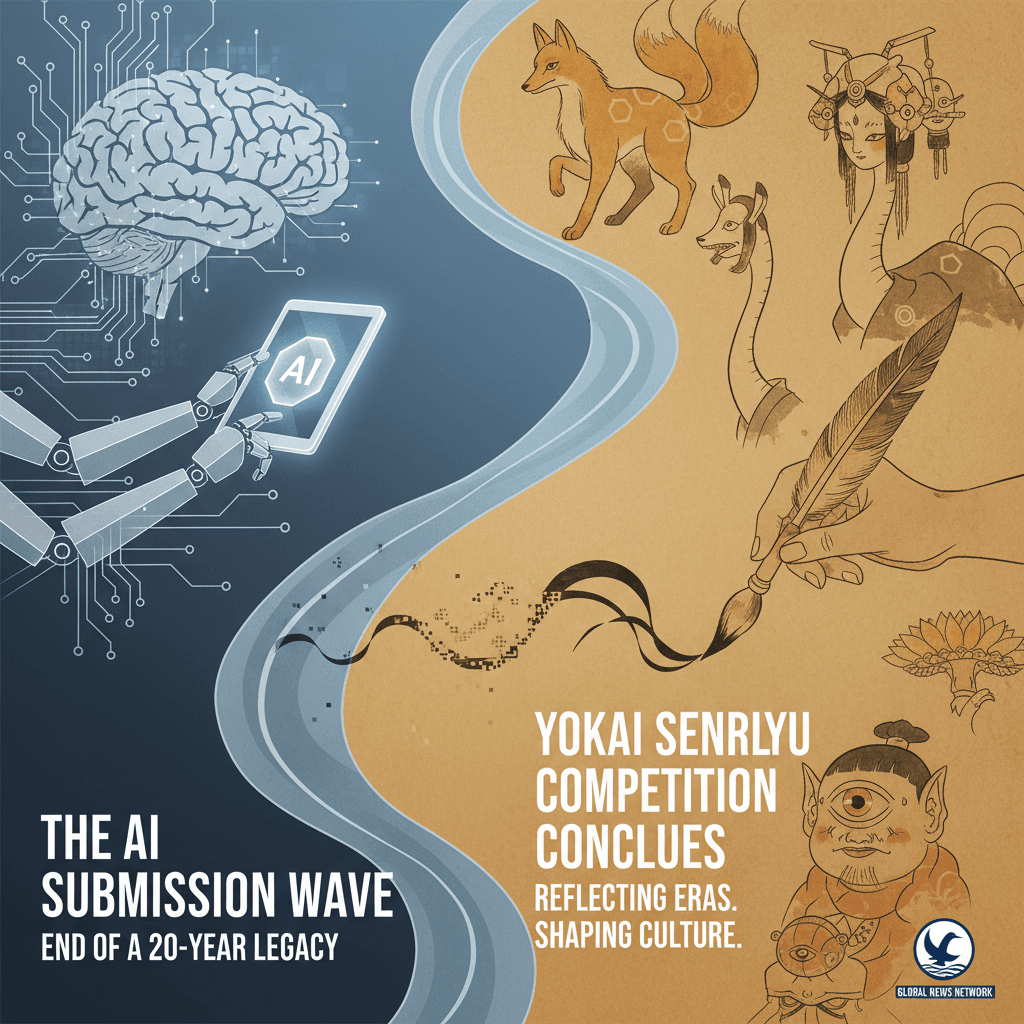
In the quiet coastal city of Sakaiminato, Tottori Prefecture, a two-decade-long tradition recently drew its final curtain. The annual Yokai Senryu contest, a charming homage to Japan's rich folklore of supernatural beings, announced its cessation. The reason, as reported by NTV News NNN, was a stark increase in AI-generated submissions. This isn't just a quaint local story about mythical creatures and poetry; it's a whisper from the periphery, a subtle tremor in the creative economy that has profound implications for how we value human ingenuity and, ultimately, how capital flows toward it.
For years, the Yokai Senryu offered a mirror to Japanese society, reflecting contemporary anxieties and humor through the lens of its ancient monsters. It was a delightful, accessible form of cultural expression. What strikes me about this development is how quickly the digital tide can erode analog traditions. We’ve seen this movie before, haven't we? The music industry grappled with digital downloads, journalism wrestled with online aggregation, and now, the very essence of human creativity faces a new algorithmic challenge. The question isn't whether AI can write a senryu; it's what happens when the provenance of that creativity becomes indistinguishable, and the human effort behind it is devalued.
Indeed, the speed of AI's adoption is staggering. A recent report by Goldman Sachs suggested that generative AI could automate 300 million full-time jobs globally, a figure that includes a significant portion of creative and knowledge-based roles. While much of the financial discourse around AI focuses on efficiency gains and productivity boosts for corporations, we rarely talk about the downstream effects on the individual creator, the small cultural economies that thrive on unique, human-centric output. The market, in its relentless pursuit of optimization, often overlooks the intangible value of authenticity.
But here's what nobody's talking about: the very platforms that champion content creation are now struggling to differentiate between human and machine. This isn't a problem unique to senryu contests. Major stock photo agencies and online art marketplaces are already grappling with floods of AI-generated content, forcing them to re-evaluate their compensation models and even their terms of service. The view from Singapore, a hub for digital innovation, looks quite different; there, the focus is often on AI as a tool for augmentation, not replacement, suggesting a more nuanced approach to integration.
Call me skeptical, but I see a growing chasm. On one side, the promise of democratized creativity, where anyone can generate stunning visuals or compelling text with a few prompts. On the other, the quiet despair of professionals whose livelihoods are threatened by an endless, undifferentiated stream of machine-made output. This isn't some abstract academic exercise; it's a bare-knuckle brawl for attention and, crucially, for economic recognition. If the market can't tell the difference, and the cost of production plummets to near zero, what happens to the price of true human art, true human thought?
This challenge isn't just about preserving cultural heritage; it's about the future of intellectual property and, by extension, the financial models that underpin creative industries. How do we, as investors and consumers, continue to support human artists, writers, and thinkers when their work is indistinguishable from, and often outpaced by, algorithms? The current regulatory framework is, to put it bluntly, a mess, ill-equipped to handle the nuances of AI-generated content and its impact on copyright and fair compensation. We need to ask ourselves if we're building a future where human creativity is celebrated or simply commoditized.
Perhaps the real question isn't whether AI will continue to advance, but whether we, as a global society, are prepared to redefine value in an era where the lines between human and machine blur. Will the market learn to price the soul in a senryu, or will it simply chase the cheapest byte? The closing of the Yokai Senryu contest is a small, poignant reminder that some things, once lost, can't easily be regenerated by even the most sophisticated algorithm.
AI Image Disclaimer
Visuals are created with AI tools and are not real photographs.
Source Check Credible sources exist for this article:
NTV News NNN Goldman Sachs Bloomberg Reuters CoinDesk
Published by Banx Network. This article is part of the Banx decentralized media programme, powered by the BXE token on the XRP Ledger.