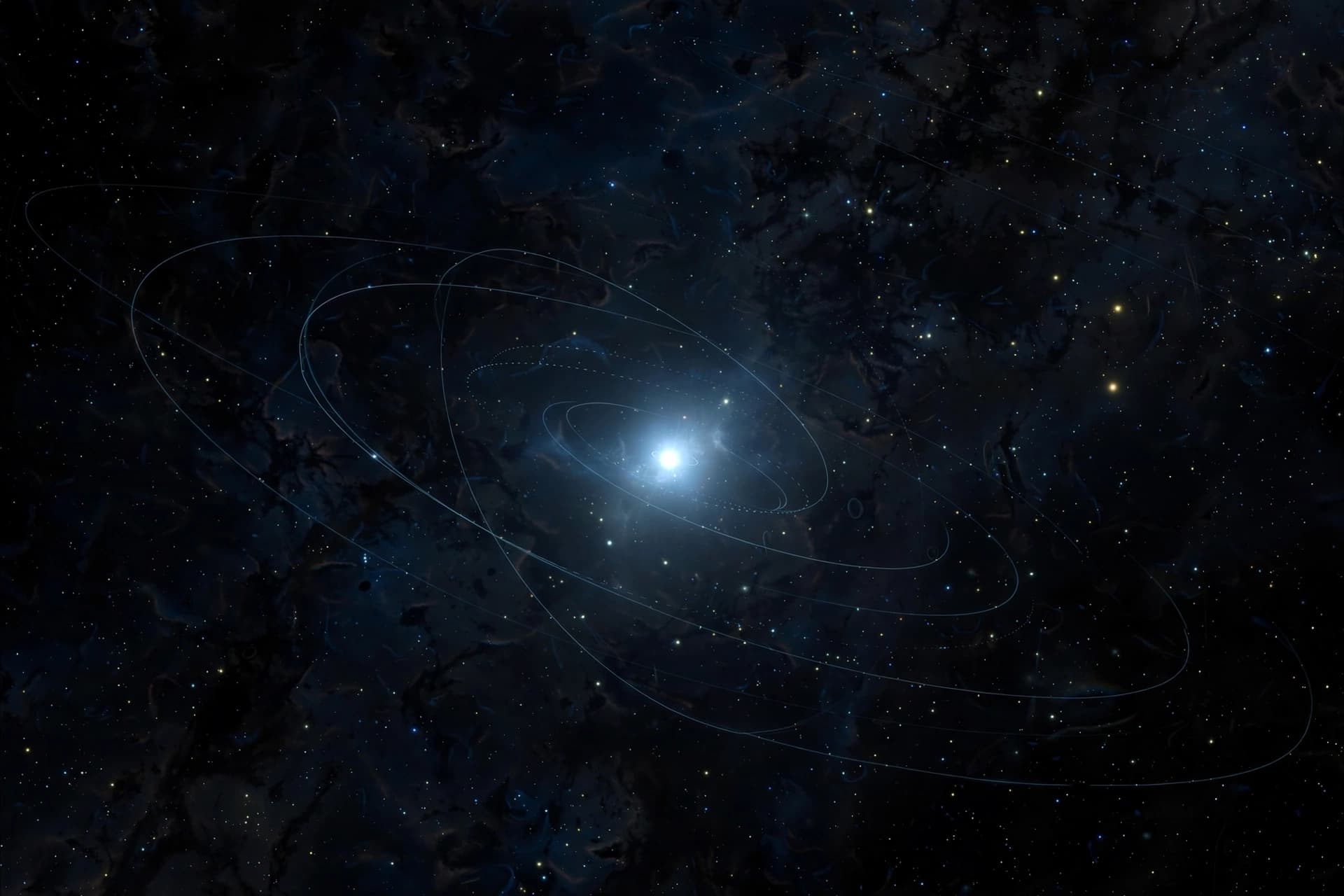
In the quiet theater of the night sky, space often appears calm—an endless canvas where the Moon hangs like a lantern above Earth. Yet beyond that calm surface, countless stones wander silently through the solar system, each following its own invisible path. Occasionally, one of these travelers draws the attention of astronomers, not because it intends harm, but because its path briefly brushes close to the worlds we know.
That was the story of asteroid 2024 YR4, a rocky object discovered in late 2024. At first glance it seemed like just another celestial wanderer. But early calculations suggested something intriguing: its orbit might bring it unusually close to Earth—and perhaps even the Moon—in December 2032. Like ripples spreading across a quiet lake, the possibility quickly traveled through scientific circles and headlines alike.
Asteroid 2024 YR4 is estimated to measure roughly 50 to 70 meters across, about the size of a ten-story building. In cosmic terms, it is not enormous, but it is large enough to attract the careful attention of planetary defense scientists. Early models suggested a small probability—around four percent—that the asteroid could collide with the Moon on December 22, 2032. For observers on Earth, such an impact would not have been dangerous, but it could have created a dramatic flash and a crater across the lunar surface.
Yet astronomy is a discipline of patience. The more scientists observe a moving object, the clearer its path becomes. Telescopes around the world—and eventually the James Webb Space Telescope—continued to gather data about the asteroid’s position and motion. With every new measurement, the uncertainty surrounding its orbit grew smaller.
Recent analysis by NASA’s Center for Near-Earth Object Studies has now brought a calmer conclusion. Using new observations collected in February 2026, researchers refined the asteroid’s trajectory with far greater precision. The updated calculations show that asteroid 2024 YR4 will pass the Moon at a distance of about 21,000 kilometers—close in cosmic terms, but safely distant.
In other words, the dramatic scenario once imagined will not unfold. The asteroid will glide past both Earth and the Moon like a traveler passing quietly through a valley, noticed but not disruptive. Scientists emphasize that the improved prediction does not mean the asteroid suddenly changed course; rather, the growing clarity of observations simply revealed where it had always been headed.
This process is common in planetary science. Newly discovered asteroids often carry small uncertainties in their projected paths. At first, these uncertainties can allow many possibilities—including extremely unlikely impacts. But as astronomers gather more observations, those possibilities narrow, and most potential collisions disappear from the list.
Asteroid 2024 YR4 therefore becomes less a story of danger and more a reminder of how carefully humanity now watches the skies. Through global telescope networks and advanced observatories, scientists track thousands of near-Earth objects, quietly mapping their routes through the solar system.
And so the Moon, our steady companion in the night, will continue its familiar journey across Earth’s sky in 2032—untouched by the wandering stone that once sparked curiosity across the world.
AI Image Disclaimer
Illustrations were produced with AI and serve as conceptual depictions rather than real photographs.
---
Sources
Associated Press Live Science NDTV Times of India NASA Science / Planetary Defense
Published by Banx Network. This article is part of the Banx decentralized media programme, powered by the BXE token on the XRP Ledger.