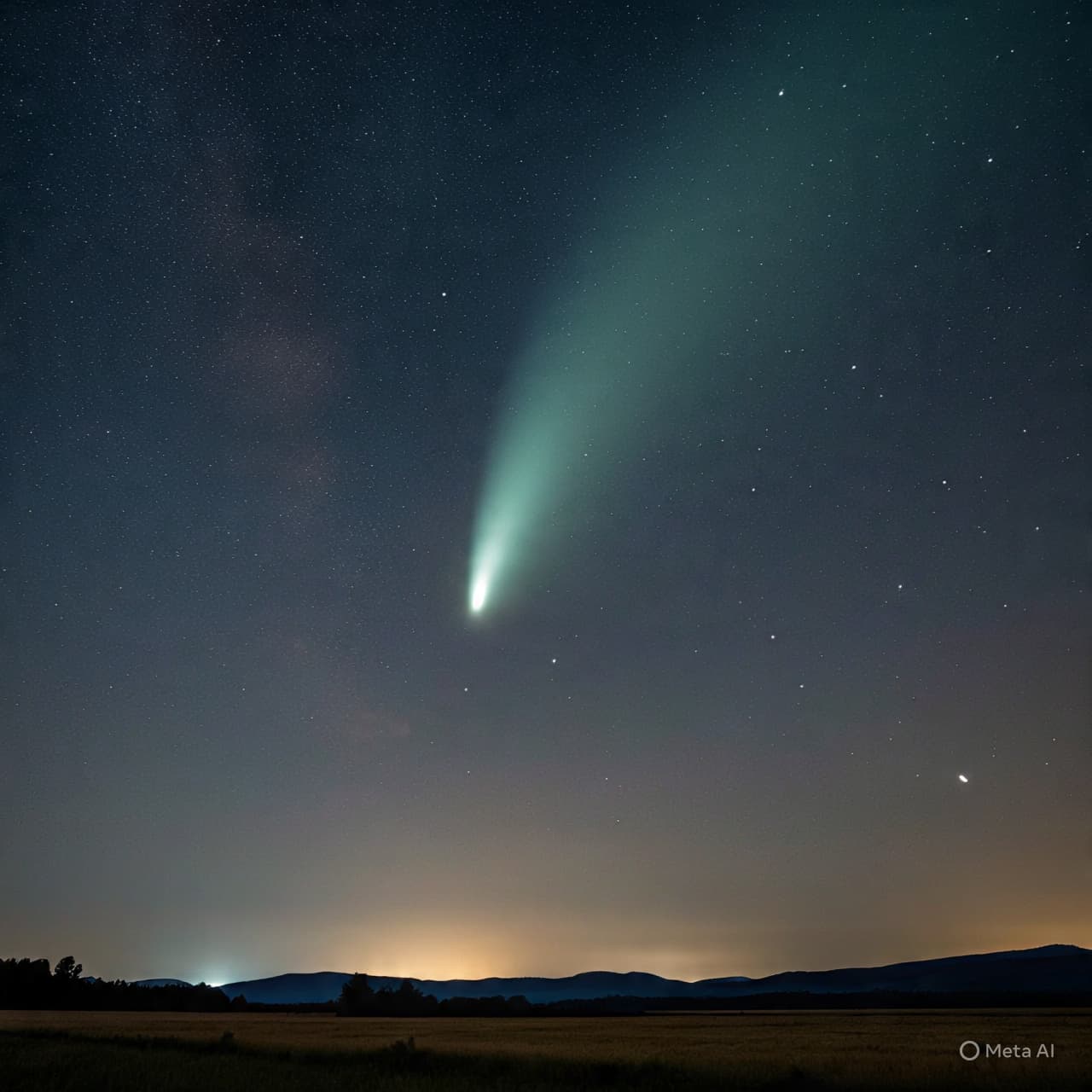
A night sky is like a great ocean of memory, holding stories not only of twinkling stars but of transient travelers that pass through once and remain only in recollection. Among these visitors, a bright green comet — known to astronomers as C/2024 E1 (Wierzchoś) — has recently stirred attention, its delicate glow a fleeting testament to journeys that last millennia before turning back toward the deep reaches of space. To gaze upon its soft emerald haze is to be reminded that the sky is not static but alive with motion, with ancient ice and dust marking passages through time.
Discovered on March 3, 2024, by Polish astronomer Kacper Wierzchoś, this icy body originates in the distant Oort Cloud, a vast reservoir of frozen objects at the edge of our solar system. Its path is highly elongated — nearly hyperbolic — and as it approached the inner solar system, sunlight warmed its surface, releasing gases that gave rise to its characteristic green coma. Scientists believe carbon dioxide and other molecules in the comet’s atmosphere contribute to this hue, a soft luminescence that betrays both composition and history.
In January 2026, C/2024 E1 reached perihelion — its closest approach to the Sun — at just over half the Earth–Sun distance. That encounter brightened its glow, like a lighthouse’s beam reflected before sea mists drift away at dawn. As it now nears its closest approach to Earth — roughly 151 million kilometers away on or around February 17, 2026 — observers with telescopes or good binoculars stand a chance to witness the tail and coma that trace its slow arc across the sky.
Yet this comet’s tale is not one of return; its orbit suggests it will continue outward after this passage, never to circle our Sun again. In that, C/2024 E1 parallels another recent visitor, the interstellar comet 3I/ATLAS, which passed through in 2025 and is now leaving the solar neighborhood forever. These rare cosmic wanderers remind us that the gravitational dance of stars and planets sometimes sends icy relics from the outer reaches or even from beyond our own system, each bearing clues about the environment in which they formed.
Astronomers have even tracked C/2024 E1’s motion against the backdrop of stars, noting its gentle rise and fall in brightness and its path through constellations invisible until recently. As the comet continues it outward trajectory, its once‑faint glow gradually dims, like embers fading after a long night’s vigil. For those who have peered upward in recent weeks, the impression lingers — a sense of wonder that something so distant can, for a brief moment, grace our skies with ancient light.
In straightforward astronomical terms, comet C/2024 E1 (Wierzchoś) is a long‑period comet from the Oort Cloud that made its closest approach to the Sun on January 20, 2026, and is currently near its closest point to Earth at about 1.01 AU (151 million km). The object is brightening and visible through telescopes and binoculars, and its trajectory suggests it will be ejected from the solar system after this visit.
AI Image Disclaimer Visuals are created with AI tools and are not real photographs.
Sources Live Science The News International Gadgets 360 Wikipedia (C/2024 E1 Wierzchoś) SkyLive tracker data
Published by Banx Network. This article is part of the Banx decentralized media programme, powered by the BXE token on the XRP Ledger.