The sky often appears constant to those who look up from Earth. Stars move slowly across the night, planets wander in quiet arcs, and satellites pass silently overhead, their presence noticed only by those who search for them. Yet every object that circles our planet carries a beginning—and eventually, an ending.
High above the atmosphere, thousands of human-made machines drift through orbital paths carved by physics and ambition. Some remain active, sending streams of data back to Earth. Others, long after their missions have ended, continue their slow and patient journey around the planet, gradually descending as the faintest traces of Earth’s upper atmosphere tug at their orbits.
One such traveler is now approaching its final moment.
A NASA spacecraft weighing about 1,300 pounds (roughly 600 kilograms) is expected to plunge back into Earth’s atmosphere after spending nearly fourteen years in orbit. Known as Van Allen Probe A, the satellite was launched in 2012 as part of a twin mission designed to study the mysterious radiation belts surrounding our planet.
Those belts—named after physicist James Van Allen—form rings of energetic particles trapped by Earth’s magnetic field. Invisible to the eye yet powerful in effect, they act as a protective barrier that shields the planet from much of the harmful radiation arriving from the Sun and beyond. Understanding how these belts behave has been crucial for protecting satellites, astronauts, and technology operating in space.
The mission itself was initially planned to last just two years, but like many spacecraft, the probes quietly exceeded expectations. Both satellites continued gathering valuable scientific data for nearly seven years before the mission officially concluded in 2019, when the spacecraft ran out of fuel needed to maintain orientation in space.
Even after retirement, however, the probes did not immediately leave orbit. Instead, they remained as silent relics of their mission, circling Earth again and again while atmospheric drag slowly lowered their paths.
Originally, scientists believed the satellite would not return to Earth until around 2034. Yet space weather had other plans. During the recent peak of the Sun’s activity cycle, stronger solar radiation heated Earth’s upper atmosphere, causing it to expand slightly. That expansion increased atmospheric drag on orbiting objects, gently pulling some of them back toward Earth sooner than predicted.
As a result, Van Allen Probe A’s long orbital journey is ending years ahead of schedule.
According to predictions by the U.S. Space Force, the spacecraft is expected to reenter the atmosphere around 7:45 p.m. Eastern Time, though the exact moment could shift by roughly 24 hours in either direction. Such uncertainty is common in orbital reentries, where small variations in atmospheric density and orbital speed can influence the final timing.
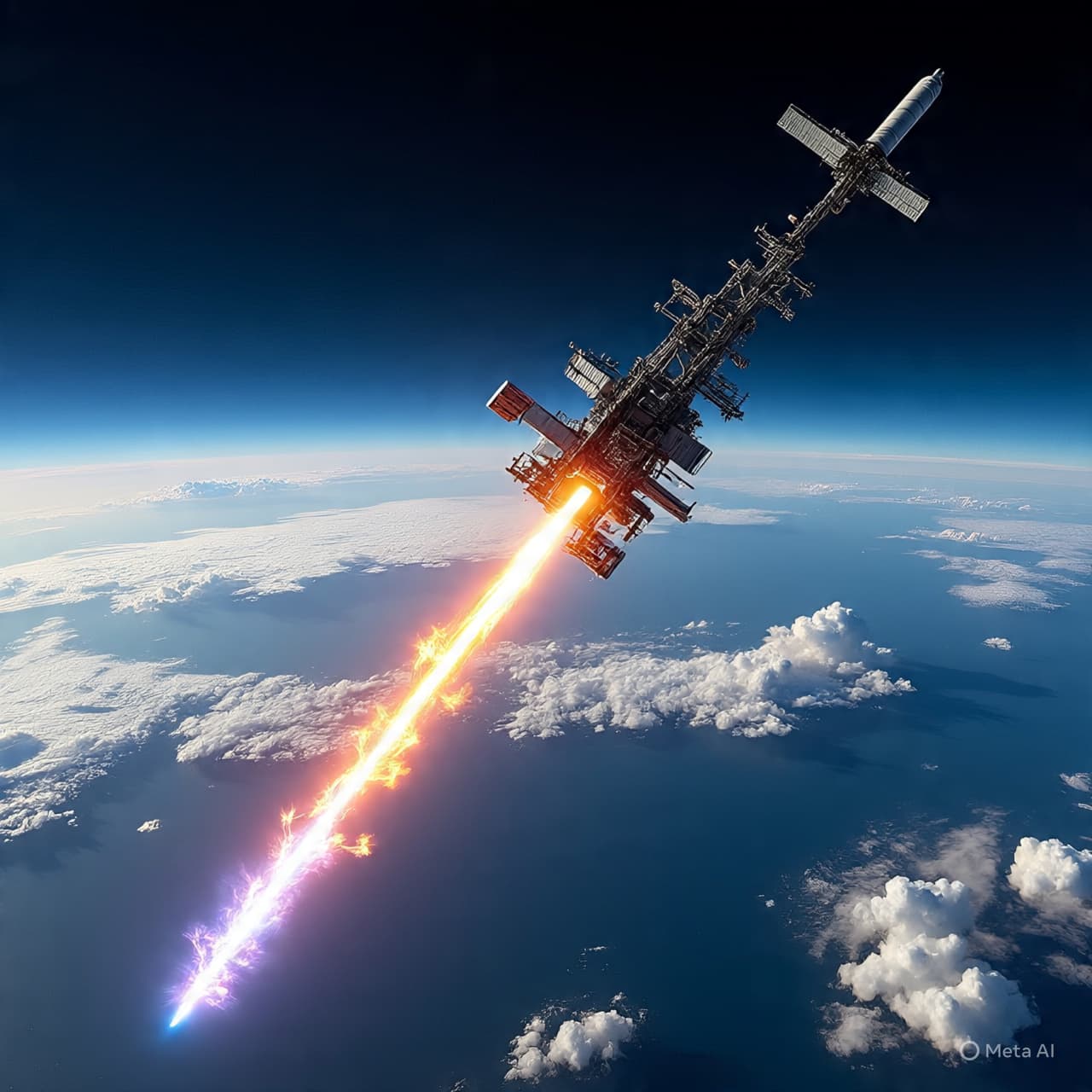
When the probe meets the denser layers of the atmosphere, friction will rapidly heat the spacecraft as it travels at thousands of miles per hour. Most of the structure is expected to burn up in the intense heat of reentry, briefly appearing as a bright streak of light across the sky—something like an unusually large meteor created not by nature, but by human engineering.
NASA notes that while most of the spacecraft will disintegrate, some fragments could survive the descent and reach the surface. Even so, the overall risk to people on the ground is considered extremely small. The estimated probability of someone being harmed by falling debris is roughly 1 in 4,200, a figure influenced heavily by the fact that oceans cover more than two-thirds of Earth’s surface.
In other words, if any pieces do survive the fiery journey downward, they are far more likely to fall into open water or remote areas than into populated regions.
While its physical presence may soon disappear, the scientific legacy of the mission remains firmly intact. Data gathered by the Van Allen probes continues to help researchers understand how solar storms interact with Earth’s magnetic field—knowledge that influences how scientists predict space weather and protect modern technological systems.
The spacecraft’s twin, Van Allen Probe B, still circles Earth today and is expected to remain in orbit for several more years, possibly until around 2030.
For Van Allen Probe A, however, the long orbit is ending. After more than a decade spent quietly observing the invisible forces around Earth, the satellite’s final act will be brief—a fiery descent through the atmosphere, marking the quiet conclusion of a mission that helped illuminate the protective magnetic cocoon surrounding our planet.
And like many explorers before it, the probe’s journey closes not with silence, but with a final bright passage across the sky.
AI Image Disclaimer Graphics are AI-generated and intended for representation, not reality.
Source Check Credible coverage of the event exists across major science and news outlets. Key sources include:
Live Science Space.com The Guardian Gizmodo ABC News
Published by Banx Network. This article is part of the Banx decentralized media programme, powered by the BXE token on the XRP Ledger.