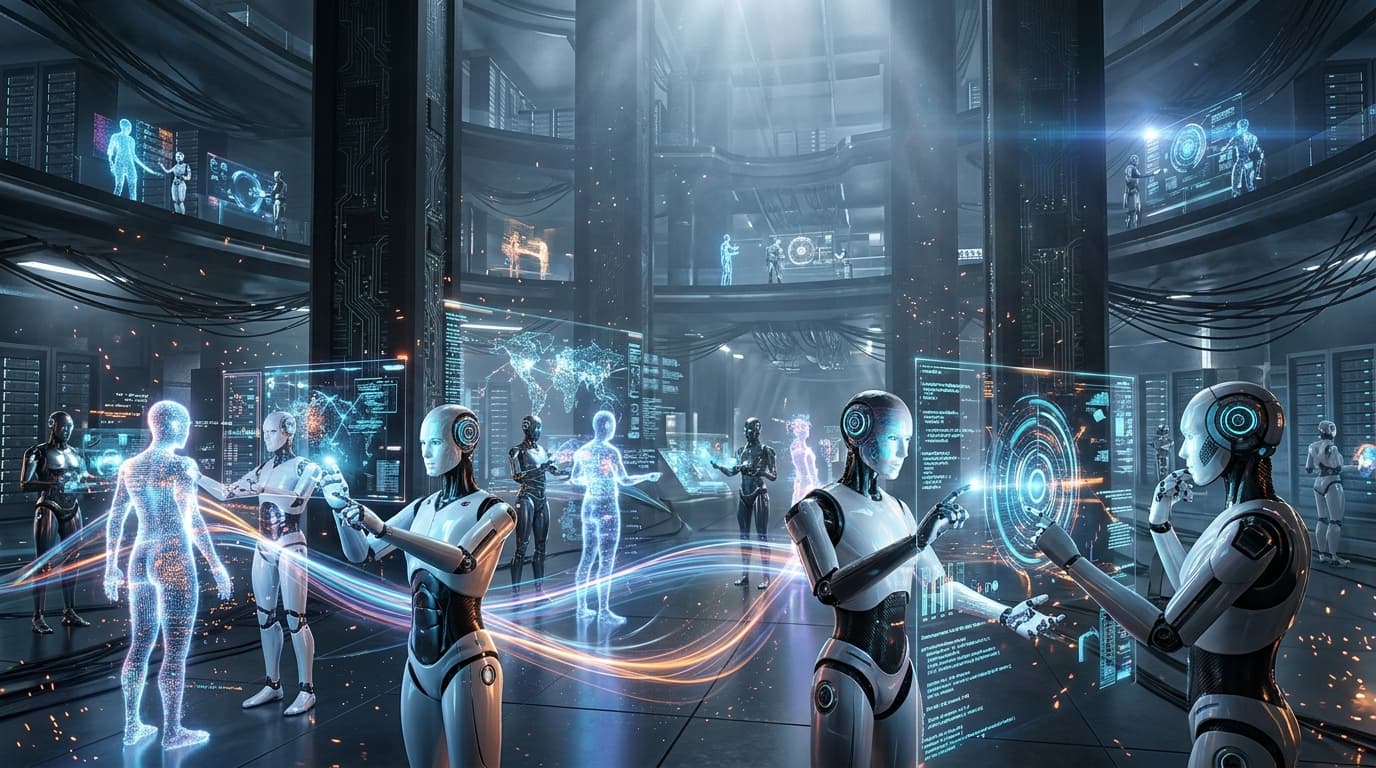
There are moments when a single image feels like a doorway rather than a frame. A photograph of a quiet street, a sketch of a forest path, a fragment of imagined terrain — all seem to invite the mind to step inside and wander. For centuries, this invitation belonged to painters, writers, and dreamers. Today, that threshold is quietly shifting, as artificial intelligence learns not only to see images, but to inhabit them.
Google’s Project Genie, developed by DeepMind researchers, gestures toward this subtle transformation. Rather than treating images or text prompts as static inputs, Genie turns them into living spaces — interactive worlds that respond, evolve, and unfold. From a single photo or short description, the system generates a navigable environment, one where users can move through scenes as if stepping into a dream rendered playable. The technology does not merely imagine a picture; it imagines how that picture might behave if given time, motion, and rules.
At its heart, Project Genie is a “world model,” trained on vast collections of video and gameplay data to understand how environments tend to function. When presented with an image — say, a snowy landscape or a city street — Genie infers what could exist beyond the frame, how objects might react, and how space might extend. The result is not a perfect replica of reality, but something gentler and more suggestive: a world that feels coherent enough to explore, even if it remains slightly abstract, like memory rather than map.
This approach reflects a broader shift in artificial intelligence research. Instead of focusing solely on producing answers or images, developers are teaching models to simulate experiences. Interactive environments offer a way for AI to learn cause and effect, continuity, and consequence — the quiet grammar of the physical world. For users, the implications stretch beyond novelty. Game designers, educators, and artists may find new ways to prototype ideas quickly, using AI-generated worlds as sketchbooks rather than finished products.
Still, the experience carries a deliberate restraint. Genie’s worlds are not designed to replace hand-crafted games or detailed simulations. Movements can feel simplified, textures impressionistic, and physics approximate. Yet this softness may be part of its appeal. By leaving space for interpretation, the system invites creativity rather than closing it off. It becomes less a machine for precision and more a companion for exploration.
As with many advances in generative AI, questions naturally arise around authorship, originality, and control. If a world emerges from a photograph, who owns the space that follows? Google researchers have emphasized that Project Genie remains a research prototype, shared to explore possibilities rather than define final products. Safeguards, limitations, and transparency continue to shape how such systems may eventually reach the public.
In recent announcements, Google DeepMind described Project Genie as an early step toward AI systems that understand environments as fluid, interactive places rather than fixed outputs. The project remains experimental, but it signals a future where creating a world may be as simple as describing one — and where imagination, once again, becomes the most important interface.
AI Image Disclaimer (Rotated Wording)
Images in this article are AI-generated illustrations, meant for concept only.
---
Sources
Google DeepMind The Verge Wired MIT Technology Review TechCrunch
Published by Banx Network. This article is part of the Banx decentralized media programme, powered by the BXE token on the XRP Ledger.