
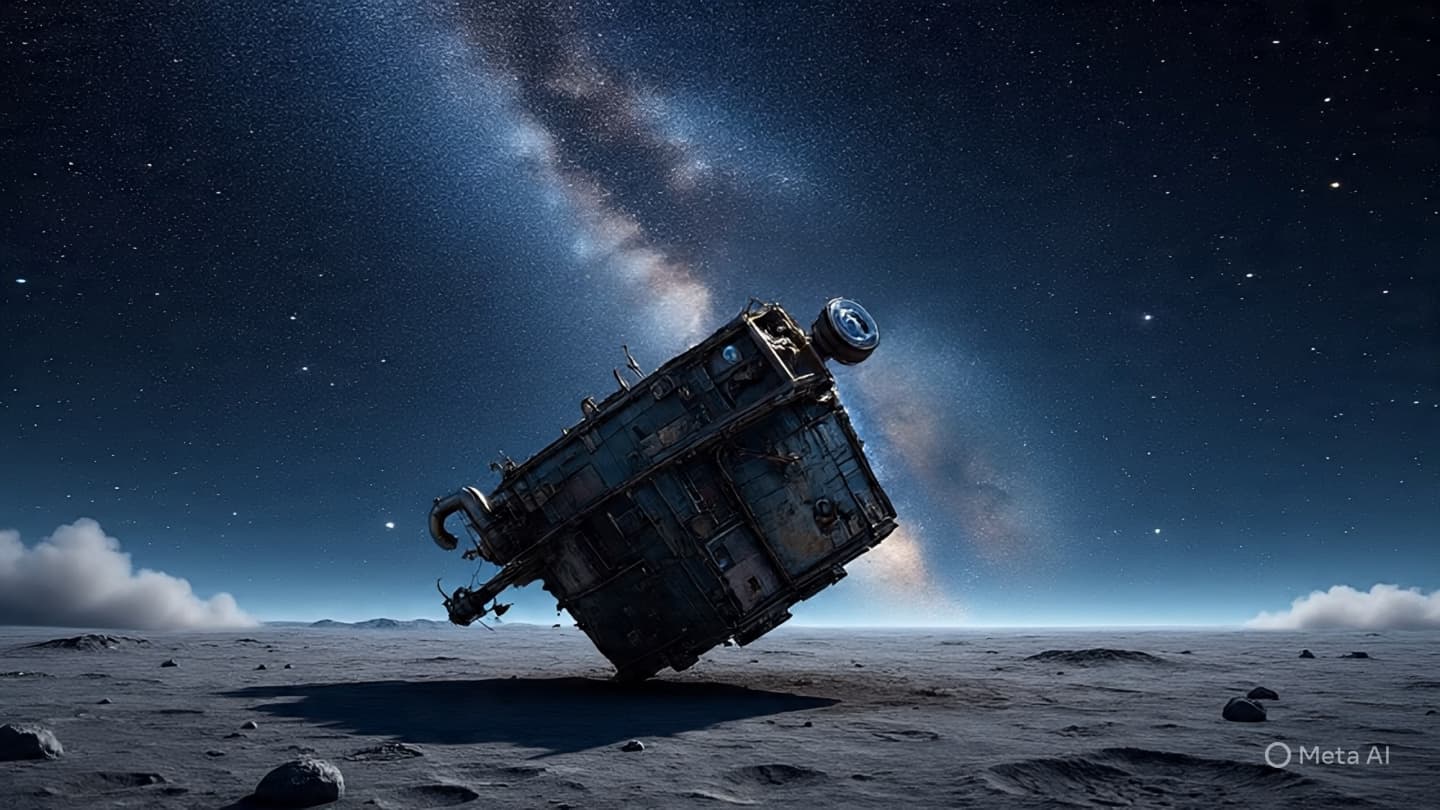
In the vastness of space, even small remnants can continue their quiet journeys long after their original purpose has faded. A discarded rocket stage, once part of a mission’s ascent, may now be tracing an unintended path—one that could intersect with the moon in the months ahead.
An amateur astronomer has identified a trajectory suggesting that a stray rocket stage, believed to be associated with a past SpaceX mission, could impact the lunar surface in August. Such observations often rely on careful tracking of orbital debris using publicly available data and independent calculations.
Objects left in space after launch can remain in orbit for extended periods, influenced by gravitational forces from Earth, the moon, and the sun. Over time, these forces can alter trajectories in subtle but meaningful ways.
The possibility of an impact highlights the challenges of monitoring space debris beyond Earth’s immediate orbit. While near-Earth space is increasingly tracked by agencies and organizations, objects traveling further afield can be more difficult to follow with precision.
Past incidents have shown that identifying the origin of space debris is not always straightforward. Initial assumptions about ownership or mission association have, in some cases, been revised as additional data becomes available.
If the object were to collide with the moon, the event would not pose any risk to Earth. The lunar surface, already marked by countless impacts over billions of years, regularly absorbs such घटनाएँ without broader consequence.
However, such an event could provide scientific value. Observing an impact in real time may offer insights into crater formation and the behavior of materials upon collision.
Space agencies continue to emphasize the importance of tracking and managing debris, particularly as the number of launches increases. Even distant objects can contribute to a more complex orbital environment.
For amateur astronomers, discoveries like this underscore the meaningful role that independent observers can play in complementing institutional research.
Whether or not the predicted impact occurs, the observation serves as a quiet reminder that the remnants of human activity in space continue to move, sometimes in ways that draw renewed attention to the need for careful tracking.
AI Image Disclaimer: Certain images used here are AI-generated to help visualize space debris and lunar impact scenarios.
Sources: SpaceNews NASA The Guardian
Published by Banx Network. This article is part of the Banx decentralized media programme, powered by the BXE token on the XRP Ledger.



