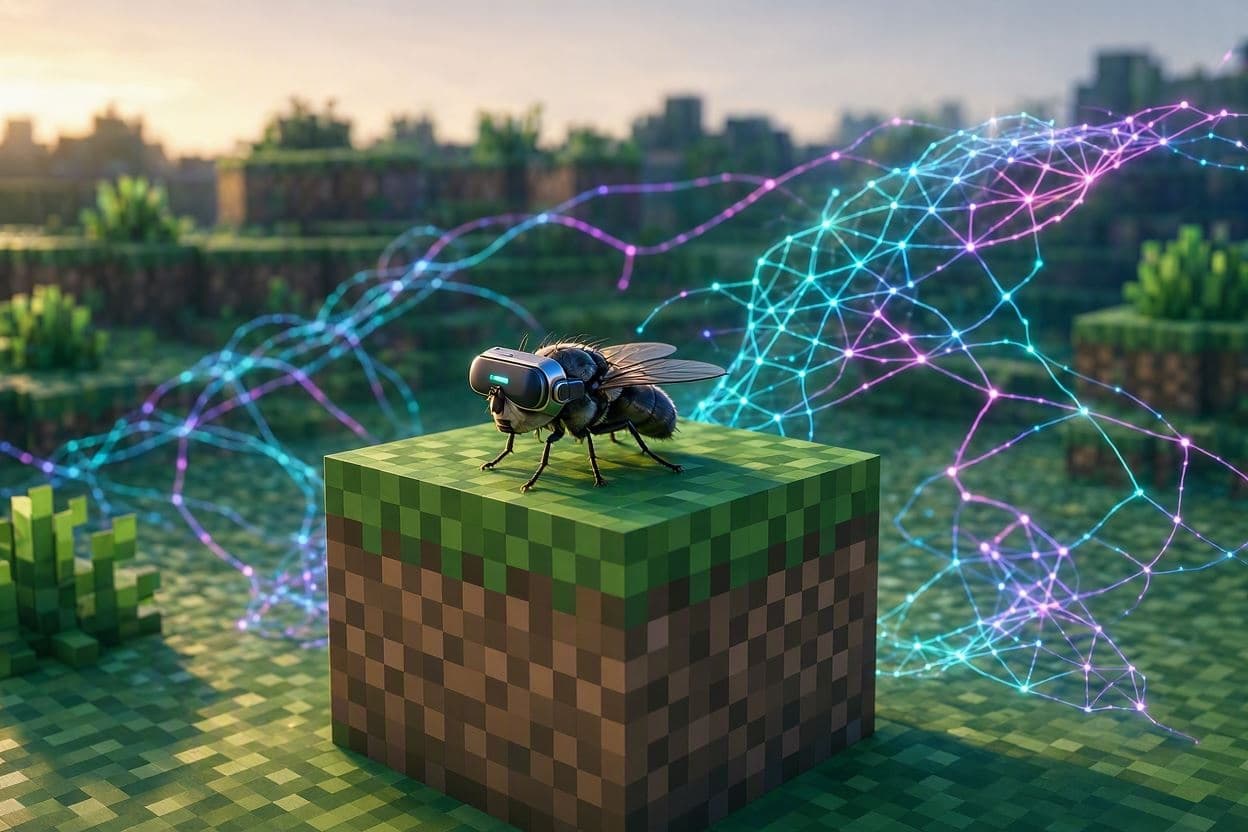
The line between the digital and the biological has always been thin, but recent experiments suggest it may be more permeable than we imagined. In a development that feels plucked from a dystopian sci-fi narrative, researchers have successfully integrated a living fly’s brain into the virtual world of Minecraft. This bizarre yet fascinating fusion of neuroscience and gaming raises questions about consciousness, control, and the future of human-computer interaction.
The experiment, conducted by a team of neuroscientists and computer engineers, involved connecting the neural activity of a fruit fly to the game’s interface. By interpreting the electrical signals from the fly’s brain, the researchers were able to translate its sensory inputs and motor commands into actions within the Minecraft environment. The fly, in essence, became a player, navigating the blocky landscape through its own neural impulses.
While the concept may seem whimsical, the underlying science is serious. This type of brain-computer interface (BCI) research aims to understand how biological neurons process information and interact with digital systems. It has potential applications in prosthetics, robotics, and even treating neurological disorders. However, the choice of Minecraft as the platform adds a layer of cultural resonance, making the science accessible and provocative.
Critics and ethicists have raised concerns about the welfare of the animal subjects and the broader implications of merging life with code. Is the fly aware of its actions? Does it experience the game in any meaningful way? These questions touch on the hard problem of consciousness, a puzzle that science has yet to fully solve. The experiment does not provide answers, but it certainly sharpens the inquiry.
For the gaming community, the news is both intriguing and unsettling. Minecraft, a game built on creativity and exploration, has become a testbed for cutting-edge neuroscience. It challenges players to reconsider what it means to "play" and who, or what, can be a player. The boundary between user and used, between agent and tool, becomes increasingly blurred.
The technical achievement is significant. Translating neural data into real-time game mechanics requires sophisticated algorithms and low-latency processing. The team’s success demonstrates the growing capability of BCIs to handle complex, dynamic environments. It paves the way for more advanced interfaces that could one day allow humans to control digital worlds with thought alone.
As we stand on the brink of this new frontier, it is essential to approach these developments with both curiosity and caution. The integration of biology and technology offers immense promise, but it also demands ethical vigilance. The fly in Minecraft is a small step, but it points toward a future where the distinction between the living and the digital may no longer be clear.
The images presented here are AI-generated creations designed to visualize the conceptual nature of the story.
Sources: Vice Motherboard, New York Post, Daily Mail, IEEE Spectrum, Futurism
Published by Banx Network. This article is part of the Banx decentralized media programme, powered by the BXE token on the XRP Ledger.