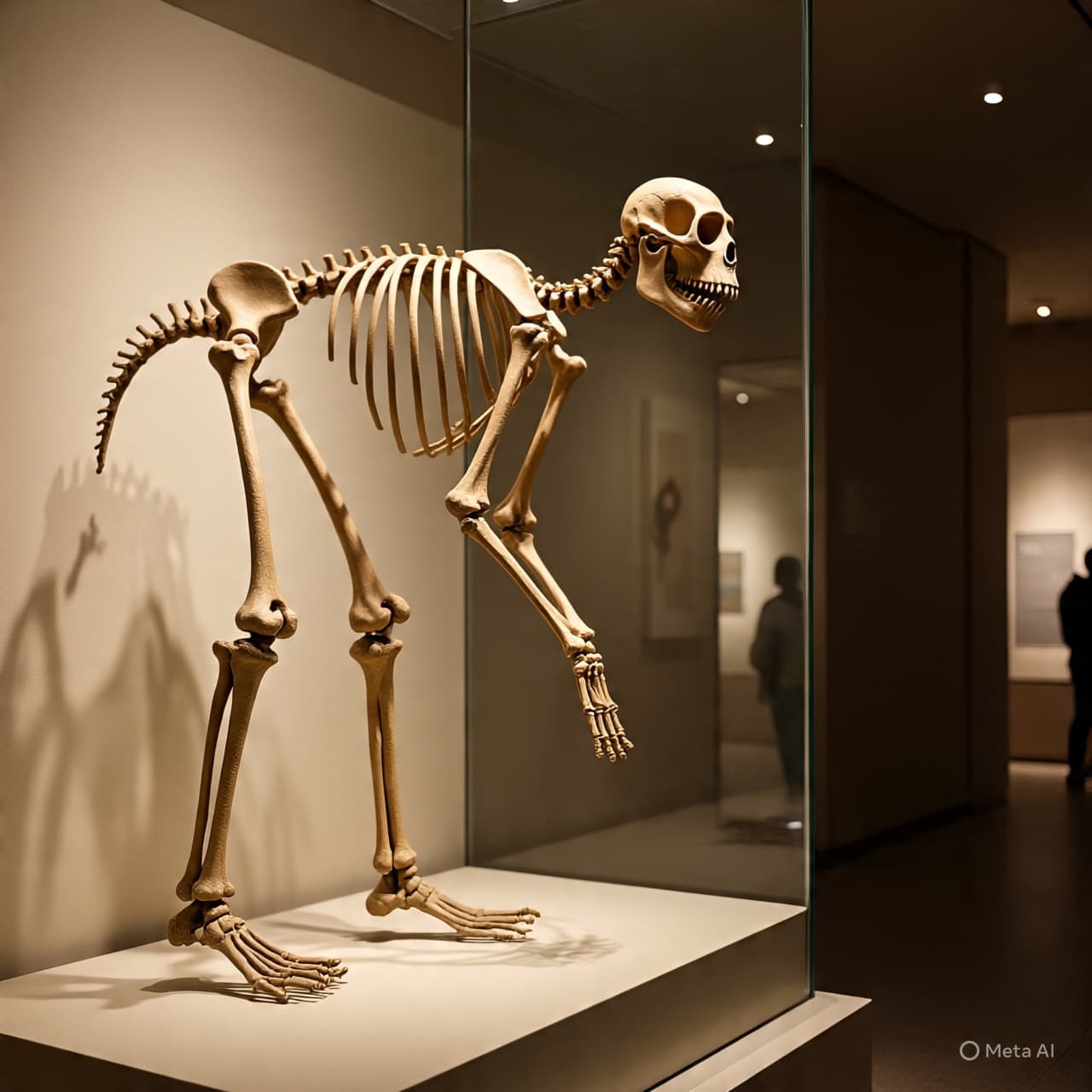
Some discoveries seem settled the moment they enter public memory. They take on a certainty that feels permanent, woven into textbooks and timelines. Lucy, the famed fossil unearthed in Ethiopia half a century ago, has long occupied such a place — a quiet figure walking confidently through humanity’s deep past.
Recent scientific debate, however, has unsettled that certainty. New analyses suggest that Australopithecus afarensis, the species to which Lucy belongs, may not be a direct ancestor of modern humans after all. Instead, some researchers argue, it could represent a close evolutionary cousin, branching away rather than leading forward.
The argument rests on reexaminations of fossil anatomy, comparative skeletal traits, and evolutionary pathways that may be more complex than once believed. Subtle differences in limb structure, locomotion, and dental features have prompted questions about whether A. afarensis fits neatly on the human family tree or occupies a side branch now lost to time.
Not all scientists agree. Many caution against drawing firm conclusions from incomplete evidence, noting that the fossil record remains fragmentary by nature. They argue that evolutionary relationships are rarely linear, and that excluding Lucy from direct ancestry risks oversimplifying a process defined by overlap, variation, and gradual change.
What has emerged instead is a broader discussion about how ancestry itself is defined. Evolution does not move with the clarity of a single path, but with divergence and convergence intertwined. In this view, Lucy’s importance is not diminished by uncertainty about lineage, but enriched by it, offering insight into a period when multiple human-like species coexisted.
The debate has also revealed how scientific understanding evolves alongside new tools and perspectives. Advances in imaging, modeling, and comparative datasets allow researchers to revisit iconic finds with fresh eyes, challenging assumptions once held as foundational.
Whether Lucy stands as a direct ancestor or a close relative, her role remains central. She reminds science that origins are rarely simple, and that knowledge advances not by preserving certainty, but by testing it. In the shifting landscape of human evolution, even the most familiar figures must be willing to step back into question.
Published by Banx Network. This article is part of the Banx decentralized media programme, powered by the BXE token on the XRP Ledger.