
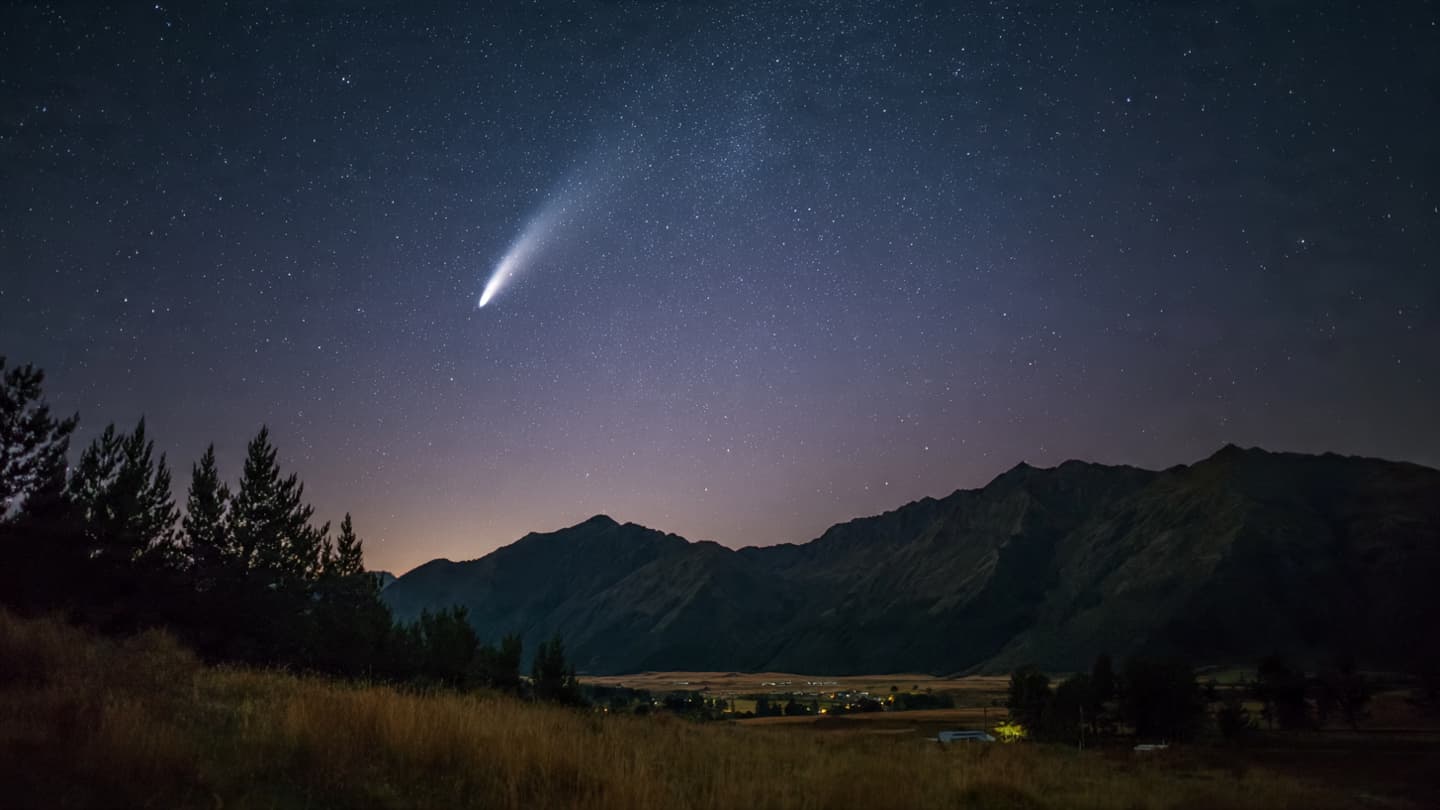
Across the vast quiet of space, objects drift with a patience that defies human urgency. Occasionally, one of them draws close enough to be noticed—not with spectacle alone, but with a quiet invitation to look upward and remember the scale of the universe.
A newly visible comet has begun appearing in the skies over New Zealand, drawing attention from astronomers and skywatchers alike. Described as relatively bright, the comet offers a rare opportunity for observation without the need for advanced equipment under favorable conditions.
Astronomers note that comet visibility depends on several factors, including its distance from Earth, its trajectory, and local weather conditions. Clear, dark skies away from urban light pollution provide the best chance for viewing.
In New Zealand, viewing conditions are often enhanced by expansive rural areas and low levels of light interference. Observers are encouraged to look toward specific regions of the sky during early morning or evening hours, depending on updated guidance from astronomical organizations.
Comets are composed primarily of ice, dust, and rocky material. As they approach the Sun, heat causes their icy components to vaporize, creating a glowing coma and sometimes a tail that can stretch across vast distances.
This particular comet has gained attention for its brightness relative to typical comet appearances, though experts caution that such descriptions are relative. What appears bright in astronomical terms may still require patience and adjusted expectations for casual observers.
Astronomy groups and observatories have shared viewing tips, including allowing time for eyes to adjust to darkness and using binoculars for enhanced visibility. These small steps can significantly improve the experience.
Public interest in such events often reflects a broader fascination with celestial phenomena. Moments like these offer a connection to scientific understanding while also inviting reflection on humanity’s place within a larger cosmic landscape.
As the comet continues its passage, it offers a brief but meaningful reminder that even distant travelers can, for a moment, become part of our shared sky.
AI Image Disclaimer: Some images are AI-generated to visually represent the celestial event and may differ from actual observations.
Sources: NASA, Sky & Telescope, BBC News, Royal Astronomical Society
Published by Banx Network. This article is part of the Banx decentralized media programme, powered by the BXE token on the XRP Ledger.



