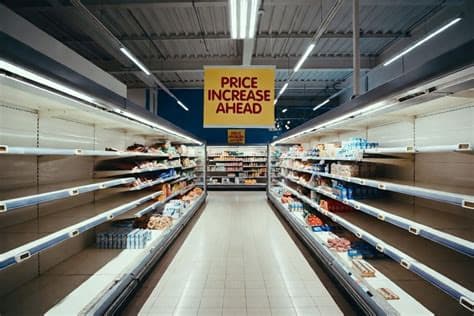
In the fluorescent calm of a grocery store, time moves differently. Carts roll slowly. Refrigerated doors sigh open and shut. Hands reach for the familiar without much thought. And yet, lately, even the most ordinary items seem to carry a faint unease, as if their prices might suddenly leap when no one is looking.
Milk, often cited as proof that everything has gone too far, has become shorthand for that anxiety. It appears in conversations, on social media, in jokes sharpened by concern — a symbol of inflation unmoored from fact. “Milk is twenty dollars,” the claim goes, less an observation than a feeling given numbers.
But it is not. Across the United States, milk prices have risen and fallen with predictable forces — feed costs, fuel prices, drought, supply chains — yet they remain far from the extreme figures circulating online. A gallon still sits within a familiar range, varying by region and brand, but anchored in reality rather than rumor.
The persistence of the exaggeration reveals something quieter and more telling. Milk is not just a product; it is a benchmark. It appears in childhood kitchens, school cafeterias, late-night refrigerators. When people worry about milk, they are rarely worried about milk alone. They are measuring stability — asking whether the small, dependable things still behave as expected.
Economic uncertainty tends to surface this way. It bypasses spreadsheets and finds expression in anecdotes. One price remembered incorrectly becomes a story repeated correctly, because it carries emotional truth even when the numbers drift. The claim spreads not because it is accurate, but because it feels plausible in a moment shaped by rent increases, medical bills, and wages that lag behind both.
Retail data tells a steadier story. Prices fluctuate, sometimes sharply, but they also retreat. Dairy markets respond to seasons and policy, to weather and trade, to forces that rarely trend in only one direction. The shelf, more often than not, corrects the fear placed upon it.
Still, the rumor persists, because it is easier to hold a symbol than a chart. Saying milk is twenty dollars is another way of saying that predictability feels expensive, that trust in ordinary systems has thinned. It is a shorthand for a broader unease about whether tomorrow will resemble yesterday closely enough to plan around it.
Milk remains what it has long been — cold, perishable, modestly priced, waiting behind glass doors. The panic attached to it says more about the moment than the market. And perhaps that is the quieter lesson: sometimes what feels inflated is not the cost of living, but the space uncertainty occupies in everyday thought.
AI Image Disclaimer
Visuals are AI-generated and serve as conceptual representations.
Sources
U.S. Bureau of Labor Statistics Department of Agriculture dairy market reports Consumer price index analyses Retail food pricing studies
Published by Banx Network. This article is part of the Banx decentralized media programme, powered by the BXE token on the XRP Ledger.