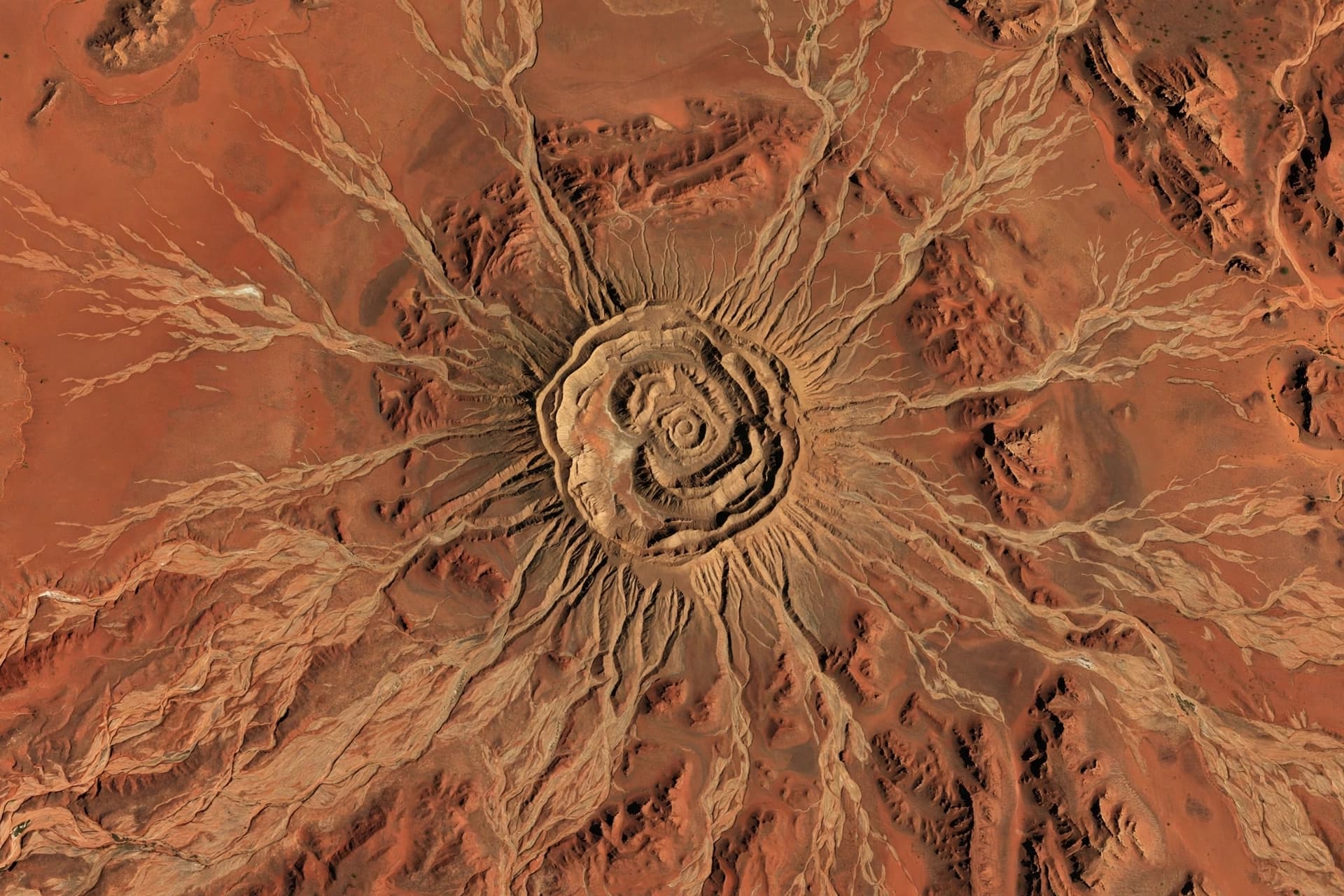
From the ground, the Kimberley region of Western Australia is a vast, remote expanse of red earth and sparse vegetation, a place where the scale of the landscape resists easy comprehension. From orbit, it becomes something else entirely—a canvas on which ancient violence and slow erosion have traced a shape that looks almost deliberate, almost alive. The Spider Crater is not alive, of course. But it is a reminder that the Earth keeps its scars in strange and beautiful forms.
The image, captured by the Operational Land Imager aboard the Landsat 9 satellite, shows an impact structure roughly 8 by 7 miles across, with a central "spider" formation measuring about 2.5 miles in diameter . The legs that give the crater its name are ridges of light-colored sandstone that have resisted erosion better than the surrounding rock, remaining exposed after hundreds of millions of years of wind and water . The body of the spider is thought to be the remnant of the crater's central uplift, the rebound of the ground after the initial impact—a process NASA compares to the splash of a drop hitting a puddle .
The impact occurred long before the dinosaurs, during the late Precambrian, an estimated 600 to 900 million years ago . At that time, life on Earth was almost entirely microbial and marine. The landscape that the object struck bore little resemblance to the Kimberley of today, and the rock layers that now form the spider's legs were buried deep underground. Erosion has since removed the rest of the crater, leaving only this resistant core exposed.
For years after its discovery in the 1950s, the crater puzzled geologists. Some suggested a volcanic origin. The evidence for an impact came later, in the form of shatter cones—cone-shaped fractures that form only when intense shock waves tear through rock—and distorted layers of sedimentary rock that could not be explained by any other process . The oval shape of the structure suggests the impacting object struck at a shallow angle rather than straight down, which would account for its elongated outline .
Australia is a good place to find such scars. The continent's ancient, stable crust and arid climate allow impact structures to persist far longer than they would in wetter, more geologically active regions. The Spider Crater is one of many, though its resemblance to an arachnid has given it a particular hold on the public imagination. The image from Landsat 9 does not reveal anything new to science. It simply offers a perspective that ground-level observation cannot provide—a view of a geological memory, written in stone and shaped by time.
Visuals in this article were created using AI and are for illustrative purposes only.
Sources: Yahoo, NASA, Daily Mail, Diario Córdoba
Published by Banx Network. This article is part of the Banx decentralized media programme, powered by the BXE token on the XRP Ledger.