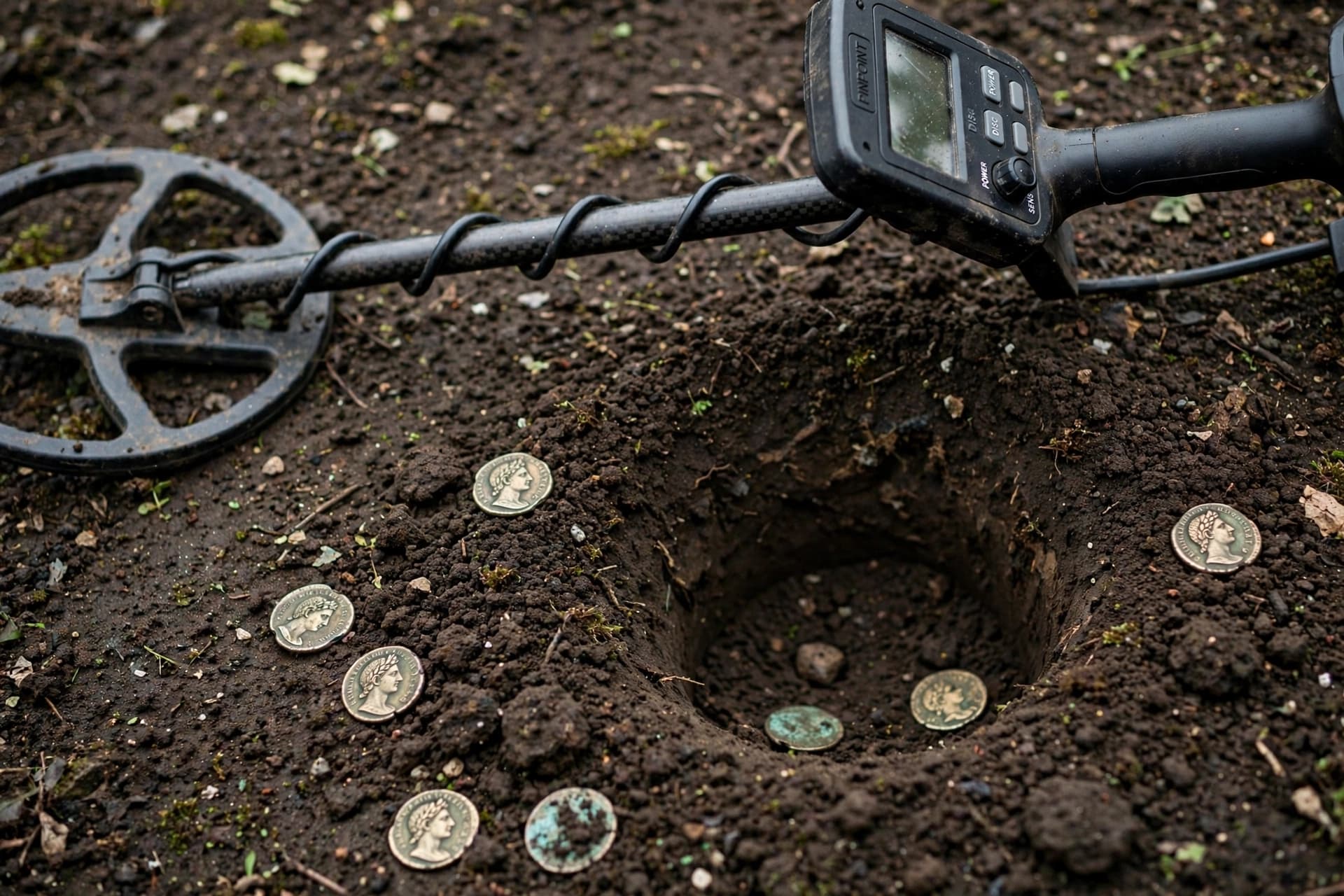
There is a particular kind of magic in the ordinary—the way a routine afternoon can suddenly tilt into something extraordinary. For one man walking through a field in Germany with a metal detector, that tilt arrived with a signal that seemed unremarkable at first, the sort of faint chirp that hobbyists learn to ignore or investigate on a hunch. He chose to dig.
What emerged from the soil near Cologne was not the scattered debris of a forgotten campsite or a rusted tool, but a cache of 934 Roman silver denarii—the largest coin hoard from the reign of Emperor Hadrian ever discovered in the region . The coins had rested beneath the field for nearly two thousand years, waiting through the rise and fall of empires, through plagues and wars and the slow turning of centuries, for someone to notice the quiet insistence of metal beneath the earth.
The discovery, details of which are still emerging, offers a window into a distant time when Roman legions patrolled the Rhine frontier and silver coins carried the weight of an empire's economy. Hadrian, who ruled from 117 to 138 AD, is remembered for consolidating Rome's borders rather than expanding them—a builder of walls, a stabilizer of frontiers. The denarii that bear his likeness or that of his predecessors would have circulated through the hands of soldiers, merchants, and provincial administrators, each coin a small instrument of Roman authority in a land far from the capital.
Coin hoards of this size are rare, and their presence often raises more questions than answers. Was this a soldier's savings buried for safekeeping during an uprising? The proceeds of a merchant's successful season, hidden against the threat of bandits? Or a ritual offering, consigned to the earth for reasons that made sense to someone living in a world where gods and omens were as real as taxes and grain? The coins themselves may carry traces of their journey—wear patterns, mint marks, the subtle signatures of hands that passed them from one owner to the next.
For archaeologists, such finds are invaluable not primarily for their monetary worth but for what they reveal about the texture of daily life in the Roman provinces. A single coin can suggest trade routes and economic connections; hundreds together, deposited in a specific place and time, can illuminate patterns of settlement, conflict, or prosperity that written records may have overlooked. The field near Cologne, now quiet farmland, was once part of a frontier zone where Roman and Germanic worlds met, sometimes in commerce, sometimes in conflict.
The man who found the hoard has not been widely named, but his discovery places him in a lineage of amateur enthusiasts whose patience and curiosity have yielded some of archaeology's most significant finds. Metal detecting, when practiced responsibly and within legal frameworks, has contributed to our understanding of the past in ways that formal excavations alone cannot. Each signal investigated is a small act of faith—a belief that the ordinary ground beneath our feet may still hold secrets worth finding.
The coins now pass into the hands of archaeologists and historians, who will study them for years to come. And the field near Cologne returns to its quiet state, its surface unchanged, its deeper layers a little lighter for the treasure that waited so long to be found.
AI Image Disclaimer: The visual content associated with this article is AI-generated and intended for illustrative purposes only, not as a photographic record of the discovery.
Sources: NewsBreak, Fox News
Published by Banx Network. This article is part of the Banx decentralized media programme, powered by the BXE token on the XRP Ledger.