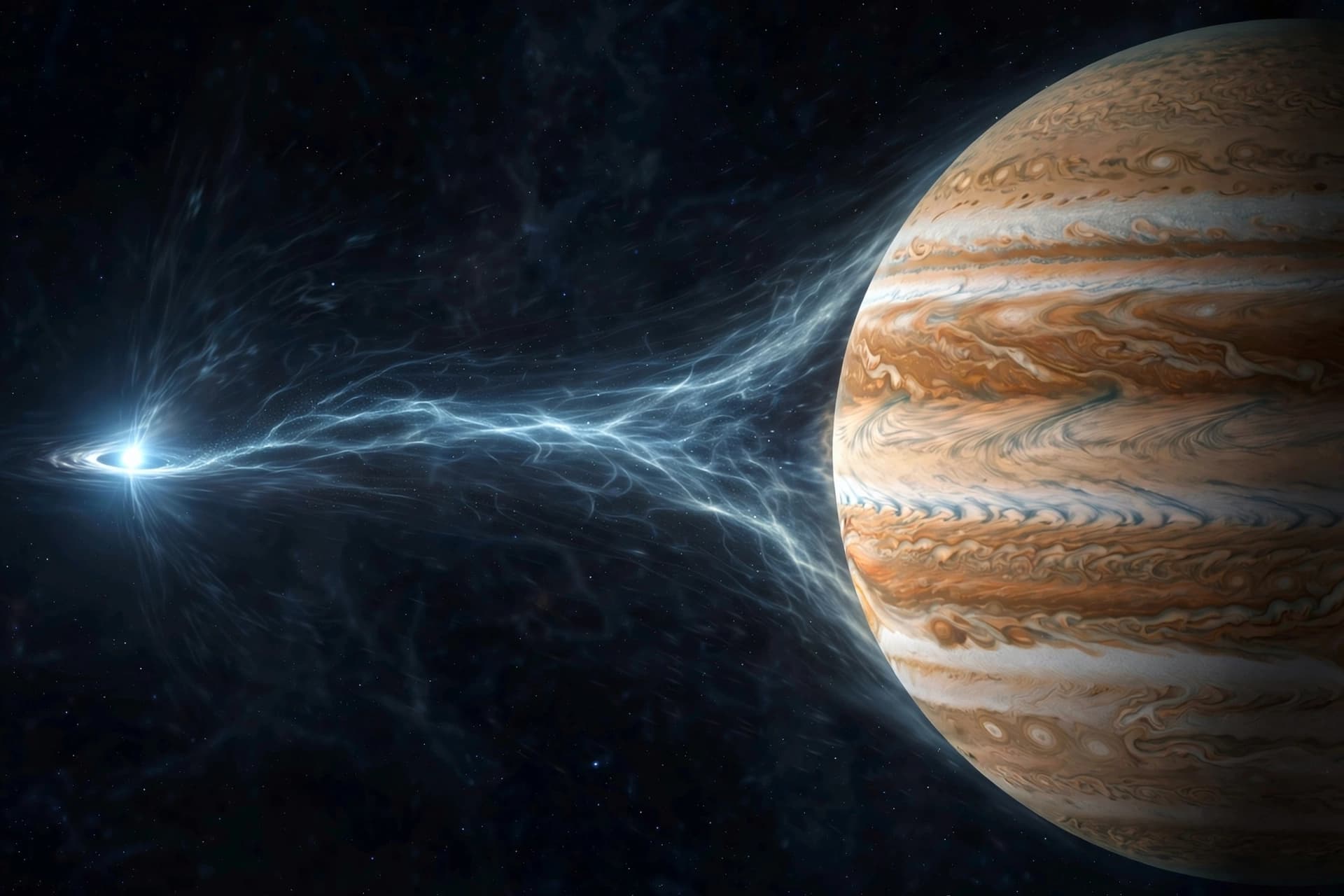
Jupiter does not reveal itself easily. From a distance, it appears generous with detail — wide bands of color, great storms spinning like ancient clocks, clouds piled high in restless motion. Yet the more closely astronomers look, the clearer it becomes that these familiar patterns are not explanations, but invitations. The planet’s clouds behave less like answers and more like curtains, drifting just enough to suggest something larger moving behind them.
For decades, scientists believed they understood Jupiter’s atmosphere as a layered system, neatly stacked and largely predictable. But recent observations have softened that certainty. Instruments peering deeper into the planet reveal cloud formations that do not sit where theory once placed them. Some layers plunge far deeper than expected, while others thin out, fading into regions once assumed to be uniform. It is as if Jupiter’s atmosphere is not built in floors, but woven like fabric, dense in some places and surprisingly open in others.
Lightning flashes far below the visible clouds, hinting at storms that do not announce themselves on the surface. Ammonia and water appear to mingle in unfamiliar ways, forming structures that challenge long-held models. Even the iconic belts and zones — those stripes children recognize in textbooks — seem less permanent than once thought, shifting and rearranging as if the planet is quietly rewriting its own rules.
What lies beneath the clouds may not be a single dramatic discovery, but something more subtle: a new understanding of how giant planets breathe, circulate, and evolve. Jupiter, after all, is not only a planet but a record keeper. Its immense gravity and ancient formation preserve clues from the earliest days of the solar system, sealed beneath layers of motion and mist.
As spacecraft continue to listen to Jupiter’s gravity and taste its atmosphere from afar, the clouds remain in place — not as barriers, but as storytellers that speak slowly. They remind researchers that even the largest objects in the solar system can be reserved, choosing revelation over time rather than all at once.
Closing The search beneath Jupiter’s clouds continues with patience rather than urgency. Each new measurement adds quiet detail, suggesting that understanding will come not through a single breakthrough, but through steady listening to a planet that prefers to whisper.
AI Image Disclaimer (Rotated) Illustrations in this article were created using AI tools and are intended as conceptual representations rather than real photographs.
Source Check (before writing) NASA ESA (European Space Agency) Nature Science Magazine Scientific American
Published by Banx Network. This article is part of the Banx decentralized media programme, powered by the BXE token on the XRP Ledger.