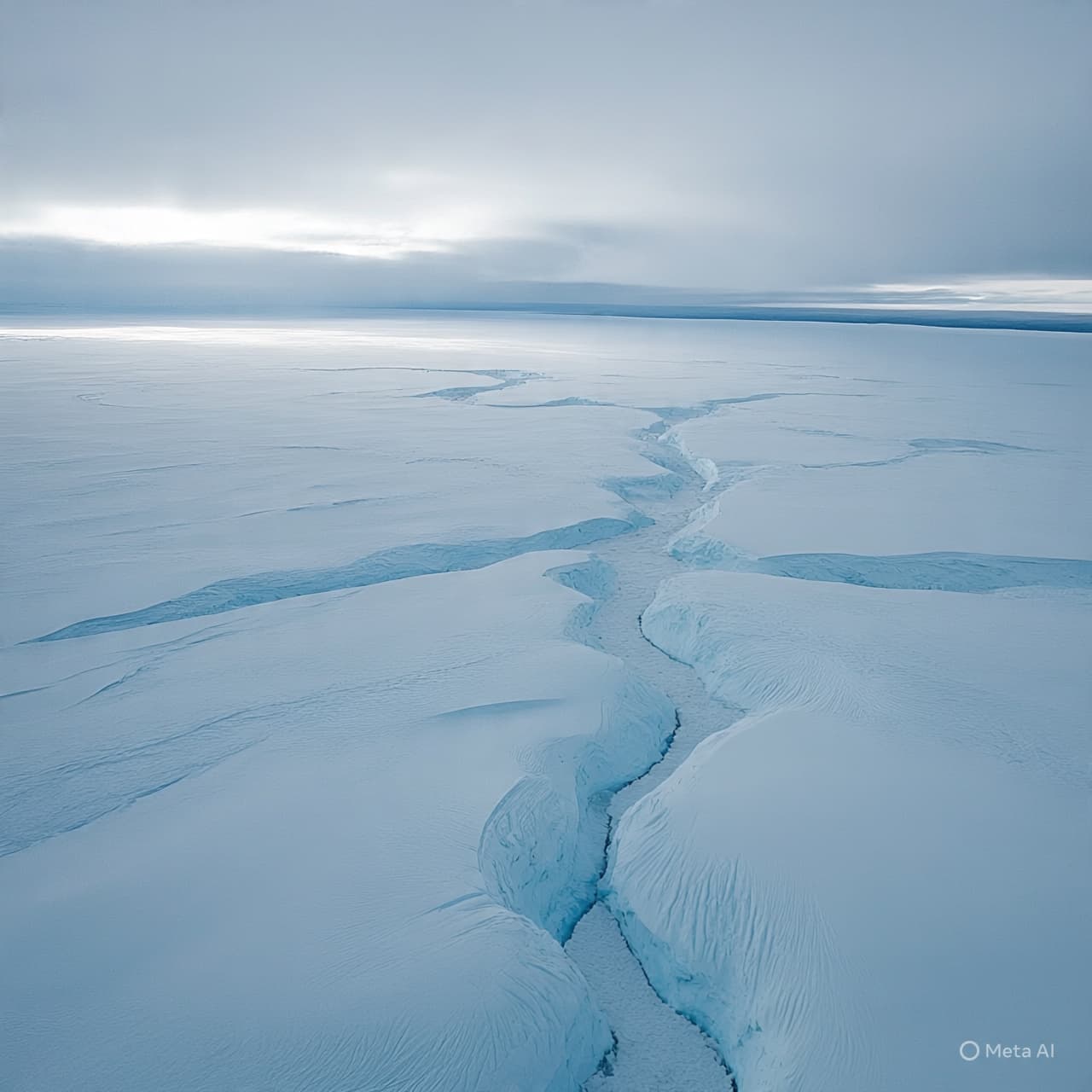
In the vast quiet of West Antarctica, where wind moves like a patient sculptor across endless white, the past does not vanish. It settles. It gathers. It presses downward in layers of snow that, over millennia, harden into ice. There, beneath miles of frozen stillness, history is not written in ink but preserved in crystal. And now, with the retrieval of a record ice core, scientists have opened another page in the long and intricate story of our planet’s climate.
The new core—extracted from deep within the West Antarctic Ice Sheet—extends further back in time than previous samples from the region, offering an unusually detailed archive of atmospheric conditions, temperature shifts, and ice sheet behavior. Each layer represents a year, sometimes even a season, capturing microscopic traces of ancient air, volcanic ash, and shifting snowfall patterns. In these compressed strata lies a chronology of change.
West Antarctica holds particular scientific interest. Unlike parts of East Antarctica, which rest largely on stable bedrock above sea level, much of the West Antarctic Ice Sheet sits on land below sea level, making it more vulnerable to ocean-driven melting. Understanding how it responded to past warming periods is essential for anticipating future sea-level rise. The deeper the core, the further back scientists can trace how temperature, greenhouse gas concentrations, and ice volume have interacted.
Preliminary findings from the record core suggest that West Antarctica has experienced significant shifts in the past—periods of retreat and regrowth influenced by both atmospheric warming and ocean circulation changes. By analyzing trapped air bubbles, researchers can directly measure ancient levels of carbon dioxide and methane. These measurements provide a mirror to today’s rising greenhouse gas concentrations, allowing comparisons across tens or even hundreds of thousands of years.
The work itself is a testament to patience and precision. Drilling operations in Antarctica require international collaboration, specialized equipment, and months of preparation in extreme conditions. Cores must be extracted carefully to preserve their delicate layering, then transported under strict temperature control to laboratories where they are sliced, scanned, and chemically analyzed. The process is slow, methodical, and deliberate—much like the ice sheet it seeks to understand.
What makes this particular core notable is not only its depth, but its clarity. Scientists report that it captures intervals of past warmth with sharper resolution than previously available in the region. This may help refine models predicting how the ice sheet could respond under current climate trajectories. While models are powerful tools, they are strengthened by historical evidence—by knowing how ice behaved when the world last grew warmer.
Yet even as data accumulates, the tone among researchers remains measured. Ice cores do not shout warnings; they offer evidence. They reveal that Earth’s climate has always shifted, but they also show that the pace and drivers of change matter deeply. By comparing ancient transitions to modern trends, scientists can better distinguish natural variability from human influence.
In the frozen expanse of West Antarctica, time is layered but not lost. With each meter drilled, another chapter emerges—quietly, precisely, without spectacle. The new record core does not provide all the answers, but it enriches the dialogue between past and present. In understanding how the ice once responded to warmth, researchers move closer to understanding how it may respond again.
As analysis continues, the findings are expected to inform global climate assessments and sea-level projections. The record core stands as a scientific milestone—an expanded archive from one of the planet’s most sensitive regions, offering insight not only into what has been, but into what may lie ahead.
AI Image Disclaimer Graphics are AI-generated and intended for representation, not reality.
Sources Reuters BBC News The Guardian Nature Scientific American
Published by Banx Network. This article is part of the Banx decentralized media programme, powered by the BXE token on the XRP Ledger.