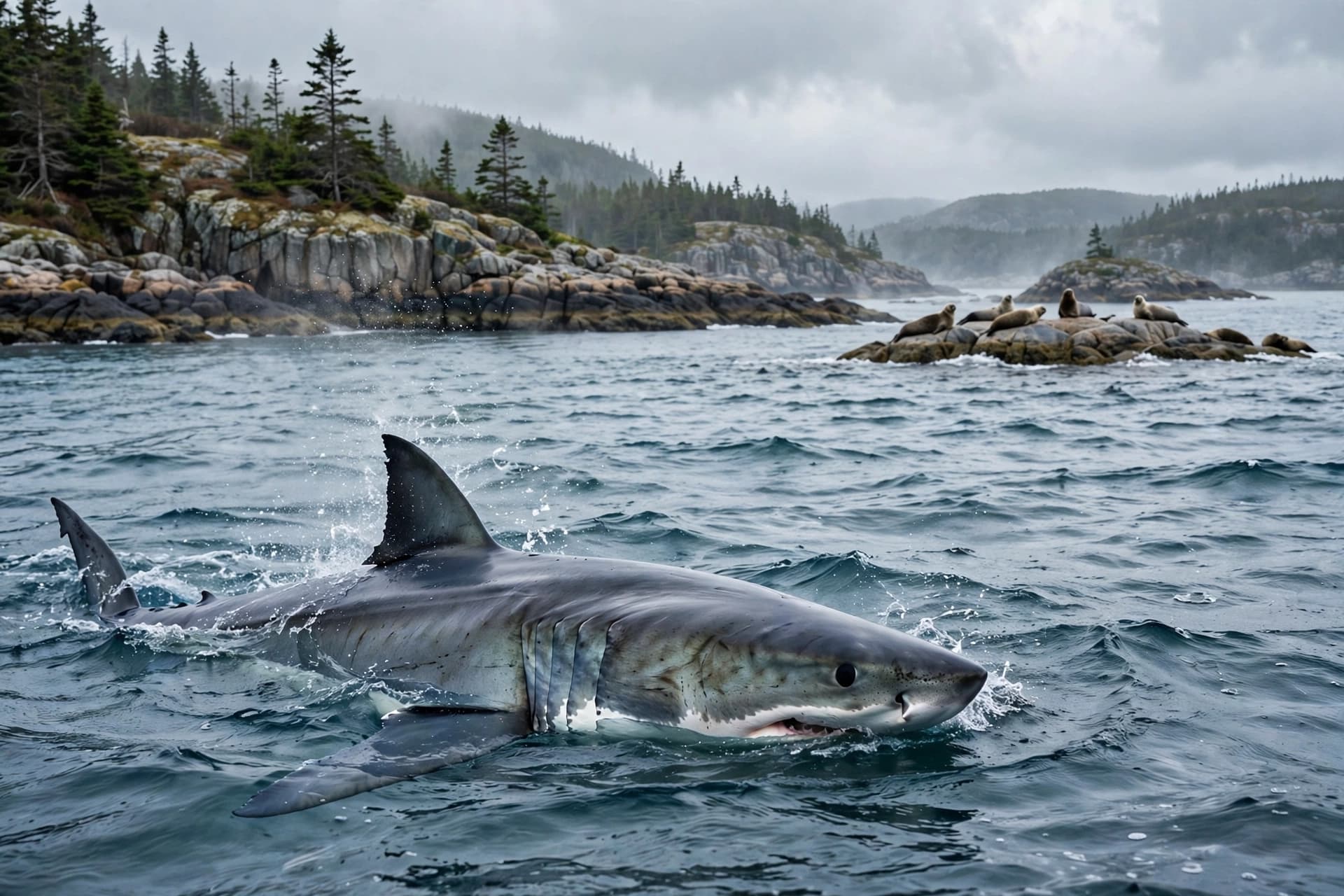
There is a particular wonder in watching a creature return to a place it was nearly erased from—a slow, patient homecoming measured not in years but in decades, not in miles but in the recovery of an entire ocean. Off the Atlantic coast of Canada, that homecoming is underway. Great white sharks, once decimated by unregulated fishing, are swimming north in growing numbers, drawn by rebounding seal populations and warming waters that have made their traditional prey more abundant in northern latitudes. The sharks are not invaders. They are returnees.
The numbers tell a story of recovery. An estimated 2,000 great white sharks from the western North Atlantic population are believed to migrate north to feed in Atlantic Canadian waters each summer . Researchers have tracked individuals as far north as the Strait of Belle Isle, near the northern tip of Newfoundland—a range that very few tagged sharks have ever ventured into . One shark, a sub-adult male named Quint, was recorded moving north in the Strait of Belle Isle, about 18 miles from shore . Another, a 12-foot, 1,000-pound shark named Webster, has been swimming around the northern peninsula of Newfoundland, mostly near beaches in the Cow Head area .
The primary driver is food. Seals, a favorite prey of great whites, have rebounded along the U.S. and Canadian coasts in recent decades. The surface waters off Nova Scotia are believed to have warmed by about 1.5 degrees Celsius in the last 30 years, with seafloor temperatures warming by about 3 degrees Celsius . More fish means more seals, and more seals mean more great whites. John Tyminski, a data scientist with the research organization OCEARCH, explained that sharks are using Atlantic Canadian waters as a summer foraging area: "There are lots of seals there and schooling fishes which they can prey on. Food is a big driver but there are also sustainable habitats there" .
The recovery is a direct result of protection efforts. White shark populations were greatly depleted from the 1960s through the early 1990s due to unregulated fishing practices, with only around nine percent of the global population remaining . Protective measures reduced harvesting, and the population has since shown signs of recovery. "We are seeing a positive return to abundance in great white shark numbers," Tyminski said . Chris Fischer, founder of OCEARCH, described the sharks' return to Newfoundland as a sign of a healing ocean: "Newfoundland is supposed to be surrounded by white sharks putting pressure on seals. It's just that we wiped out the ocean so much, none of us have seen it. And now the ocean is returning to abundance" .
The presence of these apex predators carries ecological significance. Caroline Miri, a marine biologist with Fisheries and Oceans Canada, noted that sharks play a key role at the top of the marine food chain, helping to keep in check invasive species and competing fish species lower down . Fischer argued that sharks around Newfoundland indicate that fisheries management programs are succeeding: "These are the lions of the ocean" .
For the people who share these waters, the shift requires awareness rather than alarm. Alanna Canaran, a dive instructor based in Halifax, said sightings were "pretty unheard of" when she first moved to Nova Scotia in 2010, but by 2020 the situation had changed dramatically. She now includes a briefing about sharks in her dive courses, prefacing it by saying the risk of an attack is "very, very, very unlikely, but it's increasing" . Shark attacks in Canada remain extremely rare—just 15 confirmed attacks over the past 330 years, with only one confirmed fatality . The sharks are not actively seeking humans, but they are curious, and they can confuse a wetsuit or a surfboard with a seal .
The northward movement of great whites is part of a broader pattern. As ocean temperatures rise, marine species across the globe are shifting toward higher latitudes. Warming waters are making once-cool habitats more suitable for great whites, while their traditional ranges may become too warm. The sharks are not choosing to expand their territory; they are following their food, and their food is following the changing climate. The return of the great white to Canadian waters is a conservation success story and a climate signal at once—a reminder that the ocean is not static, and that its inhabitants are moving in ways we are only beginning to understand.
AI Image Disclaimer: The images accompanying this article were generated by artificial intelligence and are for illustrative purposes only.
Sources: BBC, CBC News, Nonstop Local News, TechNews
Published by Banx Network. This article is part of the Banx decentralized media programme, powered by the BXE token on the XRP Ledger.