

Key Highlights
- Evidence of a supermassive black hole merger detected in NGC 4486B.
- Gravitational waves emitted during black hole mergers provide insights into cosmic events.
- Understanding these mergers is crucial for studying galaxy evolution and dark matter distribution.
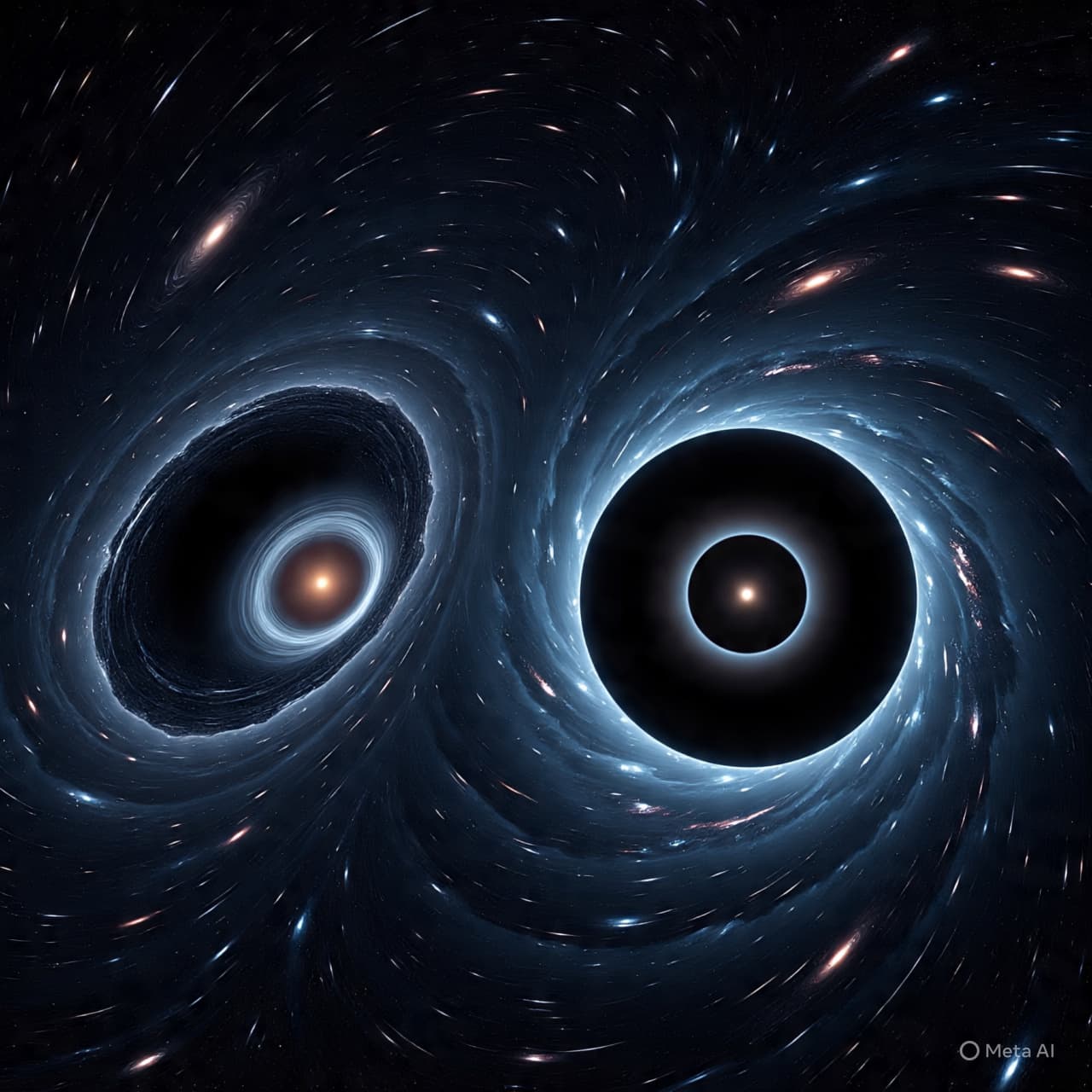
Astronomers have recently uncovered compelling evidence suggesting that the compact galaxy NGC 4486B may be home to the remnants of a supermassive black hole merger. This monumental event, one of the most powerful in the universe, occurs when two galaxies collide, causing their central black holes to spiral toward one another. The implications of such mergers extend far beyond the immediate vicinity of the black holes, influencing the very structure and evolution of galaxies.
The evidence for this merger is not derived from direct observation but rather from subtle distortions in the galaxy's stellar motions and density distributions. In NGC 4486B, scientists have observed an unexpected concentration of stars near its core, a phenomenon often associated with the gravitational interactions of massive objects. These interactions can warp spacetime itself, leading to the emission of gravitational waves as the black holes orbit each other and gradually lose energy.
While astronomers have successfully detected gravitational waves from smaller black hole mergers, the challenge of observing supermassive black hole mergers remains significant. Instead, researchers rely on indirect signatures, such as those emerging from NGC 4486B, to piece together the history of these cosmic events. Computer simulations have been instrumental in interpreting these findings, allowing scientists to recreate galactic collisions and compare theoretical outcomes with real observations. In this case, the models align with the presence of a past merger event, bolstering the case for NGC 4486B as a site of significant cosmic activity.
The implications of understanding supermassive black hole mergers are profound. These events can influence star formation rates, alter galactic structures, and even affect the distribution of dark matter within galaxies. As researchers continue to study these phenomena, they gain insights into the broader processes that govern galaxy evolution and the dynamics of the universe.
However, scientific caution is paramount. Alternative explanations, such as unique stellar dynamics unrelated to mergers, remain under consideration. The scientific community is committed to ensuring that conclusions are built on robust evidence, and certainty in such discoveries often comes slowly. Even so, the possibility of a black hole merger in NGC 4486B is compelling, representing a rare glimpse into one of the universe's most dramatic processes, which unfolds over millions of years, far removed from human timescales.
In contemplating such events, our perspective shifts. The universe reveals itself not as a static entity but as an ever-changing tapestry, shaped by forces both immense and invisible. If confirmed, this discovery would add another chapter to our understanding of cosmic evolution, quietly reminding us that even in the vast stillness of space, profound transformations are always underway.
Published by Banx Network. This article is part of the Banx decentralized media programme, powered by the BXE token on the XRP Ledger.




