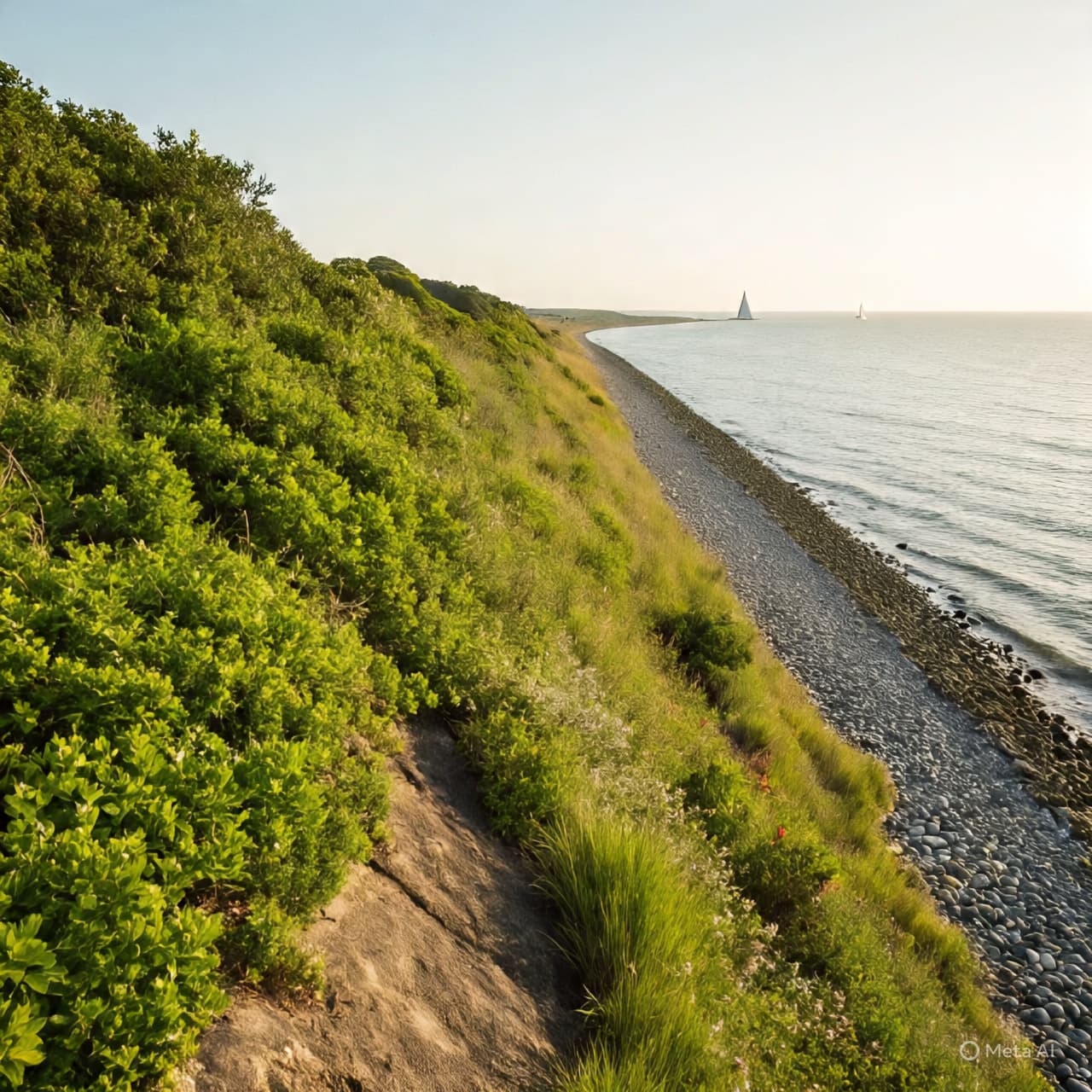
There are ideas in engineering that feel less like construction and more like cultivation—where protection is not only built, but grown, tended, and allowed to evolve with time. The concept of “living dikes” seems to belong to this quieter, more organic approach to safeguarding land from the steady rise of the sea, where vegetation becomes both shield and structure.
At the forefront of this exploration is the Deltares Institute, which is testing how plant-based systems can strengthen coastal defenses against rising water levels in the North Sea. Traditionally, dikes have been engineered with layers of soil, stone, and concrete—solid barriers designed to hold back the force of water. The idea of incorporating vegetation introduces a different kind of resilience, one that grows over time and adapts to environmental conditions.
These “living dikes” rely on carefully selected plant species whose roots can bind soil, reduce erosion, and absorb the impact of waves and wind. In this way, the vegetation does more than simply exist on the surface—it becomes an active participant in reinforcing the structure itself. It is a system where biology and engineering meet, creating a layered defense that responds dynamically to its surroundings.
There is a quiet ingenuity in this approach. Rather than relying solely on static materials, living dikes introduce an element of growth and renewal. Plants can regenerate, adapt to changing conditions, and contribute to the long-term stability of the dike. This creates a form of infrastructure that is not fixed, but evolving—one that changes with the seasons and strengthens over time.
The North Sea, with its rising levels and shifting weather patterns, presents a complex challenge for coastal regions. Traditional infrastructure must be continually maintained and, in some cases, upgraded to meet these changing conditions. Living dikes offer an alternative or complementary strategy, one that works with natural processes rather than against them. By integrating vegetation into the design, these systems aim to enhance resilience while also contributing to ecological balance.
There is also a broader environmental dimension to this approach. Vegetated systems can provide habitats for wildlife, support biodiversity, and improve water quality. In this sense, living dikes serve multiple purposes at once—protecting human settlements while also fostering natural ecosystems. This dual function reflects a growing recognition that infrastructure and environment need not be separate, but can instead be integrated in ways that benefit both.
Yet, as with any emerging concept, the testing of living dikes involves careful study and observation. Researchers must evaluate how different plant species perform under varying conditions, how the structures hold up over time, and how they respond to extreme weather events. This process requires patience, as the true effectiveness of such systems can only be understood through long-term observation and analysis.
There is something quietly hopeful in this work. In a time when rising sea levels pose increasing challenges, the idea that nature itself can be part of the solution offers a different perspective—one that blends innovation with ecological awareness. It suggests that resilience may not always come from resisting nature, but from working alongside it.
As Deltares continues its experiments with living dikes, the results may inform future approaches to coastal defense—not only in the Netherlands, but in other regions facing similar challenges. The work represents a careful step forward, one that explores how infrastructure can evolve in harmony with the natural world.
In this way, living dikes stand as both a practical response and a conceptual shift—a reminder that even the most enduring structures can take root, grow, and adapt, much like the landscapes they are designed to protect.
Published by Banx Network. This article is part of the Banx decentralized media programme, powered by the BXE token on the XRP Ledger.