There is a natural temptation, when a new telescope takes its place among the stars, to compare it to the one that came before—to ask which is stronger, which is better, which will see farther into the darkness. But the most interesting answer is often not a ranking but a division of labor. The Nancy Grace Roman Space Telescope, launched in August 2026, is not a replacement for the James Webb Space Telescope. It is something Webb was never designed to be: a surveyor, a mapper, a machine built to see the universe in wide, sweeping strokes rather than close, piercing gazes.
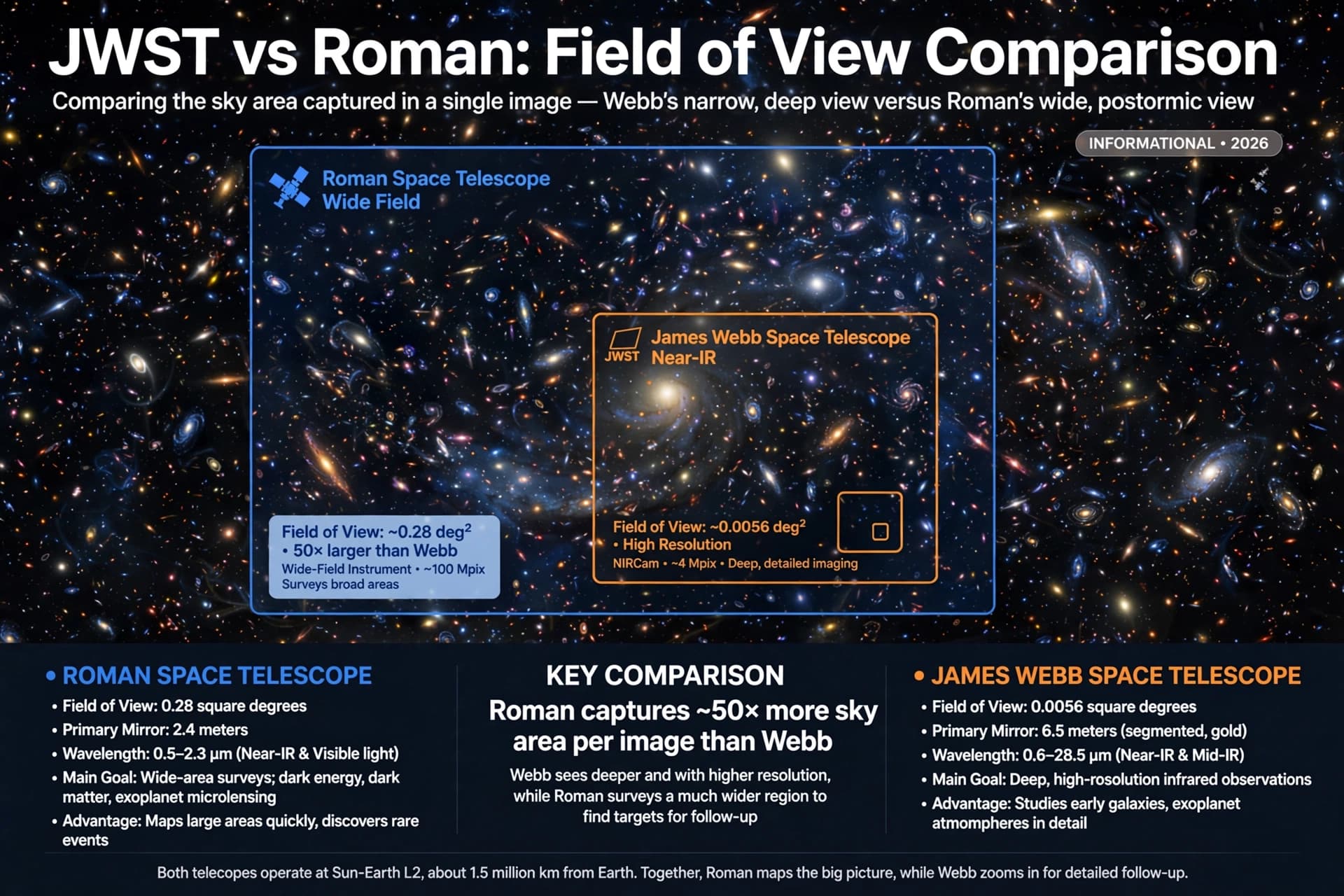
The most fundamental difference between the two observatories lies in their fields of view. Webb, with its segmented gold mirror, was built to capture extraordinary detail in tiny patches of sky. Roman, by contrast, will capture images with a field of view roughly 100 times larger than Webb’s, while still achieving the sharp resolution of the Hubble Space Telescope . Where Webb might spend hours staring at a single distant galaxy, Roman can photograph a region containing millions of galaxies in a single exposure.
This difference is not a matter of one being superior to the other. It reflects a deliberate design choice. Roman is a survey mission, built to map the universe at unprecedented scales—to observe hundreds of millions of galaxies, to discover thousands of exoplanets, to trace the distribution of dark matter and the influence of dark energy across cosmic time . Webb, with its unmatched sensitivity to faint infrared light, is designed to follow up on discoveries and examine individual objects in exquisite detail. The two telescopes are meant to work in tandem: Roman finds the interesting targets, and Webb studies them closely.
The instruments aboard the two observatories reflect their different purposes. Roman carries the Wide Field Instrument, a 300-megapixel infrared camera that will scan the sky a thousand times faster than Hubble . It also carries a Coronagraph Instrument, a technology demonstration designed to block the glare of stars and directly image Jupiter-sized exoplanets—a stepping stone toward future missions that might image Earth-like worlds . Webb’s instruments, by contrast, are tuned for spectroscopy and high-resolution imaging of specific targets, not for sweeping surveys.
The data volumes tell a similar story. Webb transmits less than 60 gigabytes of data to the ground each day . Roman will send back approximately 1,400 gigabytes—1.4 terabytes—every day, the highest data rate of any NASA astrophysics mission . This flood of information will require machine learning and citizen scientists to help sift through it, flagging the most promising findings for detailed study .
Roman’s origins are also unusual. Its primary mirror, 2.4 meters in diameter—the same size as Hubble’s—was originally built for a classified spy satellite program and donated to NASA by the National Reconnaissance Office . The telescope was completed ahead of schedule and under budget, a rare achievement in the world of flagship space missions .
Together, Webb and Roman will address different aspects of the same cosmic questions. Webb looks deep, finding the faintest and most distant objects. Roman looks wide, building a map of the universe on the largest scales. One telescope completes the other, and the universe, slowly, comes into focus.
AI Image Disclaimer: All visual content in this article is AI-generated and serves illustrative purposes only, not as documentary records of the telescopes or their observations.
Sources: Space Telescope Science Institute, ABC Science Show, NASA, Science (AAAS), NASA Goddard
Published by Banx Network. This article is part of the Banx decentralized media programme, powered by the BXE token on the XRP Ledger.