For nearly a century, physics has been divided into two magnificent but incompatible realms: the smooth, continuous curvature of general relativity and the discrete, probabilistic jitter of quantum mechanics. Bridging these two frameworks has been the holy grail of theoretical physics, a quest for a theory of quantum gravity. Now, emerging experimental designs and subtle anomalies in existing data suggest that the first hints of this unification may already be here, hiding in plain sight within the noise of our most precise measurements.
The challenge has always been scale. Quantum effects are dominant at the atomic level, while gravity is significant only at massive scales. Testing their intersection requires energies or sensitivities that have long been out of reach. However, recent advances in tabletop experiments and precision measurement technologies are changing the landscape. Researchers are now able to probe the gravitational influence of small masses, approaching the realm where quantum effects might become detectable.
One promising avenue involves the study of entanglement in gravitational fields. If gravity is truly quantum, it should be able to mediate entanglement between particles, just as electromagnetic forces do. Recent proposals suggest that carefully controlled experiments with microscopic masses could reveal this signature. While definitive proof remains elusive, preliminary data from high-precision interferometers and atom traps show fluctuations that some theorists argue could be consistent with quantum gravitational effects.
Another potential hint comes from cosmological observations. The cosmic microwave background, the afterglow of the Big Bang, contains tiny irregularities that may bear the imprint of quantum fluctuations in the early universe’s gravitational field. By analyzing these patterns with greater sophistication, scientists hope to find evidence of gravitons, the hypothetical particles that carry the force of gravity. While indirect, such findings would provide strong support for the quantization of spacetime.
Skepticism remains healthy and necessary. Many of these "hints" could still be explained by conventional physics or experimental artifacts. The scientific community is cautious, demanding rigorous peer review and reproducibility before accepting any claim of discovery. Yet, the convergence of multiple independent lines of inquiry is encouraging. It suggests that we are closing in on a phenomenon that has long been relegated to the realm of pure mathematics.
The implications of confirming quantum gravity are profound. It would revolutionize our understanding of black holes, the Big Bang, and the fundamental nature of reality. It could unlock new technologies, much as quantum mechanics led to the transistor and the laser. But beyond practical applications, it would satisfy a deep intellectual hunger, unifying our description of the universe into a single, coherent framework.
As experiments become more sensitive, the next few years may prove pivotal. Tabletop devices, once considered too small to matter, are now at the forefront of fundamental physics. They demonstrate that big questions can sometimes be answered with small, clever setups. The hunt for quantum gravity is no longer just a theoretical exercise; it is an experimental reality.
Whether these current hints solidify into discovery or fade into statistical noise, the pursuit itself is valuable. It pushes the boundaries of technology and thought, forcing us to refine our tools and our theories. In the quiet hum of a laboratory instrument, we may finally hear the whisper of gravity’s quantum nature, echoing from the deepest foundations of the cosmos.
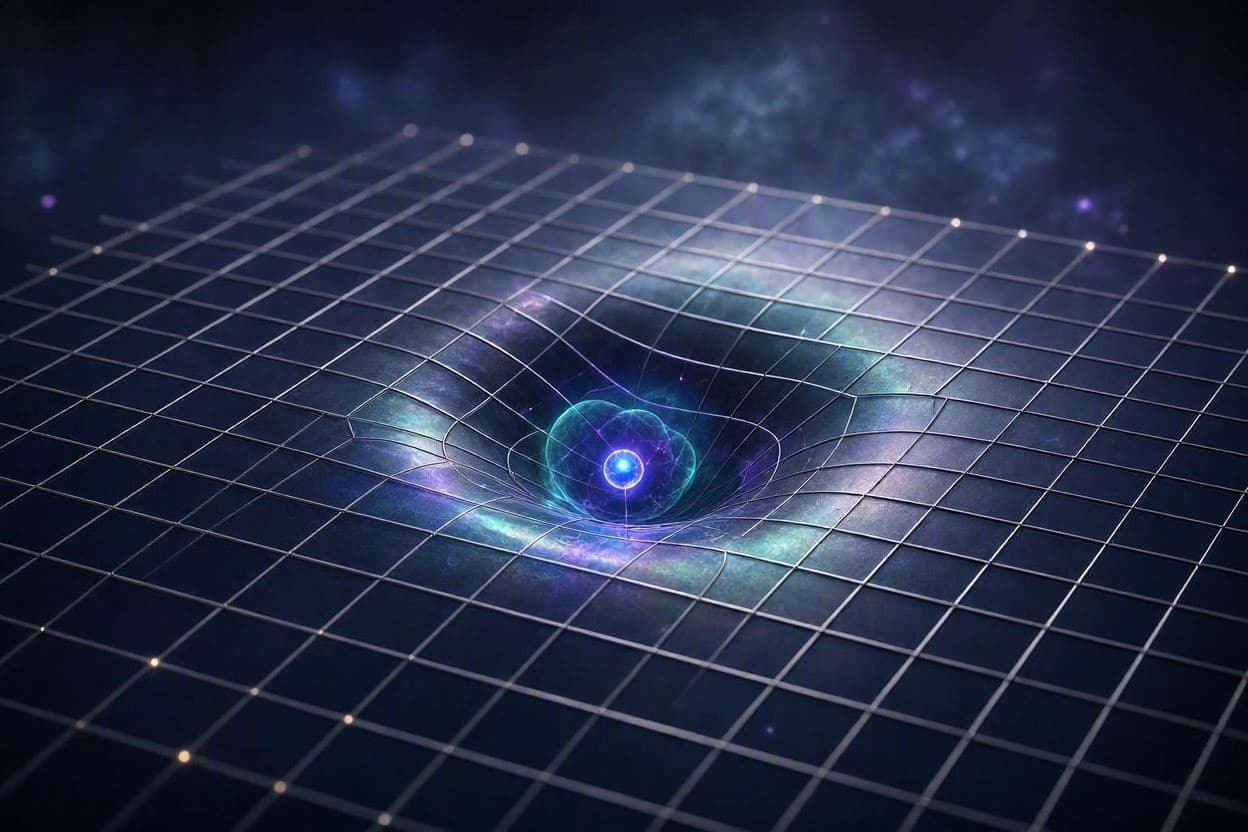
AI Image Disclaimer: Visuals in this article are AI-generated illustrations depicting abstract physics concepts and laboratory settings, designed to visualize the theme of quantum gravity without showing real proprietary experimental data.
Sources: APS Physics, Starts With a Bang (Substack), Nautilus, Springer Nature
Published by Banx Network. This article is part of the Banx decentralized media programme, powered by the BXE token on the XRP Ledger.