Although the Sun rises each day with familiar reliability, scientists know that it is far from static. Beneath its brilliant surface, powerful magnetic forces generate cycles of activity that can influence conditions across the solar system. As solar activity continues to increase, researchers are strengthening efforts to monitor space weather with greater precision.
Observatories around the world are tracking a growing number of solar flares, sunspots, and coronal mass ejections. These phenomena are natural features of the Sun's activity cycle, which typically spans approximately eleven years.
The current phase of the cycle has attracted particular attention because stronger solar activity can affect modern technological systems. Satellites, radio communications, navigation networks, and electrical infrastructure may all experience varying levels of disruption during significant solar events.
Space weather forecasting has become an increasingly important field of scientific research. Just as meteorologists monitor storms in Earth's atmosphere, solar scientists observe conditions on the Sun to anticipate potential impacts.
International cooperation plays a central role in this work. Space agencies and research institutions regularly exchange data collected from satellites and ground-based observatories.
Advanced instruments provide continuous monitoring of solar conditions. These systems allow scientists to detect eruptions shortly after they occur and estimate when associated particles might reach Earth.
Researchers emphasize that most solar activity poses little direct risk to the public. However, understanding space weather remains important because modern societies rely heavily on technologies that can be influenced by geomagnetic disturbances.
Recent improvements in forecasting models have enhanced predictive capabilities. Operators of satellites and critical infrastructure can now receive earlier warnings when elevated solar activity is detected.
As scientific observation continues, each new solar event contributes to a growing body of knowledge. The effort reflects a broader recognition that understanding our nearest star is not only a matter of curiosity but also an essential component of technological resilience.
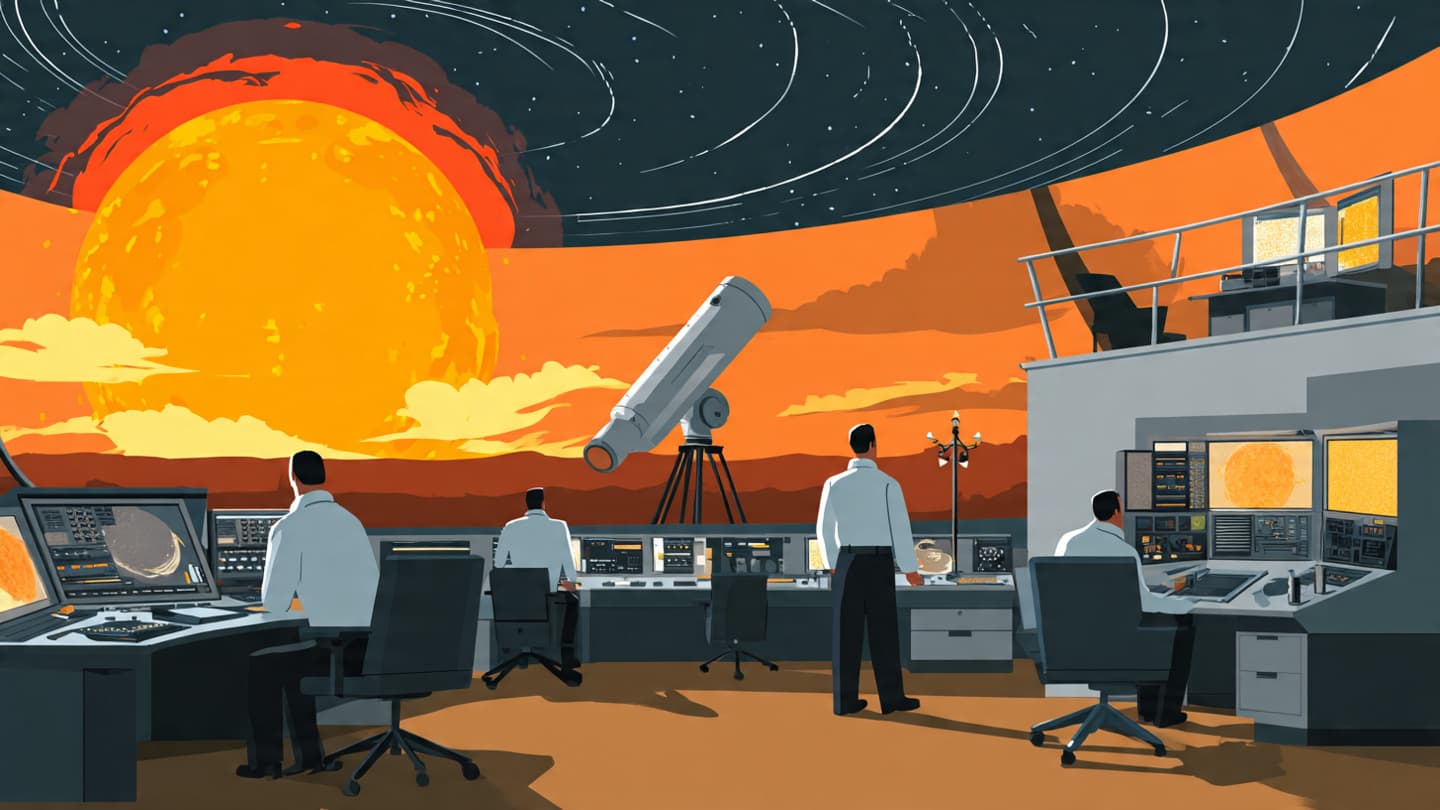
AI Image Disclaimer: Visual content accompanying this article is AI-generated and designed to illustrate scientific concepts rather than depict actual observations.
Sources (Verification Check): NASA, NOAA Space Weather Prediction Center, Reuters, ScienceDaily, European Space Agency
Published by Banx Network. This article is part of the Banx decentralized media programme, powered by the BXE token on the XRP Ledger.