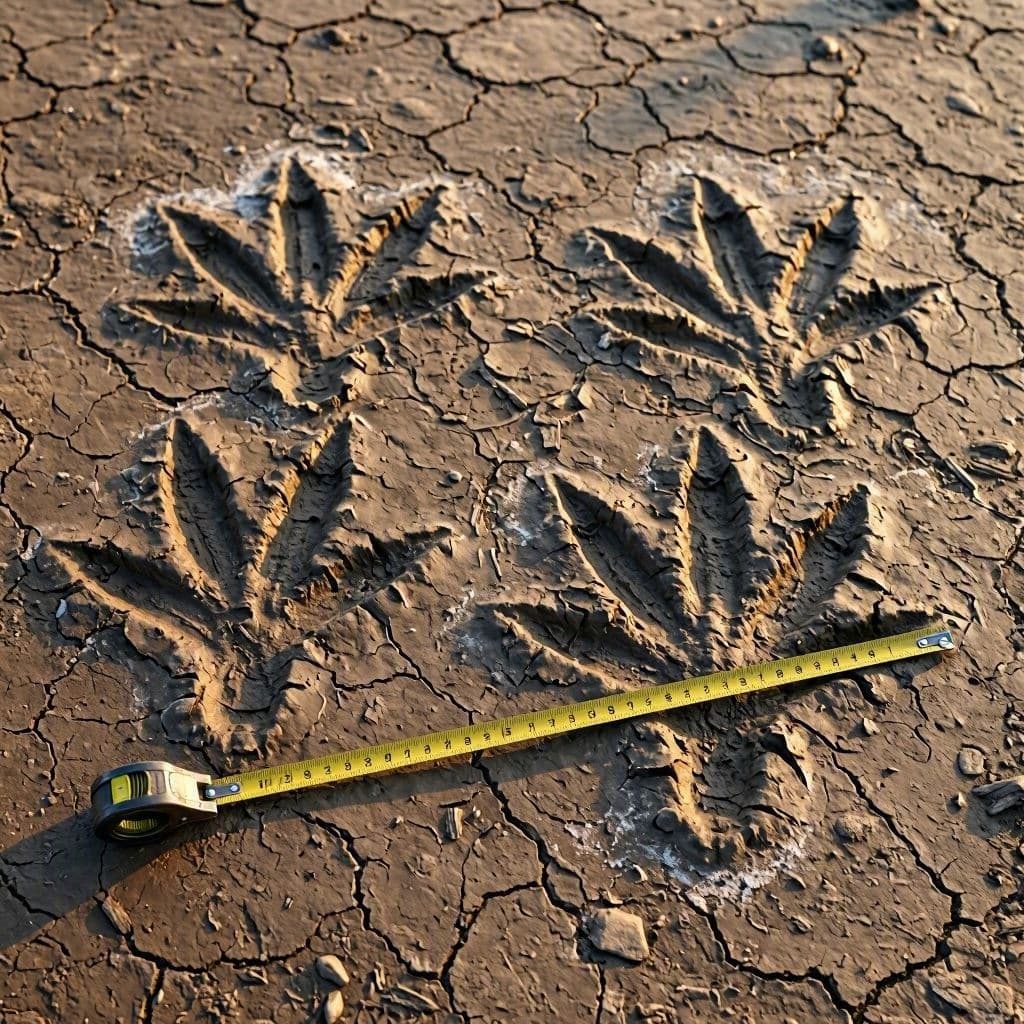
In the badlands of North Dakota, where the earth reveals its ancient secrets layer by layer, a set of footprints has rewritten a small but significant chapter in paleontological history. Discovered in 2025 near Marmarth, four large, three-toed impressions have been identified as the first known trackway of an adult Tyrannosaurus rex. These fossilized steps, preserved for 66.5 million years, offer a rare glimpse into the daily life of the most famous predator in history.
Unlike skeletal remains, which provide static snapshots of anatomy, trackways capture motion and behavior. The spacing of these prints, with a stride length of approximately 13 feet, allowed researchers to calculate the dinosaur’s speed. The analysis suggests the T. rex was moving at a leisurely 3.5 to 4.5 miles per hour, a pace comparable to a brisk human walk. This finding challenges the popular image of the tyrant king as a constant sprinter, suggesting instead that it often moved with deliberate, energy-conserving confidence.
The identification of the tracks as belonging to an adult is crucial. Previous T. rex trackways have been attributed to juveniles or subadults, whose smaller size and different proportions left distinct marks. The sheer scale of these prints, combined with their depth and shape, points to a fully grown individual, likely weighing several tons. This distinction helps fill a gap in our understanding of how these animals moved as they reached their maximum size.
The location of the find, in the Hell Creek Formation, is well-known for its rich fossil record. This area was once a lush floodplain, teeming with life before the mass extinction event that ended the Cretaceous period. The preservation of these tracks suggests they were made in soft mud that quickly hardened, protecting them from erosion and other disturbances until their recent discovery by careful observers.
For paleontologists, this discovery is a treasure trove of biomechanical data. By studying the depth and orientation of the prints, scientists can infer details about the dinosaur’s gait, weight distribution, and even its posture. It provides real-world evidence to test computer models of dinosaur locomotion, bridging the gap between theoretical reconstruction and physical reality.
The human element of the story is also compelling. The fact that these tracks were found by amateurs and then verified by experts highlights the importance of public engagement in science. It serves as a reminder that significant discoveries can happen anywhere, given a keen eye and a passion for the natural world. The collaboration between local enthusiasts and professional researchers ensures that such finds are properly documented and studied.
As the study of these tracks continues, they serve as a tangible connection to the past. Walking in the footsteps of a T. rex, even metaphorically, allows us to imagine the world as it was millions of years ago. It is a humbling experience that underscores the continuity of life on Earth and the enduring fascination we hold for the giants that once ruled it.
AI Image Disclaimer: The images used in this report are AI-generated visuals created to illustrate the prehistoric landscape and fossil discovery.
Sources: Scientific American, National Geographic, University of Kansas
Published by Banx Network. This article is part of the Banx decentralized media programme, powered by the BXE token on the XRP Ledger.