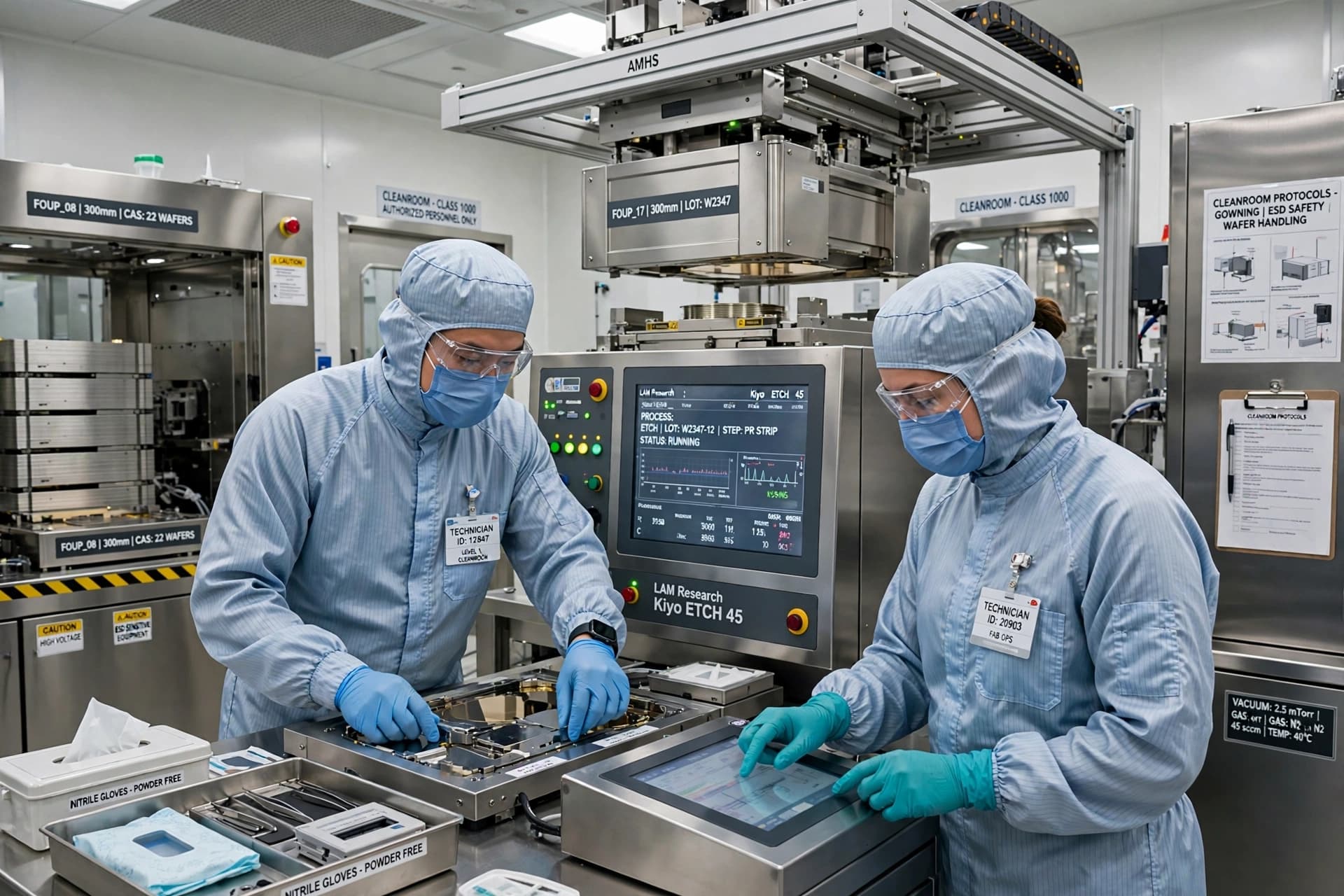
On the eastern side of Singapore, a new semiconductor facility has opened its doors, adding another large piece to the city-state’s manufacturing landscape. VisionPower Semiconductor Manufacturing Company, or VSMC, opened its 300-millimeter wafer fabrication plant in Tampines on September 28, 2026.
The facility represents an investment of about US$7.8 billion and is a joint venture between Taiwan-based Vanguard International Semiconductor, which is backed by TSMC, and Dutch semiconductor company NXP Semiconductors.
The partners are positioning the plant around demand for what the industry increasingly calls “physical AI” — systems in which artificial intelligence operates through vehicles, robots, factories and other physical infrastructure rather than remaining primarily within cloud-based applications.
The factory will support process technologies ranging from 130 nanometers to 40 nanometers. These technologies are used for mixed-signal chips, power management, analogue applications and interposer products, serving markets that include high-performance computing, mobile devices, automobiles, industrial equipment and consumer products.
At full capacity, which is expected by 2029, the facility is projected to produce approximately 44,000 300-millimeter wafers each month. That scale places the plant within a broader semiconductor manufacturing ecosystem that Singapore has been building for decades.
The opening comes as demand for chips continues to broaden beyond traditional personal computers and smartphones. Modern vehicles, industrial machinery and connected infrastructure increasingly depend on semiconductor components for power management, sensing, communications and processing.
The physical-AI theme adds another dimension. As automated machines become more capable of interacting with their surroundings, semiconductor requirements can spread across factories, transport systems, robotics and other equipment. That creates demand not only for the most advanced processors, but also for a wide range of supporting chips.
Singapore has long sought to maintain a significant role in the global semiconductor supply chain. The VSMC facility adds capacity at a time when companies across the industry are paying greater attention to manufacturing resilience and the geographical distribution of production.
The project also illustrates how semiconductor investment is no longer confined to one narrow definition of technology. Behind an AI-enabled vehicle or automated factory are layers of components, from processors to power-management devices, each requiring specialized manufacturing processes.
As the Tampines facility moves toward full production, its importance will ultimately be measured not only by the size of the investment but by how effectively it connects Singapore’s manufacturing base with the next generation of industrial technology. The factory begins its journey at a moment when the boundary between digital intelligence and physical machinery is becoming increasingly difficult to separate.
Image Disclaimer: The illustrations described below are conceptual visualizations created for editorial purposes and are not photographs of the VSMC facility.
Sources: The Business Times; CNA; VSMC; NXP Semiconductors; Vanguard International Semiconductor.
Published by Banx Network. This article is part of the Banx decentralized media programme, powered by the BXE token on the XRP Ledger.