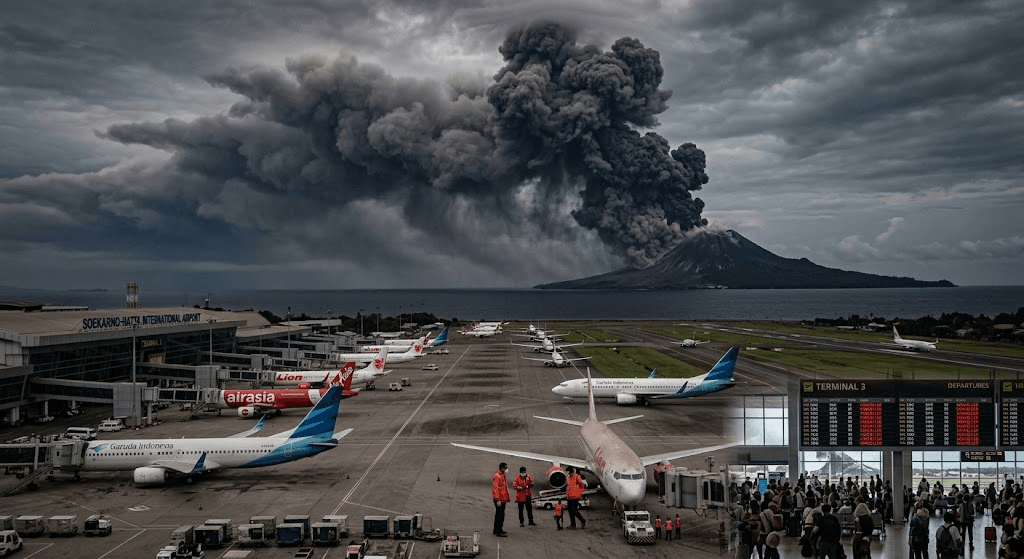
JAKARTA — Mount Anak Krakatau erupted in a dramatic series of explosions, sending massive volcanic ash plumes soaring up to 50,000 feet (15,000 meters) into the sky. The sudden surge in volcanic activity forced authorities to temporarily ground hundreds of flights and temporarily suspend operations at Indonesia’s busiest aviation hub, Soekarno-Hatta International Airport near Jakarta.
The disruption affected at least 209 flights and stranded more than 22,000 passengers. High-altitude ash clouds swept eastward across Java and westward over Sumatra, threatening jet engines and forcing safety officials to issue urgent airspace closures.
As departure boards turned red with cancellation notices, thousands of travelers found themselves stranded at Soekarno-Hatta. The closures caused widespread delays across major international corridors, including routes connecting Jakarta with Singapore, Sydney, Kuala Lumpur, and Doha. Domestic travel was equally hit, with dozens of flights to popular destinations like Bali and North Sulawesi delayed or canceled.
Airport authorities extended initial groundings after routine "paper tests" on the taxiways confirmed the presence of dynamic volcanic ash fall. Air navigation agencies warned that fine volcanic particles can melt inside jet engines, stall turbines, and abrade windshields, making flying through affected corridors extremely hazardous.
The infamous volcano—located in the Sunda Strait between Java and Sumatra—began its latest eruptive phase late Friday before unleashing several powerful explosions overnight into Sunday morning.
Satellites tracked volcanic ash reaching altitudes of up to 50,000 feet toward Sumatra and 20,000 feet toward Java. The resulting fallout blanketed Banten province and nearby coasts, forcing schools to suspend classes and keeping fishermen ashore due to poor visibility and health risks. In response, disaster management officials advised residents to wear face masks and protective goggles to prevent eye and respiratory irritation.
Indonesia sits on the seismically active Pacific "Ring of Fire," home to more than 120 active volcanoes. Mount Anak Krakatau ("Child of Krakatoa") formed inside the caldera left by the catastrophic 1883 eruption of Krakatoa.
While officials confirmed there is no immediate threat of a tsunami, the volcano remains on Alert Level 3 (the second-highest level). Authorities have established a 3-kilometer exclusion zone around the active crater, advising mariners and residents to remain vigilant as aviation experts monitor wind patterns to safely resume air travel.
Published by Banx Network. This article is part of the Banx decentralized media programme, powered by the BXE token on the XRP Ledger.