
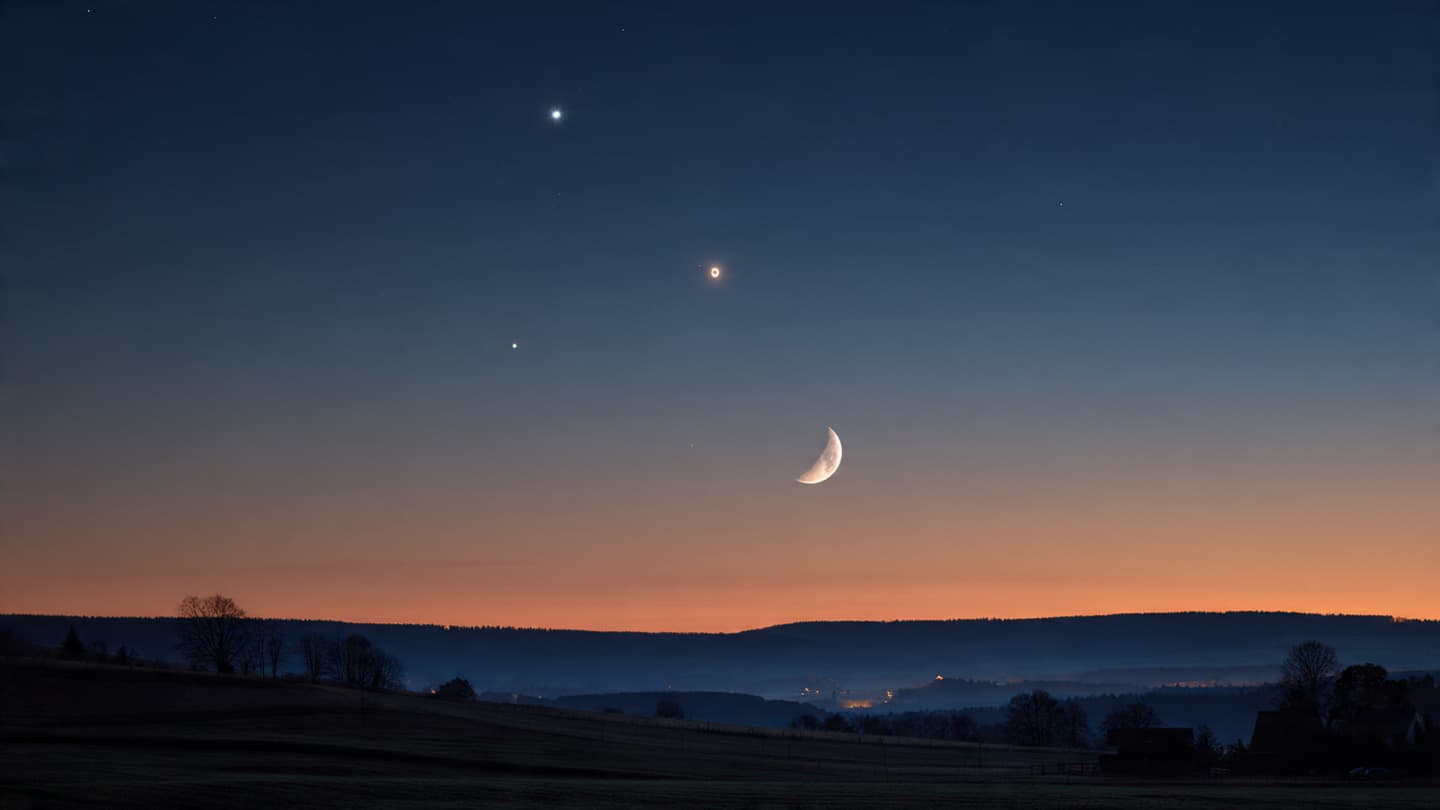
Some astronomical events arrive not with dramatic explosions or distant discoveries, but with quiet beauty visible from an ordinary backyard. Tonight’s alignment of the crescent Moon between Venus and Jupiter offers one of those moments—a brief arrangement in the evening sky that invites people to pause, look upward, and reconnect with the wider universe beyond daily routines.
The event will feature a thin crescent Moon positioned visually between Venus and Jupiter shortly after sunset. Both planets are among the brightest objects visible from Earth, making the alignment relatively easy to observe without specialized equipment under clear skies.
Astronomers explained that the spectacle is an example of apparent alignment rather than close physical proximity in space. Venus, Jupiter, and the Moon remain separated by enormous distances, yet from Earth’s perspective they appear gathered together within the same region of the sky.
Venus is often called the “Evening Star” because of its intense brightness near sunset or sunrise. Jupiter, much farther from the Sun, also shines prominently due to its massive size and reflective cloud layers. The crescent Moon adds a softer visual balance between the two bright planetary points.
Experts recommend observing shortly after sunset with an unobstructed western horizon. Urban observers may still see the alignment despite moderate light pollution, though darker skies generally improve visibility. Binoculars can enhance the experience, especially for viewing the Moon’s illuminated edge and nearby stars.
Astronomy educators noted that visible celestial events often serve as gateways into broader scientific interest. Simple observations of planetary motion, lunar phases, and sky patterns have historically inspired curiosity about navigation, calendars, physics, and humanity’s place within the cosmos.
The alignment also arrives during a period of renewed public enthusiasm for space science. Modern telescopes and spacecraft continue expanding scientific understanding of planets and stars, yet direct naked-eye observation remains one of astronomy’s most accessible experiences.
For many observers, events like this carry emotional meaning beyond technical explanation. A quiet sky shared across cities, villages, deserts, and coastlines can create rare moments of collective attention in an increasingly fast-moving world.
Astronomers encourage skywatchers to check local weather conditions and observe safely after sunset as the crescent Moon, Venus, and Jupiter briefly share the evening horizon.
AI Image Disclaimer: Some visual interpretations connected to this astronomy article were created with AI-generated imaging assistance.
Sources: Sky & Telescope, Space.com, EarthSky, Live Science
Published by Banx Network. This article is part of the Banx decentralized media programme, powered by the BXE token on the XRP Ledger.



