
Key Highlights
- Upbit suffered a $37 million hack on November 27, 2025.
- The breach occurred just one day after a $10.3 billion acquisition deal with Naver Financial.
- Upbit has suspended all deposit and withdrawal services in response to the incident.
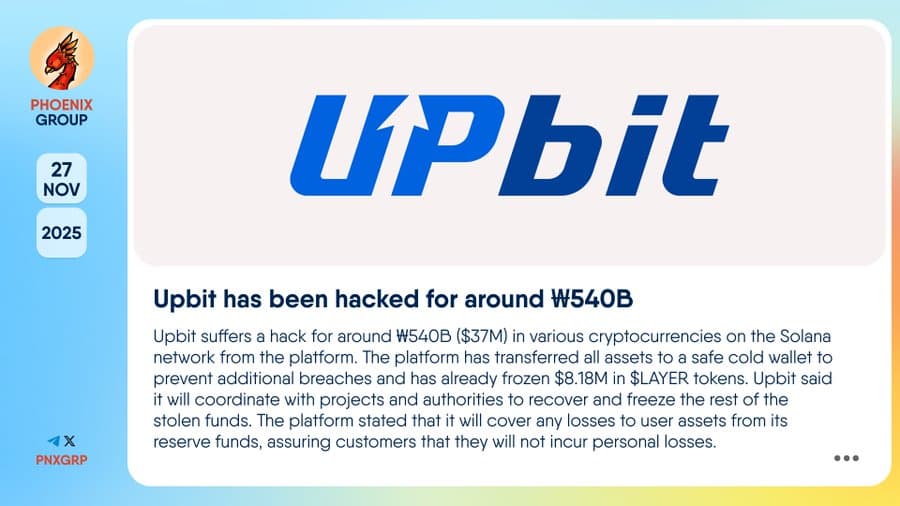
Upbit, South Korea's leading cryptocurrency exchange, has confirmed a significant security breach that resulted in the unauthorized transfer of approximately $37 million (54 billion Korean won) in Solana-network assets. This incident, which took place on November 27, 2025, comes at a particularly sensitive time, occurring just one day after the announcement of a landmark $10.3 billion acquisition deal with Naver Financial, a subsidiary of the South Korean internet giant Naver.
The breach was detected at 4:42 a.m. Korean Standard Time when Upbit's security systems identified abnormal withdrawal activity from the exchange's hot wallet. The stolen assets were traced to a single unidentified external wallet, prompting immediate emergency countermeasures from the exchange.
In response to the suspicious transactions, Upbit took decisive action within minutes. The exchange suspended all deposit and withdrawal services across all networks—not just Solana—and began transferring remaining digital assets into secure cold storage facilities designed to block unauthorized access. Dunamu, Upbit's parent company, initiated on-chain freezing procedures to halt the movement of tokens linked to the breach. These efforts have already proven partially successful, with approximately ₩12 billion (around $8.2 million) worth of LAYER tokens successfully frozen.
Oh Kyung-seok, CEO of Dunamu, issued a statement assuring users that all losses would be fully covered: "To prevent any damage to member assets, the entire amount will be covered by Upbit's holdings." This assurance aims to maintain user trust in the exchange amid growing concerns over its security protocols.
The breach affected a wide range of Solana ecosystem tokens, including both established projects and popular meme coins. The stolen assets included SOL, BONK, JUP (Jupiter), RAY (Raydium), ORCA, RENDER, PYTH (Pyth Network), TRUMP (Official Trump), USDC, MEW (Cat in Dog World), Moodeng, Magic Eden (ME), Pengu, Drift Protocol, Huma Finance, IONET, Sonic, and several others. Security experts have noted that the compromise was isolated to Upbit's hot wallet infrastructure, with cold wallet reserves remaining untouched. The attack appears to have originated from within Upbit's internal systems rather than a vulnerability in the Solana blockchain itself, potentially due to private key exposure, API vulnerabilities, or a compromised signing module.
The timing of this incident carries an eerie significance. Exactly six years ago, on November 27, 2019, Upbit suffered its previous major security breach when approximately 342,000 Ethereum tokens—worth around $50 million at the time—were stolen from the exchange. That 2019 hack was later confirmed by South Korean authorities to have been perpetrated by North Korean hacking groups Lazarus and Andariel, with the stolen ETH now valued at over $1 billion. This new breach marks the most significant security incident at Upbit since that 2019 attack, raising questions about the exchange's security protocols and hot wallet architecture.
The hack lands at a particularly awkward moment for Upbit and its stakeholders. Just one day prior, on November 26, 2025, Naver Financial announced a $10.3 billion all-stock deal to acquire Dunamu, making it one of the largest deals in Asia this year. The acquisition was designed to create a formidable fintech entity in South Korea, combining Naver's AI capabilities and Naver Pay's 34 million users with Dunamu's blockchain expertise and Upbit's dominant market position. The deal was expected to finalize in June 2026.
Upbit commands approximately 70-80% of South Korea's cryptocurrency trading market, making it the country's undisputed leader. In the first half of 2025 alone, Upbit's cumulative transaction volume reached 833 trillion won (approximately $642 billion). Globally, the exchange consistently ranks among the top 4-5 cryptocurrency exchanges by trading volume.
Following the breach, financial regulatory authorities in South Korea have initiated an on-site examination to evaluate the ramifications of the incident. This scrutiny comes at a time when Upbit was already under investigation by the Financial Services Commission for its compliance with local regulations. The outcome of this examination could have significant implications for Upbit's operations and its future in the competitive cryptocurrency market.
Published by Banx Network. This article is part of the Banx decentralized media programme, powered by the BXE token on the XRP Ledger.



