
Key Highlights
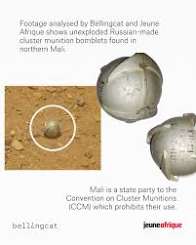
- Discovery:Unexploded Russian-made cluster munitions found in Tadjmart, Mali.
- Investigation:Bellingcat confirmed the presence of ShOAB-0.5 submunitions.
- Legal Implications:Mali's commitment to the Convention on Cluster Munitions questioned.
In a recent investigation, unexploded Russian-made cluster munition bomblets have been discovered in the village of Tadjmart, located in northern Mali. This alarming finding comes despite Mali being a state party to the Convention on Cluster Munitions (CCM), which prohibits the use, production, and transfer of such weapons. The presence of these munitions raises serious ethical and legal questions regarding compliance with international humanitarian law.
Bellingcat's investigation, conducted on May 26, 2026, confirmed the presence of ShOAB-0.5 submunitions in Tadjmart, consistent with damage patterns typically associated with bomblet impacts. Social media footage analyzed from May 17 showed unexploded bomblets near buildings in Tadjmart, approximately 55 kilometers south of Aguelhok. This coincided with airstrikes reported by the Malian Armed Forces (FAMa), suggesting a direct link between military operations and the presence of these dangerous remnants.
The deployment of cluster munitions is particularly concerning due to their indiscriminate nature and the potential for leaving behind lethal remnants long after conflicts have ended. The Africa Corps, a Russian paramilitary group that has replaced the Wagner Group in Mali, is suspected of conducting these airstrikes. This raises significant concerns about potential violations of both international law and Mali's own commitments under the CCM, which prohibits the use of such munitions.
The context of this discovery is further complicated by the intensifying civil war in Mali, with rising violence attributed to Tuareg separatists and Jama’at Nusrat al-Islam wal-Muslimin (JNIM) militants. Local populations now face compounded threats from ongoing conflict and the dangers posed by unexploded ordnance. The humanitarian implications are dire, as civilians are at risk from both active hostilities and the remnants of warfare.
Human rights experts, including Brian Finucane from the International Crisis Group, have emphasized that Mali is bound by the prohibitions of the CCM. This includes not only the prohibition on the use of such munitions but also the obligation to clear remnants from its territory. The situation presents potential implications for international relations, as calls for accountability and compliance with international humanitarian law grow louder.
Efforts are currently underway to verify the extent of cluster munition use in Mali and to raise awareness about the dangers posed by unexploded ordnance. The urgent need for action to safeguard civilian lives in conflict zones has never been more critical, as the international community watches closely and advocates for adherence to humanitarian standards.
Published by Banx Network. This article is part of the Banx decentralized media programme, powered by the BXE token on the XRP Ledger.



