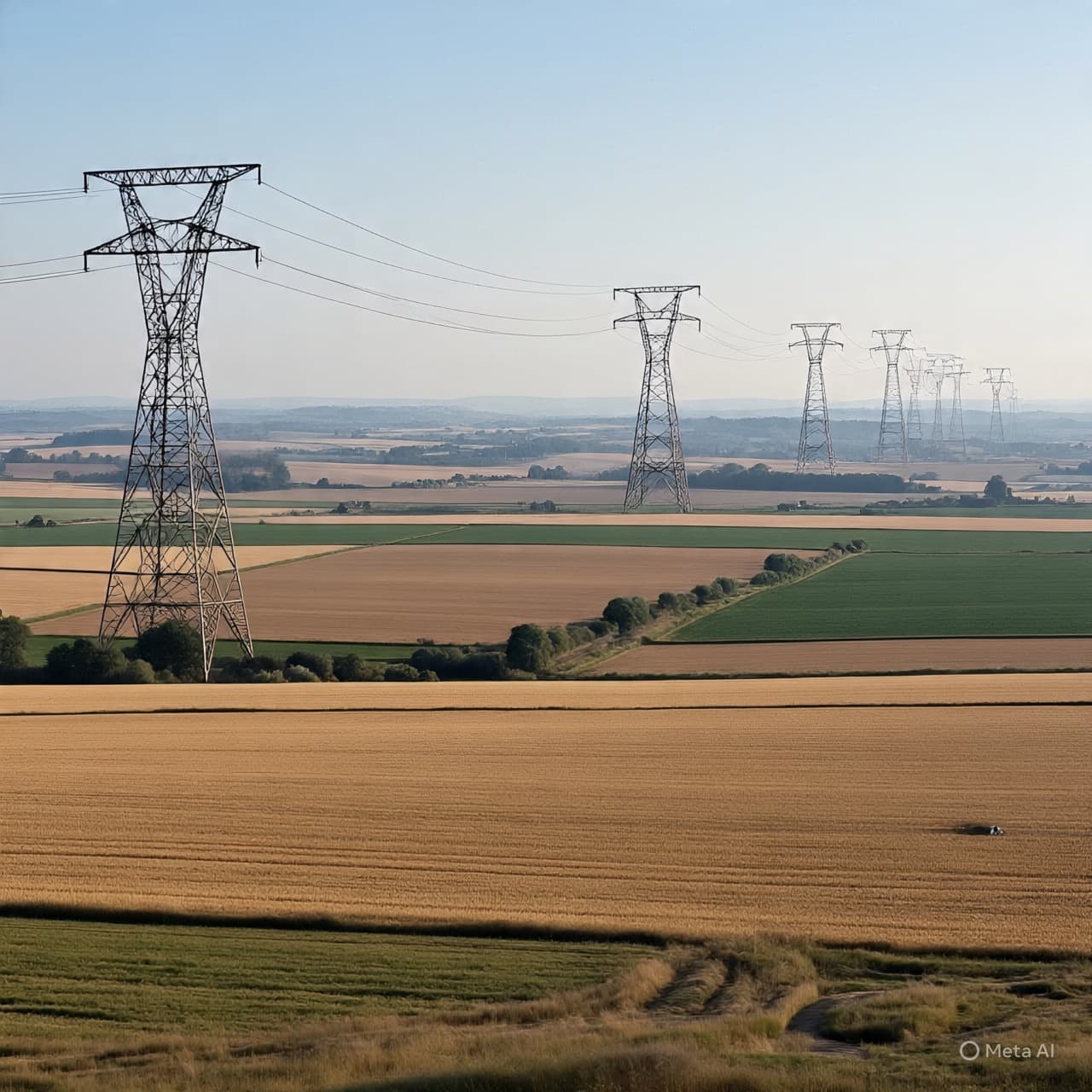
In the soft light of a late winter afternoon, where apple trees once nodded gently over rolling fields, there is now a kind of stillness that feels heavier than silence. The horizon here in Sugarloaf, Pennsylvania, is simple — endless sky meeting timber and grass — and for one family it has been the setting of generations of summers and winters. But in recent months that quiet has become a backdrop for something less ordinary: plans for a towering 500‑kilovolt electric transmission line, its steel towers planned to rise far above those century‑old trees, threading hundreds of miles of countryside with a new kind of presence that feels as stark as a horizon made of wires.
For John Zola, the orchards and meadow were more than property; they were the stage for daily life — a barn where work and family intersect, lawns where grandchildren chased basketballs at dusk, and fields where his children and grandchildren walked without the shadow of some looming structure. Then, in late 2024, a contractor representing the local utility arrived at his door with news that seemed to carry the weight of inevitability. A transmission project intended to bring vast quantities of electrical power across the region would cross his land. The towers, he was told, would be as tall as 240 feet, looming over the places where memories were rooted so easily and so deeply.
These lines are not just about poles or cables, but about the unseen currents that bind our modern world. In recent years the United States has seen a proliferation of proposals for high‑voltage power lines, often stretching across hundreds of miles. Behind this expansion is an ever‑growing demand for electricity — especially to serve enormous data centers run by some of the world’s largest tech companies, whose operations require immense and reliable power. Advances in artificial intelligence, seen by some policymakers as vital to economic and national security, have spurred the design of increasingly large and energy‑hungry facilities, threatening to strain an aging grid and to push utilities toward vast infrastructure projects.
Utility companies — and many energy analysts — argue that these transmission projects are part of preparing the grid for future needs, adding capacity and resilience in a system that saw two decades of relatively flat power demand followed by a rapid upturn. They contend that such lines will not only carry energy to data centers but also bolster the grid against the blackouts that can sweep across regions in extremes of heat or cold. Yet there is a dissonance between the broad, abstract necessity described in planning documents and the lived experience of landowners who see on paper what feels like a permanent alteration of place and landscape.
Opposition has taken shape like scattered seeds across a field: landowners, conservationists, local officials, consumer advocates and even entire states have challenged or questioned the plans. Many raise familiar concerns — that these towering structures intrude on private property, disrupt waterways and ecosystems, decrease property values, and threaten landscapes held dear well before the era of digital demand. In states like Pennsylvania and Texas, coalitions have formed, urging regulators to rethink routes, follow existing corridors, or explore alternatives that might soften the intrusion of power lines across lands where life and memory have long played out.
These debates are not merely technical arguments about volts and gigawatts, but conversations about value and connection: what we are willing to change in the name of progress, and how the costs and benefits are felt in places both near and far. Utilities sometimes offer compensation to landowners, increasing bids in hopes of reaching an agreement, yet for many holdouts no financial figure can match the sense of home and continuity that has defined their property for decades.
As these tensions unfold in small towns and across sprawling landscapes, they reflect a larger narrative about how societies adapt to the demands of technology and the rhythms of modern life. The grid’s expansion, driven in part by the power appetites of AI and data infrastructure, is a reminder that even the most familiar places are woven into networks that stretch far beyond them. In the quiet debates, cautious planning hearings, and slow march of steel and wire, there is a common theme: a negotiation between the forces of change and the rhythms of rooted life.
In straight news terms, the United States is planning a significant expansion of high‑voltage power lines to meet rising electricity demand from large data centers and other energy‑intensive needs. Local opposition has grown in many states — including Pennsylvania and Texas — with concerns over property impacts, environmental effects, and long‑term benefits. Utilities argue that grid reliability and capacity require these projects, while critics seek alternatives, changes in routing, or greater consideration of local interests.
AI Image Disclaimer
Visuals are AI-generated and serve as conceptual representations.
Sources (Media Names Only)
Associated Press ABC News Bucks County Beacon
Published by Banx Network. This article is part of the Banx decentralized media programme, powered by the BXE token on the XRP Ledger.