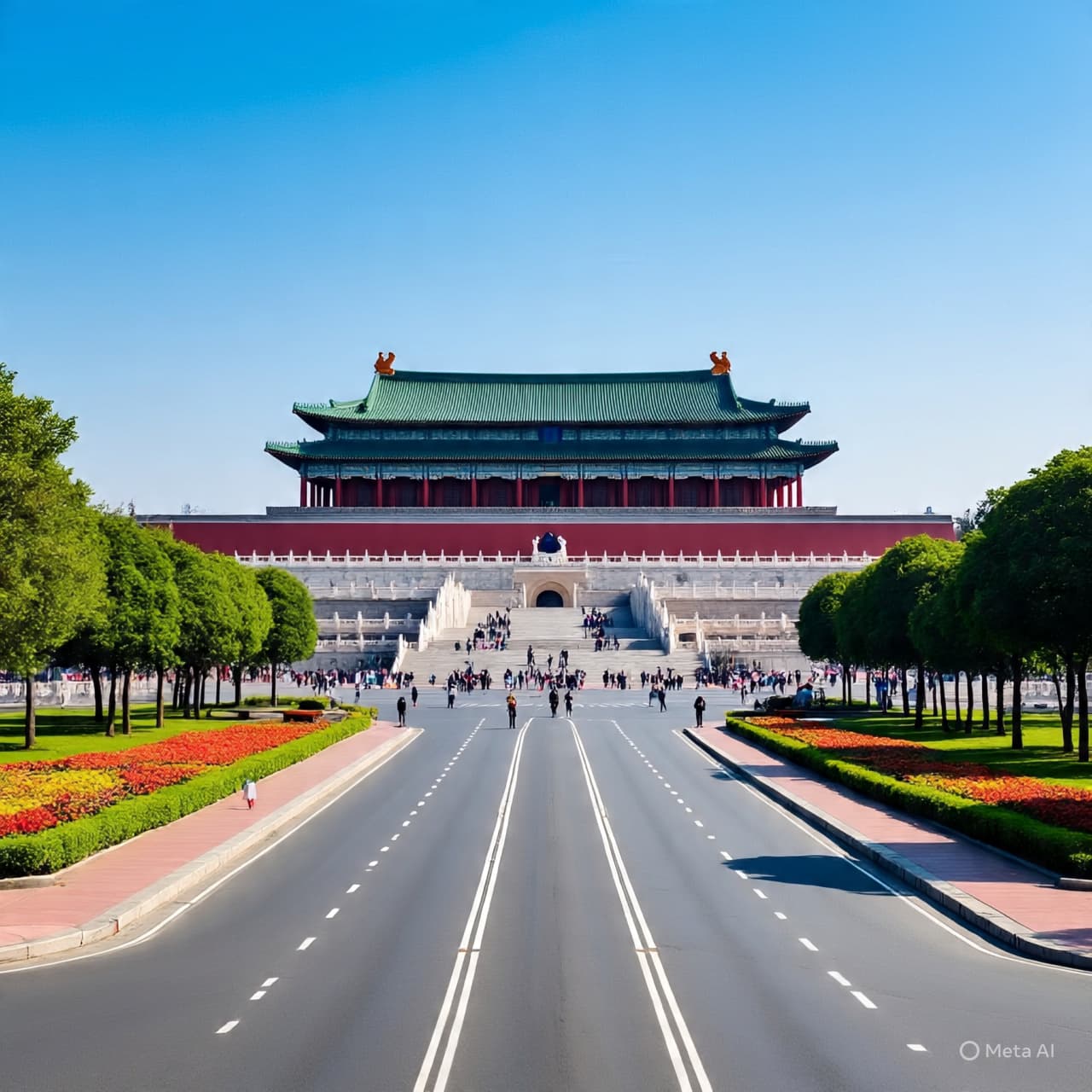
On an autumn morning in Beijing, the air along Chang’an Avenue carries a pale, suspended light. Cyclists move in steady lines past the red walls near Tiananmen, and the city hums with the predictability of routine. In the distance, the Great Hall of the People stands as it has for decades—stone, symmetrical, composed. Within such architecture, power often appears timeless, insulated from the currents that shape ordinary lives.
Yet political time, like any other, moves in cycles. For years, the leadership of China was defined by an unwritten rhythm: succession prepared well in advance, transitions staged with deliberate choreography. After the upheavals of the Mao era, Deng Xiaoping and his contemporaries sought to prevent the concentration of authority in a single figure. Informal term limits and collective leadership norms took root, reinforced over successive administrations.
When Xi Jinping assumed the top posts in 2012, he inherited not only the offices of party general secretary and state president, but also this architecture of predictability. Early in his tenure, he spoke of rejuvenation and reform, of restoring discipline within the party. A sweeping anti-corruption campaign followed, reshaping internal hierarchies and sidelining rivals. Authority gathered, gradually but unmistakably, around the center.
The pivotal moment came in 2018, when China’s National People’s Congress approved constitutional amendments removing the two-term limit on the presidency. Though the presidency itself is only one of several key titles Xi holds, the change carried symbolic weight. It signaled that the succession pattern observed since the 1990s would not necessarily constrain the present era. At the 20th Party Congress in 2022, Xi secured a third term as party leader, further consolidating his position and placing loyalists in top roles.
For some observers, the shift represents a departure from the guardrails designed after Mao—an evolution from collective leadership toward a more centralized model. For others within China’s political discourse, it reflects a need for continuity amid complex challenges: economic transition, technological rivalry, demographic shifts, and heightened geopolitical competition. Official narratives frame stability at the top as essential to navigating an uncertain global environment.
The practical implications ripple through institutions. Succession, once anticipated through carefully managed promotions of younger cadres, now appears less predictable. Analysts note the absence of a clearly designated heir apparent in the current Politburo Standing Committee. The signals that once hinted at future leadership—age norms, portfolio assignments—carry less certainty.
Beyond elite politics, the effects are subtle but tangible. Policy initiatives, from economic restructuring to national security legislation, bear the imprint of centralized direction. Campaigns emphasizing ideological alignment and party discipline underscore a governance style that prizes cohesion. Internationally, counterparts adjust their expectations, recalibrating long-term strategies in light of a leadership horizon no longer bounded by a decade.
In Beijing’s public spaces, however, daily life flows with familiar cadence. Commuters descend into subway stations. Vendors arrange fruit in careful pyramids. Students cross university gates beneath ginkgo trees turning gold. The architecture of succession may have shifted, but the city’s rhythms remain.
History suggests that political systems often oscillate between institutionalization and personalization. China’s post-Mao reforms leaned toward rules and rotation, an attempt to anchor authority in procedure rather than personality. The current era, shaped by Xi’s extended tenure, tilts toward consolidation. Whether this model endures unchanged or adapts once more will depend on forces both visible and unseen within the party’s inner deliberations.
For now, the rules that once guided leadership transitions have been revised, not erased but reinterpreted. The future remains open-ended, stretching beyond timelines that once seemed fixed. In the quiet symmetry of Beijing’s grand halls, power continues its work—measured, deliberate, and increasingly centered on one figure whose tenure has already outlasted the expectations set a generation ago.
As evening settles over the capital, lights bloom along the avenue. The institutions remain; the cadence has shifted. And in that subtle alteration lies the story of how succession, once carefully scripted, became something more fluid—reshaped by the hands of the leader it was meant to constrain.
AI Image Disclaimer Illustrations were created using AI tools and are not real photographs.
Sources Reuters BBC News The New York Times The Economist Council on Foreign Relations
Published by Banx Network. This article is part of the Banx decentralized media programme, powered by the BXE token on the XRP Ledger.