Evening arrives gently across the Karoo. The heat of the day fades from the dry plains, and a quiet stillness settles over the vast interior of South Africa’s Northern Cape. Farmhouses and small towns grow dim as the last light disappears behind distant ridges. Then the sky begins to fill.
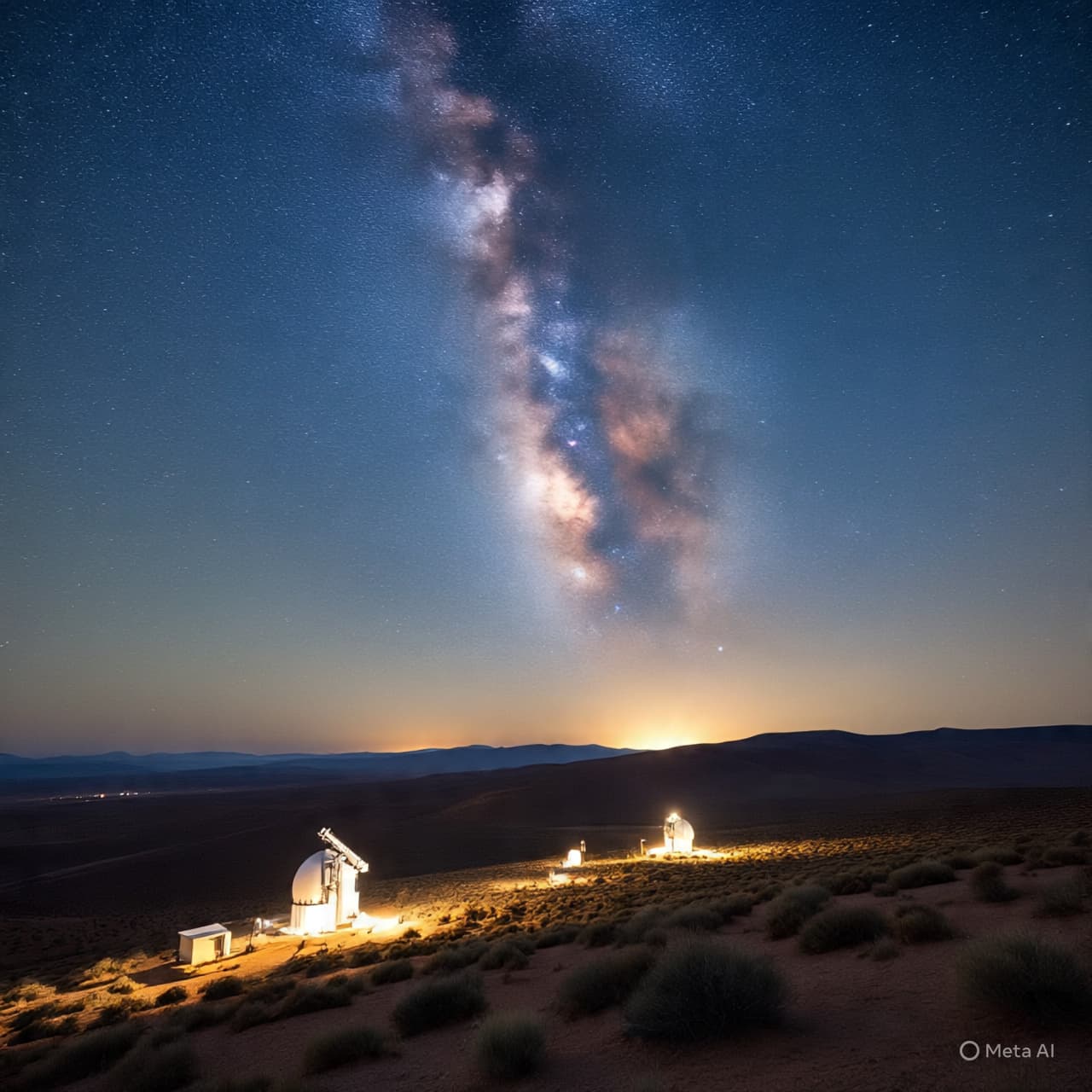
First a handful of stars. Then hundreds. Soon the Milky Way stretches across the darkness like a pale ribbon, bright and intricate against the desert air. In a world where city lights often soften the night, the Karoo remains one of the rare places where the universe still appears in full.
It is here, in this landscape of silence and wide horizons, that astrotourism is beginning to take root.
Travelers have long come to the Karoo for its stark beauty—open plains, scattered settlements, and the sense of distance that defines the region. But in recent years, another attraction has begun drawing visitors after sunset. The same qualities that make the Karoo valuable to astronomers—clear air, minimal light pollution, and remote geography—are turning the region into a destination for those who want to experience the night sky as earlier generations once did.
In towns such as Sutherland, where the Southern African Large Telescope stands on a high plateau, astronomy has already shaped the landscape. The observatory, one of the largest optical telescopes in the world, was built there because the skies remain unusually dark and stable. Farther north, the surrounding Northern Cape hosts radio astronomy infrastructure linked to the Square Kilometre Array project, a global scientific effort designed to explore the deepest signals of the universe.
These facilities have quietly placed the Karoo on the map of international astronomy. Yet outside the research centers, a parallel form of exploration is beginning to grow.
Guesthouses, rural lodges, and small tourism operators are now offering stargazing experiences designed for visitors who arrive with curiosity rather than scientific instruments. Guides lead small groups into the open night, pointing out constellations, planets, and the luminous band of the Milky Way arching across the southern sky. For many travelers—especially those from brightly lit cities—the view can feel unfamiliar, almost startling in its clarity.
The appeal of astrotourism lies partly in that sense of rediscovery. In places where artificial light has not yet overwhelmed the night, the sky becomes a landscape of its own. The Karoo’s dry climate and wide horizons allow celestial objects to appear sharp and steady, making the region especially attractive for amateur astronomers and astrophotographers.
Local communities are beginning to see opportunity in this quiet shift. Training programs and tourism initiatives are encouraging residents to develop guiding services and small businesses linked to night-sky experiences. In towns where economic options have often been limited, the stars themselves are becoming part of a new tourism economy.
At the same time, protecting the darkness of the Karoo has become an increasingly important goal. Efforts to reduce unnecessary lighting help preserve both the natural environment and the scientific value of the region. For astronomers operating sensitive telescopes nearby, even small increases in light pollution can affect observations. For visitors, the absence of artificial glow is precisely what makes the experience memorable.
In this way, astrotourism grows slowly, in rhythm with the landscape itself. It does not rely on large infrastructure or rapid development. Instead, it depends on something more fragile: the continued presence of darkness.
As night deepens across the Karoo, the plains remain still. A telescope may turn quietly toward a distant galaxy. A group of travelers might stand beside a guide, learning the patterns of the southern constellations. Above them, the sky continues its silent motion, unchanged by the small gatherings beneath it.
And so the Karoo, long defined by its emptiness and distance, is beginning to welcome a different kind of traveler—one who comes not only to see the land, but to look upward, into the deep and ancient brightness of the universe.
Published by Banx Network. This article is part of the Banx decentralized media programme, powered by the BXE token on the XRP Ledger.