There are places in the world where the wind moves through grass, and time seems to soften against the hills — places that once teemed with life now only speak in whispers of stone and shadow. In one such landscape, the echoes of ancient existence have been coaxed into sight, not by spade and brush, but by a beam of light powerful enough to pierce the veil of deep time.
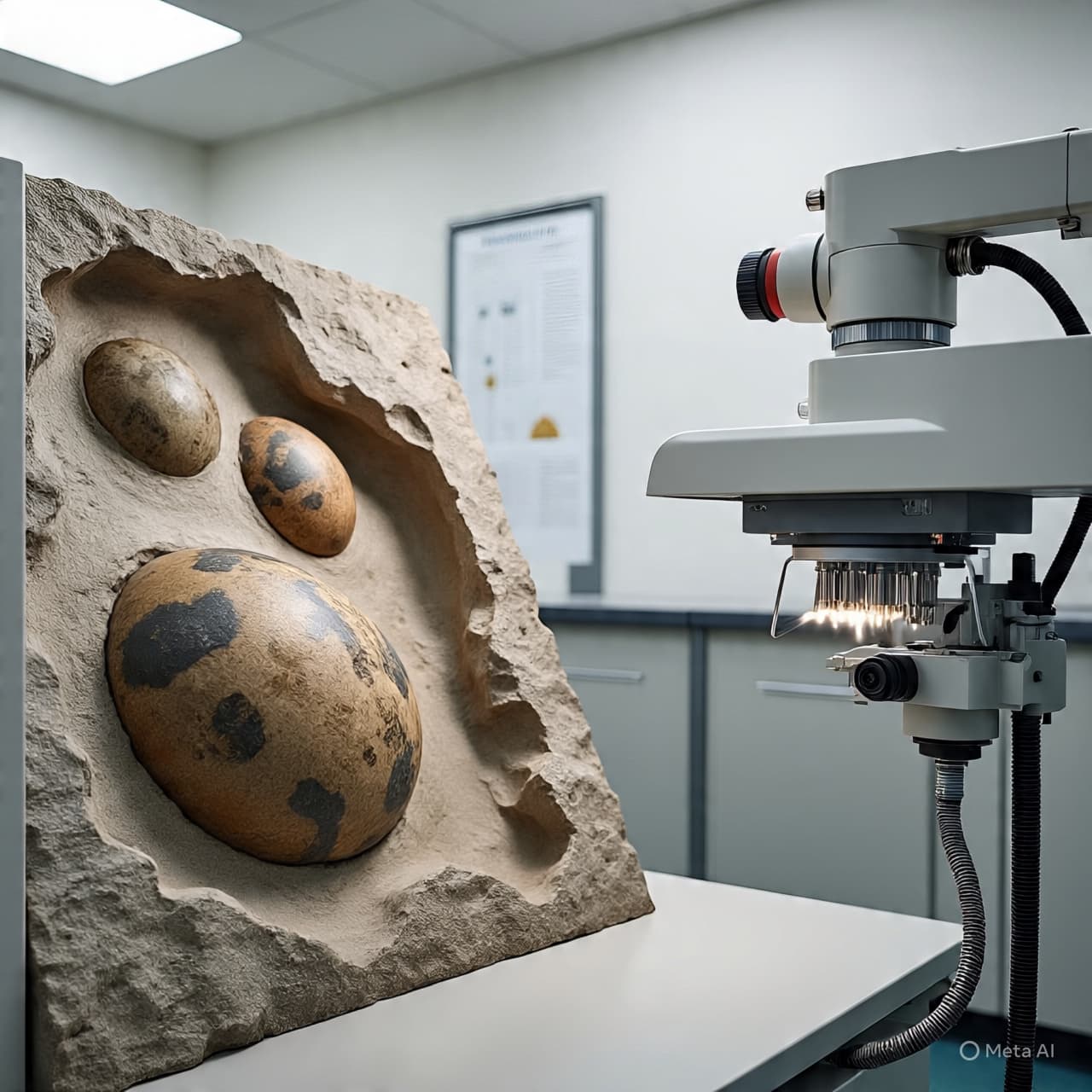
For decades, a clutch of fossilized dinosaur eggs lay silent in museum storage, relics of a moment nearly 200 million years past, when early ancestors of the great reptiles stirred within their shells. The eggs were discovered in the fertile rocks of South Africa’s Golden Gate Highlands, nestled together in a nest that once cradled young Massospondylus carinatus, long bipedal herbivores that roamed near the dawn of the Jurassic. Yet, for all their promise, the fragile embryos within resisted study, so slight and delicate that conventional methods could scarcely render them without risk of harm.
With the arrival of imaging technology of a different order, however, these ancient chambers of life have yielded their secrets. In a scientific facility where electrons hurtle close to the speed of light, a synchrotron accelerator bathes these fossils in intensely bright X‑rays, illuminating the difference between mineral and bone with a clarity once unimaginable. The resulting images — painstakingly reconstructed over years of computational effort — reveal the preserved skulls of unborn dinosaurs with astonishing resolution. In this interplay of light and matter, individual bone cells become discernible, like footprints of life pressed against deep time.
Within the intricate forms of these tiny skulls lies a narrative of development and adaptation that bridges ages. Remarkably, each embryo appears to possess not one but two distinct sets of teeth: one, composed of tiny, triangular shapes likely shed before hatching, and another resembling the more robust dentition of an adult dinosaur. The complexity embedded in such minute structures speaks to a developmental system that was fully in motion long before the eggshells finally closed upon them.
Beyond the teeth, the broader skeletal patterns reflect echoes of reptilian and avian relatives alike. Limbs and vertebrae suggest that the hatchlings would soon walk upright on two legs, hinting at a continuity of form that binds these long‑gone creatures to the living world in unexpected ways. In the stillness of their stone encasement, the embryos reveal not only the mechanics of growth but the persistence of certain biological motifs across the vast expanse of evolutionary time.
The process itself — moving the fragile fossils to a powerful accelerator, bathing them in light, and retrieving data that would have been lost to time — feels like a mediation between past and present. In the quiet hum of machines and the careful attention of researchers, there is a sense that we are not simply observing but participating in a dialogue with history. Through these ancient embryos, we glimpse the earliest rhythms of life, before feathers stirred, before vast ecosystems rose and fell, before the last of their kind slipped into extinction.
In straight scientific language, researchers have used synchrotron radiation at a large particle accelerator facility to scan fossilized dinosaur eggs from a cluster found in South Africa. These scans produced exceptionally detailed images of the embryos of Massospondylus carinatus, including skull structures and distinct dental formations, shedding light on embryonic development and skeletal features of early Jurassic dinosaurs. The imaging revealed internal details that traditional techniques could not, offering new insights into how these ancient creatures developed before hatching.
AI Image Disclaimer
Visuals are AI‑generated and serve as conceptual representations.
Sources (Media Names Only)
Daily Galaxy All That’s Interesting Science News Smithsonian Magazine National Geographic
Published by Banx Network. This article is part of the Banx decentralized media programme, powered by the BXE token on the XRP Ledger.