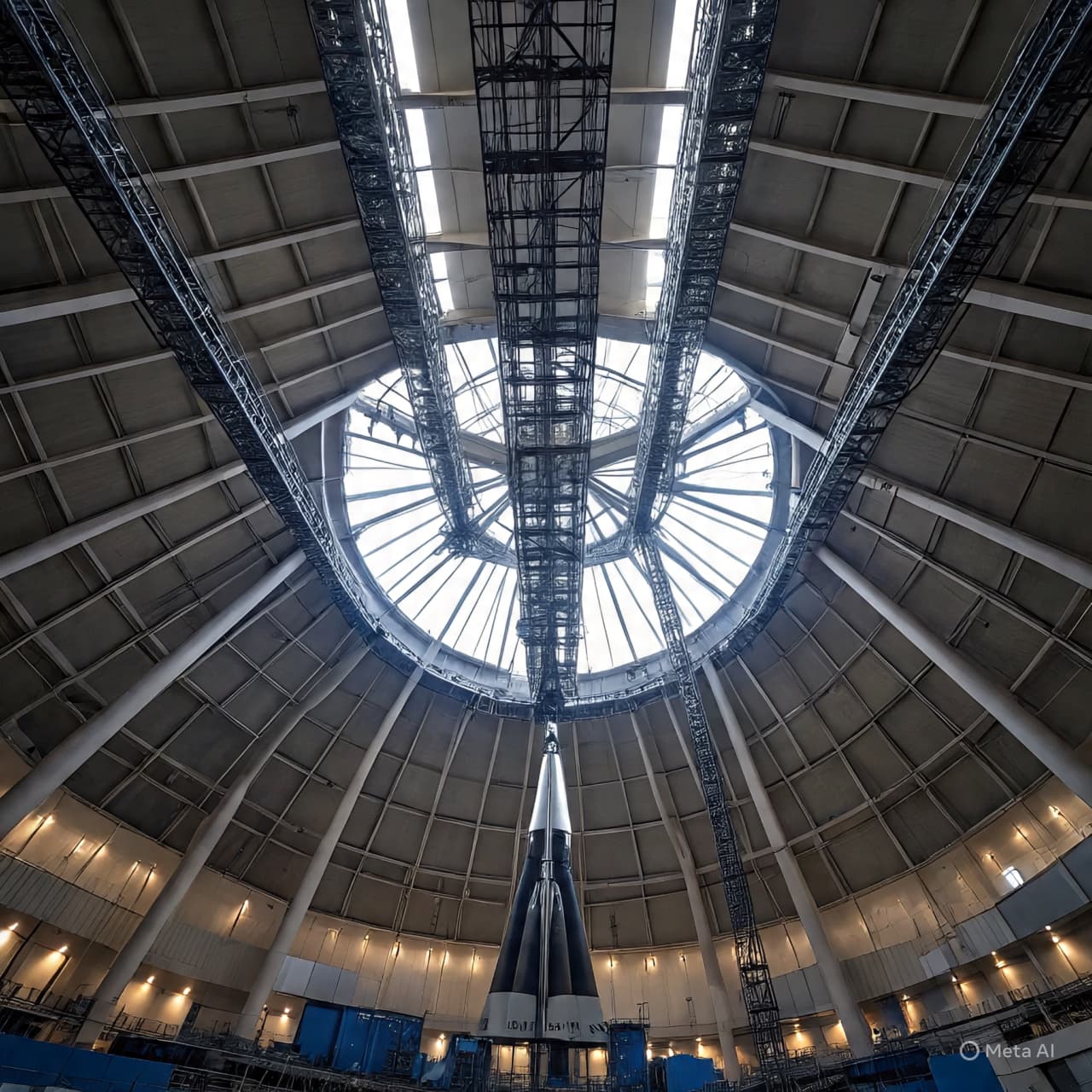
Inside the vast interior of the Vehicle Assembly Building at Kennedy Space Center, scale becomes something almost abstract. The doors alone rise like cliffs of steel, and the air carries the quiet resonance of machinery at work. Suspended cranes move with patient precision overhead, and below them, technicians gather around a vehicle that represents both inheritance and ambition.
This week, teams began repair work on hardware assigned to the Artemis II mission — NASA’s first planned crewed flight around the Moon in more than half a century. The activity inside the cavernous building marks another measured step in a program designed to return astronauts to deep space, building on the uncrewed Artemis I mission that successfully circled the Moon in 2022.
Artemis II will send four astronauts on a roughly ten-day journey, testing the Space Launch System rocket and Orion spacecraft in crewed conditions for the first time. The repairs underway involve components identified during inspections and integration checks, part of a process NASA describes as routine refinement in complex launch systems. Engineers have emphasized that the work reflects quality assurance rather than structural failure, with teams addressing hardware adjustments to ensure mission readiness.
The Vehicle Assembly Building, originally constructed during the Apollo era, has become a bridge between generations of exploration. Once home to Saturn V rockets, it now shelters the towering Space Launch System — a modern heavy-lift rocket intended to carry astronauts beyond low Earth orbit. Its high bays allow technicians to stack and service rocket stages in vertical configuration, a choreography of engineering that demands both scale and precision.
Artemis II carries symbolic weight as well as technical significance. It is designed to validate life-support systems, navigation, and performance under the stresses of deep-space travel. The crew will travel thousands of miles beyond the Moon before returning to Earth, tracing a path reminiscent of Apollo 8 while incorporating contemporary spacecraft systems and digital controls.
NASA officials have reiterated that schedule adjustments remain possible as repairs proceed. Human spaceflight programs historically accommodate inspection findings, particularly in early missions of a new system. The emphasis, agency leaders note, is on safety margins and certification standards appropriate for crewed exploration.
Beyond the hardware itself lies a broader architecture. Artemis is intended as the foundation for sustained lunar exploration, including future landings near the Moon’s south pole and the eventual development of a lunar-orbiting Gateway station. International partners, including the European Space Agency and the Canadian Space Agency, contribute components and astronaut assignments, reflecting the program’s collaborative framework.
In the Vehicle Assembly Building, however, such global ambitions narrow into immediate tasks: fastening connectors, verifying insulation, reviewing diagnostic data. Technicians work within strict procedural protocols, each adjustment documented and cross-checked. The pace is deliberate, not hurried.
The repair phase underscores a reality of modern exploration — that progress often unfolds through refinement rather than spectacle. Before engines ignite and cameras capture the ascent, there are weeks of inspection and recalibration in spaces largely unseen by the public.
As teams continue their work beneath the building’s towering ceiling, Artemis II remains both imminent and patient. The rocket stands as a vertical expression of intent, but its readiness depends on horizontal layers of detail, each bolt and circuit aligned with expectation.
When the mission eventually leaves Earth, it will do so not as a single dramatic moment, but as the culmination of thousands of careful decisions made in places like this. For now, inside the vast assembly hall, exploration advances quietly — through repair, review, and preparation — toward a return to the Moon.
Published by Banx Network. This article is part of the Banx decentralized media programme, powered by the BXE token on the XRP Ledger.