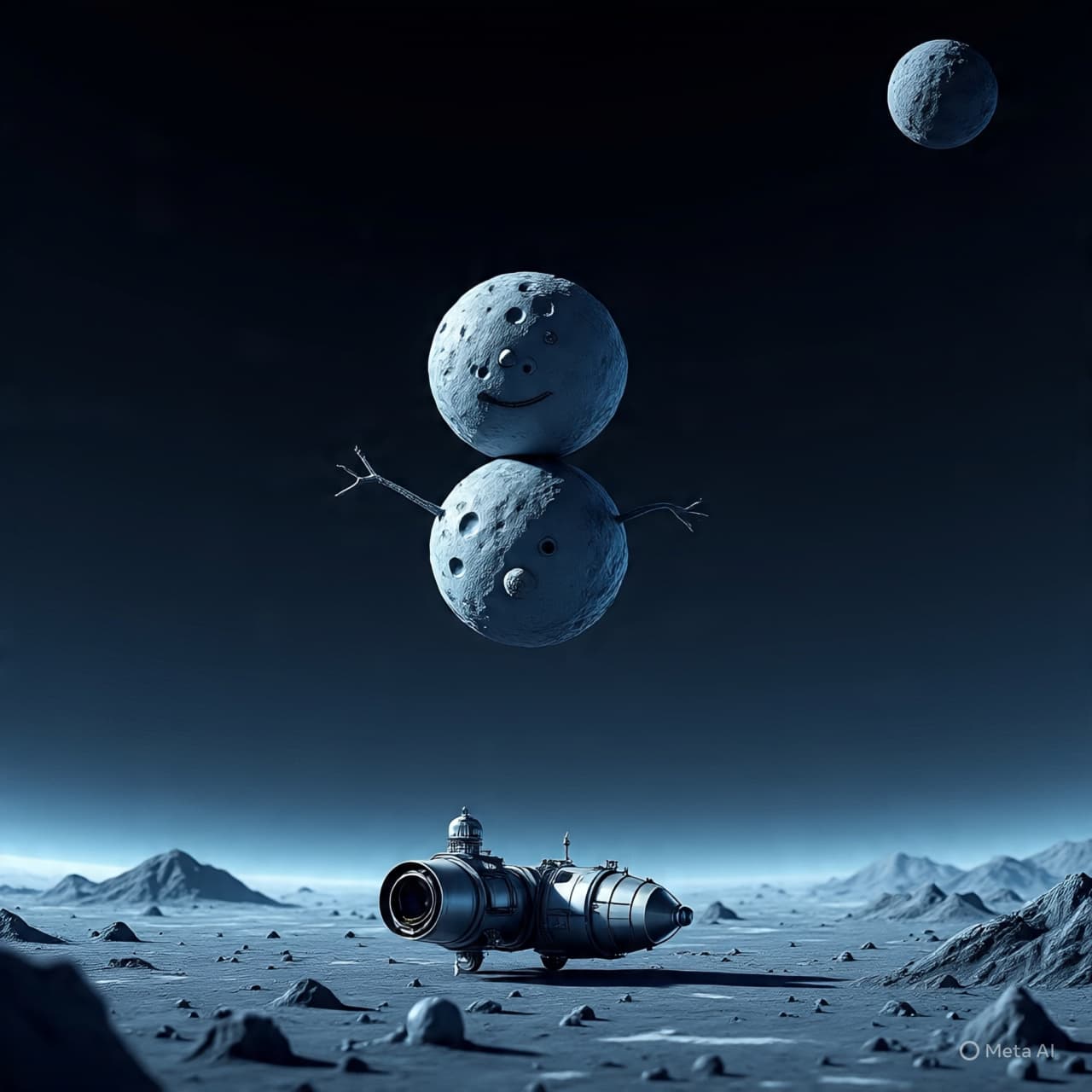
In the vast stillness of the solar system, shapes emerge that seem almost playful, like echoes of childhood winters caught in celestial drift. Astronomers and space enthusiasts alike have peered through telescopes and spacecraft cameras, only to pause at the sight of rocky bodies and icy cores joined together in gentle confluence, their forms resembling snowmen floating silently against the backdrop of eternal night.
These curious shapes are not the product of whimsy but of slow, patient cosmic motion. Comets, with their icy nuclei and rocky appendages, experience forces both subtle and relentless: the gentle tug of gravity from nearby planets, the slow sculpting by solar radiation, and the occasional collision with other small bodies in the belt of the solar system. Over millions of years, these influences can merge separate lobes into a single object, joined in a manner that to human eyes evokes a snowman’s stacked spheres.
The pattern is striking because it reflects the universe’s quiet tendency toward equilibrium and accretion. Matter in space clumps and aggregates where conditions allow, forming contact binaries and double-lobed structures, each unique yet resonating with familiar forms. Images of 67P/Churyumov–Gerasimenko, for instance, captured by the Rosetta spacecraft, reveal an elongated body with two distinct lobes—a cosmic nod to the simple joys of snow stacking on Earth, yet shaped by forces that are anything but gentle in their totality.
Observing these forms invites reflection on scale and perspective. From afar, the snowman resemblance is delightful; up close, the texture is harsh, etched with craters and lines formed by eons of sublimation and dust accumulation. Yet even in the rawness of these celestial bodies, there is a narrative: a slow-motion story of formation, erosion, and survival in a realm where time is measured not in seasons but in millions of years, and where shape itself becomes a testament to quiet forces at work.
Space, often imagined as empty and indifferent, reveals in these forms a surprising intimacy. Ice and rock coalesce, gravity and motion negotiate, and the result is a geometry both alien and strangely familiar. The snowmen of the cosmos, silent and serene, invite us to consider not only the mechanics of celestial bodies but the poetry of natural processes, the quiet artistry hidden in the trajectories of comets and asteroids, and the enduring resonance of shapes that speak across the gulf between planets and human imagination.
AI Image Disclaimer
Visuals are AI-generated and serve as conceptual representations.
Sources (Media Names Only)
NASA ESA (European Space Agency) Scientific American Space.com The Planetary Society
Published by Banx Network. This article is part of the Banx decentralized media programme, powered by the BXE token on the XRP Ledger.