
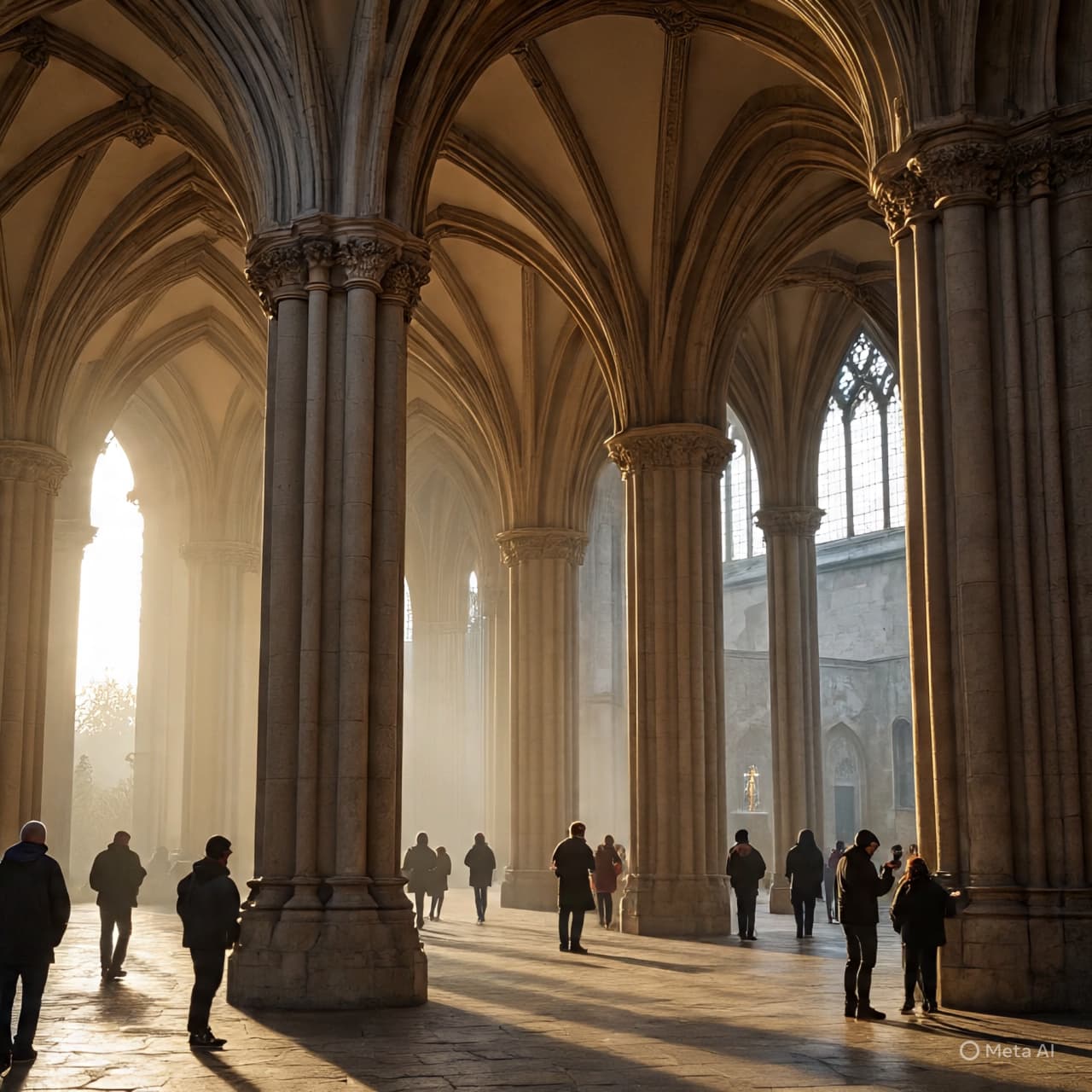
There are mornings in England when the wind threads through ancient stone and whispers beneath cathedral arches even before the bells begin. At Canterbury, that breath of air — cool, sudden, and spirited — wove itself through the limestone shadows on a day marked by tradition and ceremony. Crowds gathered in reverent hush, layers of cloth and texture becoming part of the cathedral’s living tapestry, and for a moment, the breeze seemed to play among them as though curious about every hat and hem.
On this day, Kate, Princess of Wales, attended the installation of Dame Sarah Mullally as the 106th Archbishop of Canterbury, a service held in the venerable nave of Canterbury Cathedral carrying centuries of faith and ceremony. The Princess arrived radiant in a fitted gray coatdress in Prince of Wales check, a classic pattern that quietly honored her husband’s title and royal heritage. At her side, Prince William shared in the solemnity of the occasion, the two figures moving gently through the aisles of history and lineage. Among the crowd, a playful gust of wind caught at the wide brim of Kate’s houndstooth straw hat, prompting her to steady it with graceful, assured hands — a fleeting moment of levity beneath vaulted ceilings, shared with onlookers who laughed softly at her deft poise. It was a gentle reminder that amid formality there is room for the soft humor life carries in its folds.
The installation itself was historic: Archbishop Mullally became the first woman to hold that highest ecclesiastical office in the Church of England’s 1,400‑year tradition, and dignitaries from Britain and abroad filled the ancient cathedral with a quiet, expectant murmur. For many, the service was both a testament to endurance and a subtle turning of a page — a moment where past and contemporary heralds met beneath banners and carved stone.
In the soft light pouring through the great west window, the ceremony embodied layers of continuity: a lineage of faith, the weight of tradition, and the poised presence of the Princess of Wales, who stands today as both a representative of that heritage and a bearer of her own quiet narrative. Her coat’s fabric — a nod to the “Prince of Wales” pattern — spoke of connection and continuity, while the hat she steadied in the wind spoke of immediacy and the small acts that bring grace to public life.
Outside the cathedral walls, Canterbury’s aged streets carried the day’s softer hum: visitors pausing to take in the façade of the cathedral, bicycles resting against low stone walls, and leaves trembling as the breeze passed through the town’s lanes. Here, in the subtle exchange between wind and architecture, between tradition and personal presence, there was a quiet testament to life’s layered pulse — each moment woven into the next.
The Princess’s lighthearted encounter with the wind resonated not only for its charm but for the gentle humility it revealed: even in great halls and solemn rites, there is room for laughter, for the unexpected, and for the rhythms of daily life to echo through the grandest of stages. It was a shared breath among many, a fleeting moment uniting history, weather, and the ordinariness of human experience. And as afternoon mellowed into a gentle twilight over Canterbury’s ancient rooftops, the echoes of that day remained both in memory and in the soft rustle of wind through the cathedral’s stone.
AI image disclaimer Visuals are AI‑generated and serve as conceptual representations.
Sources People, InStyle, The Guardian.
Published by Banx Network. This article is part of the Banx decentralized media programme, powered by the BXE token on the XRP Ledger.


.jpg&w=3840&q=75 "Blake Lively Awarded $400,000 in Legal Fees After Justin Baldoni Lawsuit Dismissed")