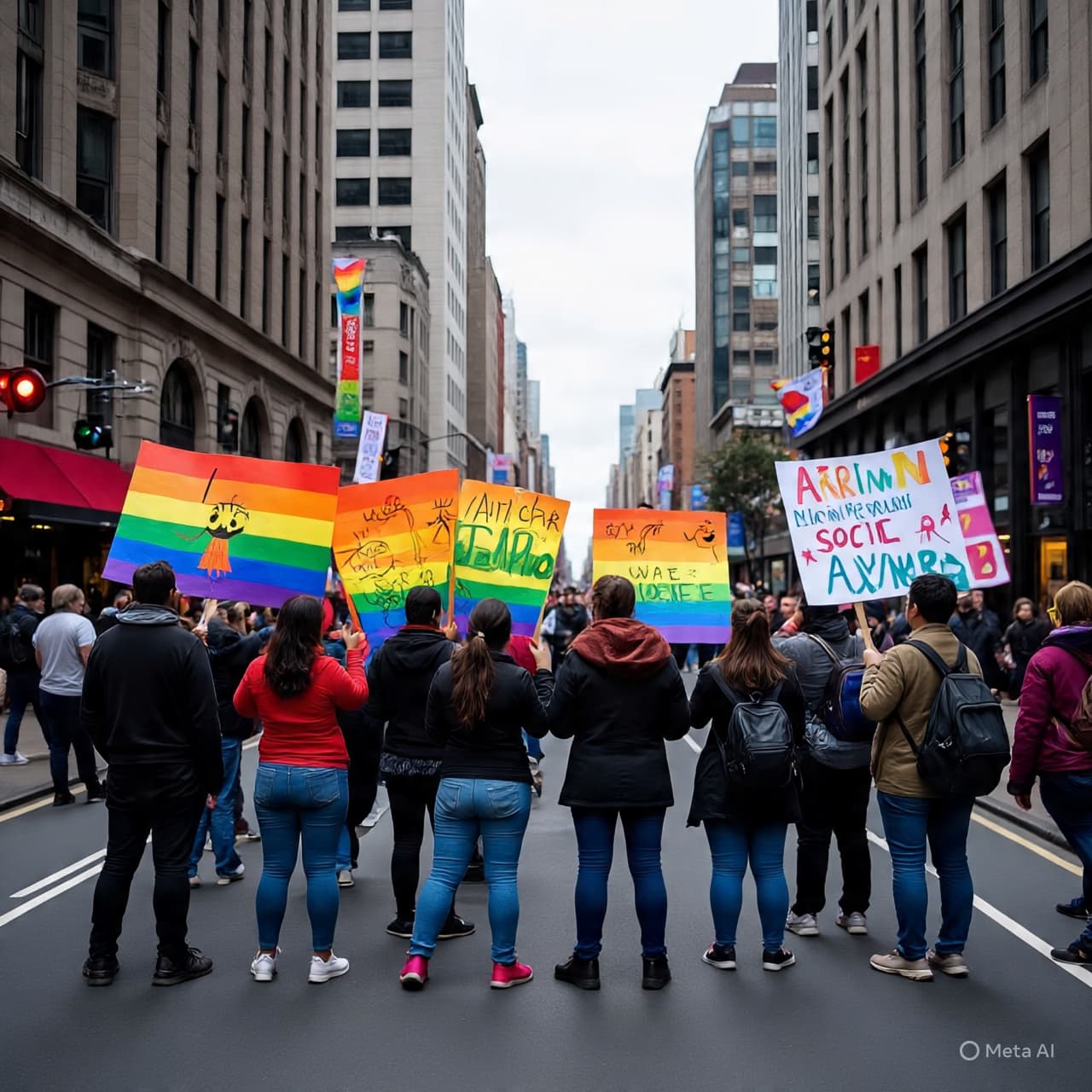
Along Oxford Street, color has long been a form of declaration. Each year, when the Sydney Gay and Lesbian Mardi Gras turns night into spectacle, the parade becomes more than procession — it becomes argument, memory, celebration, and dissent braided together under light.
This year, one of those threads has been pulled aside.
The activist collective Pride in Protest has been banned from participating in the upcoming Mardi Gras parade following controversy over social media posts. Organizers confirmed the decision after reviewing content they said breached participation guidelines and community standards tied to the event’s values and safety expectations.
Mardi Gras officials stated that groups marching in the parade must adhere to codes of conduct designed to ensure the event remains inclusive and secure. While they did not detail every element of the posts in question, they said the material conflicted with established rules governing behavior and representation within the festival. Participation in the parade requires agreement to these guidelines, which organizers describe as foundational to the event’s operation.
Pride in Protest, known for its advocacy on issues including policing, corporate sponsorship, and the political direction of Pride celebrations, has previously taken positions critical of Mardi Gras leadership and institutional involvement. The group has argued that Pride events should maintain a more explicitly activist orientation, resisting what it sees as commercial or state-aligned influences.
The ban has stirred debate within segments of Sydney’s LGBTQ+ community. Some see the decision as necessary stewardship of a major public event that draws hundreds of thousands of attendees and global attention. Others view it as a narrowing of space within a movement historically shaped by protest and confrontation.
Mardi Gras began in 1978 as a demonstration that ended in arrests and clashes with police, an origin story that still informs the symbolism of the parade. Over decades, it has grown into one of the world’s most recognized Pride celebrations, blending activism with performance, politics with pageantry.
In that evolution lies a recurring tension: who defines Pride, and how wide the circle should stretch. For organizers, the task involves risk management, sponsorship agreements, public safety, and legal compliance. For activist groups, the language of Pride remains rooted in resistance and structural critique.
As preparations continue and floats take shape in warehouses and studios, the absence of one group becomes part of the larger narrative — not visible in costume or choreography, but present in conversation. The parade will move forward, as it does each year, carried by music and memory. Yet the debate unfolding around it suggests that even in celebration, questions of belonging and boundaries persist.
In cities, as in movements, inclusion is not a fixed state but a negotiation. Under the rainbow lights of Oxford Street, that negotiation continues — sometimes in harmony, sometimes in disagreement, always in public view.
AI Image Disclaimer
Illustrations were generated using AI tools and are for representational purposes only.
Sources
Sydney Gay and Lesbian Mardi Gras Pride in Protest ABC News Australia The Guardian Australia
Published by Banx Network. This article is part of the Banx decentralized media programme, powered by the BXE token on the XRP Ledger.