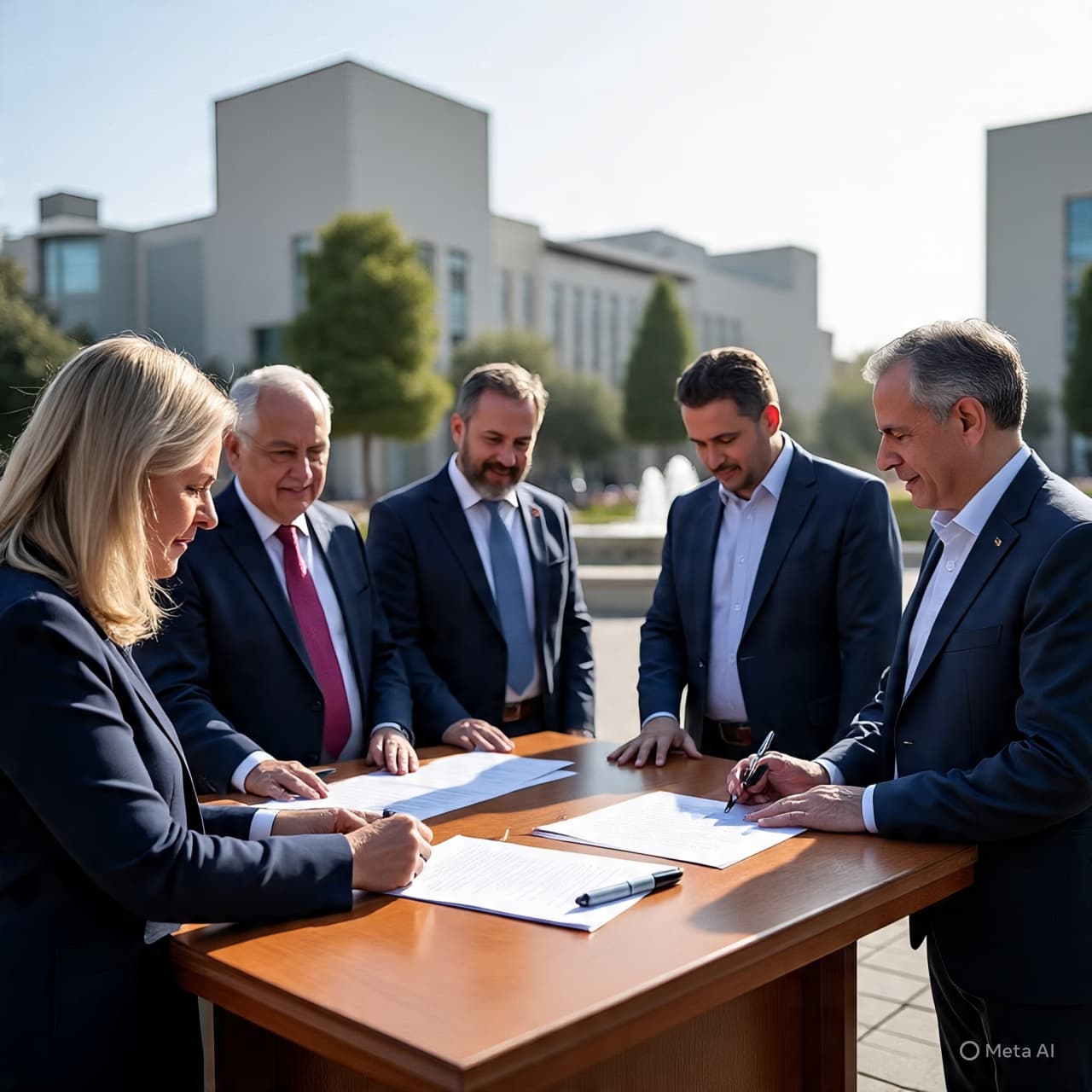
Just before dawn in Rabat, when the sky softens from indigo to a gentle blue, the city’s quiet rhythms carry a whisper of change. Along the boulevards bordered by palms and flowering oleanders, there’s a sense of anticipation — not in the abrupt flash of disruption, but in the slow gathering of promise that comes with every new day. It is in this muted morning light that a group of officials and business leaders gathered recently in Parc Technopolis, their shadows long on the plaza stones, to sign an accord meant to shape the contours of tomorrow.
At the heart of that gathering was a pact between Moroccan ministries and the global insurance and technology group AXA, one that aims to strengthen the country’s competencies in data, technology, artificial intelligence, cyber security and more. Three arms of the Moroccan government — the Ministry of Industry and Commerce, the Ministry of Higher Education, Scientific Research and Innovation, and the Ministry of Digital Transition and Administration Reform — came together with AXA’s leadership to set in motion a framework that stretches beyond the ceremony itself. This partnership seeks to weave together public institutions, universities, technical schools and the private sector in an effort to cultivate a silent but deep well of talent ready for the challenges of a rapidly evolving world.
In the soft exchange of greetings and speeches that morning, the ministers spoke of an era where technology and human capital must meet in harmony. They spoke of AI Made in Morocco, an initiative aimed at building not just proficiency, but sovereign capability — where Moroccan professionals might one day chip away at the code of future innovations, not merely use tools crafted elsewhere. Around them stood representatives from public schools and universities — from central engineering institutions in Casablanca to craft and business academies — each a node in the wider network that this agreement hopes to nurture.
In lecture halls across the kingdom, teachers and students now contemplate fields once abstract and distant: cloud computing, cybersecurity, DevOps, data analytics, testing, artificial intelligence. These aren’t merely technical phrases; they are the language of contemporary possibility, a lexicon of careers that may anchor futures in workplaces both local and global. Under the pact, curricula will be co‑designed with industry input, internships and applied research will extend into real workplaces, and continuous professional training will help bridge the worlds of theory and practice.
Here in Rabat, the palace of Technopolis overlooks a cityscape that blends ancient walls with glass façades — a visual poetry of tradition and progress. Within this space of convergence, the emphasis was not only on acquiring skills but forging pathways where young Moroccans might find their place in sectors once remote from everyday life. Building competencies in cybersecurity and data, policymakers say, not only responds to current market needs but also anticipates shifts yet to arrive, shaping citizens who understand not just how to use technology, but how to steward it.
The cadence of this partnership is a quiet one — measured in classroom hours, in the careful scaffolding of professional programs, in the shared milestones of internships and certifications. Yet its implications reach outward, toward a broader national vision that places digital transformation and sovereign innovation at the center of long‑term ambition. As the day warms and the city awakens, this accord stands as a gentle reminder that progress often grows through the patient cultivation of skills and shared purpose — a mosaic of human talent assembled one mindful step at a time.
AI Image Disclaimer Visuals were created using AI tools and are not real photographs.
Sources TechAfrica News, Le Matin, Médias24, North Africa Post.
Published by Banx Network. This article is part of the Banx decentralized media programme, powered by the BXE token on the XRP Ledger.