
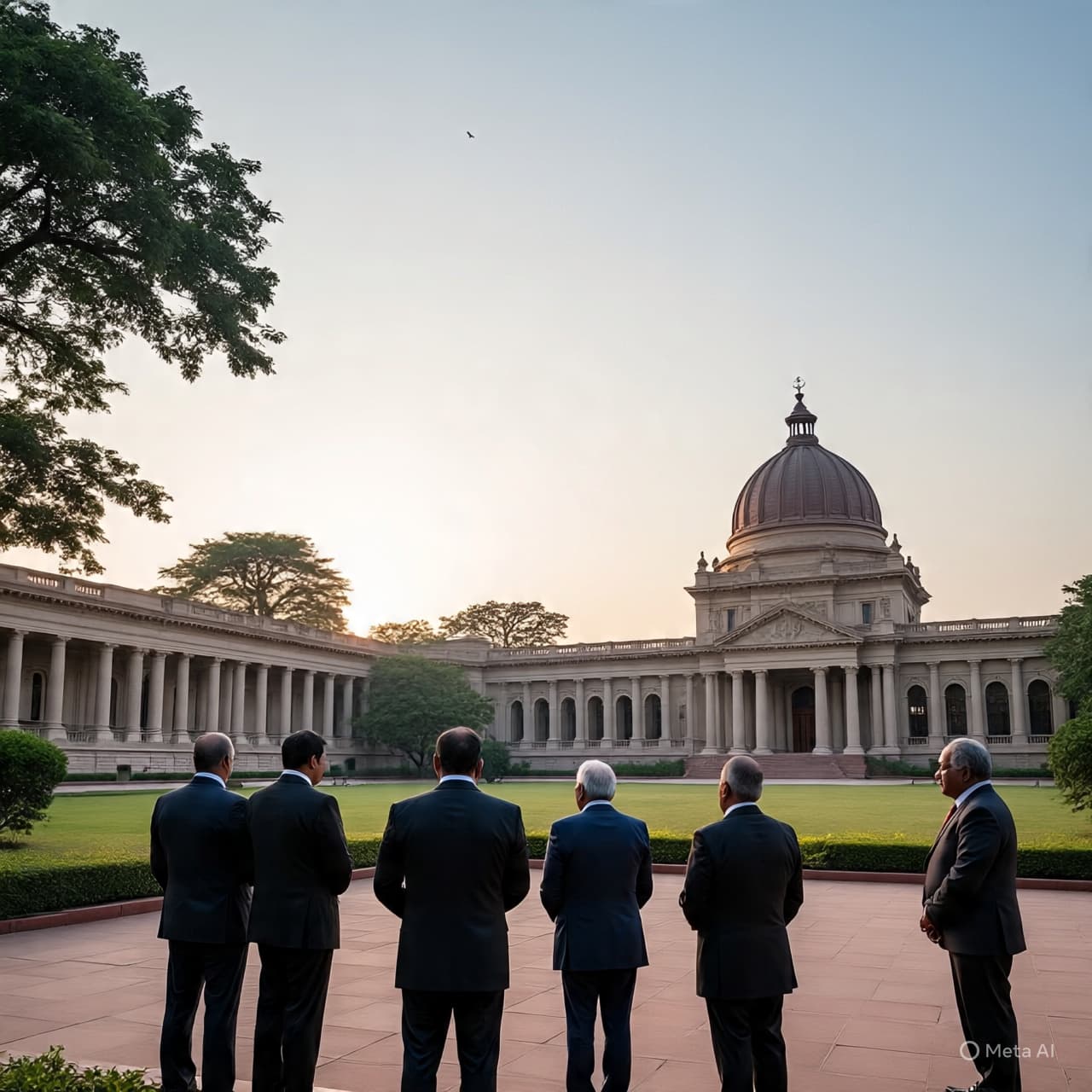
In the soft light of an early February morning in Dhaka, the city’s labyrinth of streets and verdant waterways carried the hushed anticipation of change. Here, where monsoon memories linger on mango trees and the distant echo of river barges mingles with the drone of rickshaws, a moment unfolded that many had long both awaited and wondered about. It was a day marked not by sudden torrents or thunderous proclamation, but by the gentle passage of history from one chapter to the next.
On February 17, 2026, Tarique Rahman — returning after years in self-imposed exile — stood beneath the open sky at the South Plaza of Bangladesh’s National Parliament building, his breath visible in the cool air as dignitaries, civil servants, and a scattered crowd watched on. In a ceremony officiated by President Mohammed Shahabuddin, Rahman took the oath as Bangladesh’s new prime minister, assuming leadership of a government shaped by both triumph and turbulence. His party, the Bangladesh Nationalist Party, had emerged from the recent parliamentary elections with a commanding majority, signaling a dramatic shift in the nation’s political landscape after years of rivalry and upheaval.
For decades the rhythms of Bangladeshi politics had been dominated by towering figures and long-standing alliances. Rahman, the son of former prime minister Khaleda Zia and late president Ziaur Rahman, carries with him the weight of both family legacy and national memory as he steps into this new role. His ascent follows the first general election since the 2024 mass protests that unseated the previous government and ushered in a caretaker administration led by Nobel Peace Prize laureate Muhammad Yunus. The vote was widely seen as a moment of democratic renewal, a chance for a country long defined by deep-rooted political competition to reimagine its future.
The setting of the oath-taking itself spoke to that blend of tradition and transformation. Instead of the more contained surroundings of the presidential residence, the ceremony took place openly at the South Plaza, where cool breezes brushed against the gathered guests and the distant hum of Dhaka’s traffic echoed like a tide. Alongside Rahman, ministers and state officials lined up to pledge their service, forming a new cabinet that mixes seasoned party leaders with technocrats and fresh faces, all tasked with guiding a nation at a crossroads.
The road ahead for this young administration is layered and intricate. Bangladesh confronts familiar challenges that many of its neighbors know well: reviving economic growth, stabilizing markets, tackling inflation, and reinforcing trust in institutions after years marked by political turbulence. At the same time, the geometric rise of a youthful population eager for opportunity and stability adds a current of urgency to the government’s agenda. In markets and along riverbanks, ordinary citizens whispered hopes for swift progress, mindful that the effort to rebuild both confidence and economy is rarely completed in a single season.
Yet amid these practical concerns, there was a measured poignancy to the day’s events — a reminder that politics, at its heart, weaves through the everyday lives of millions. People walked home along avenues lined with blooming jacaranda trees, children played beneath lamplit verandas, and the distant tides continued their quiet conversation with the land. In this calm, the swearing-in of a new prime minister took on the texture of an unspoken promise: of continuity amid change, of history bending gently toward what comes next.
AI Image Disclaimer
Illustrations were created using AI tools and are not real photographs.
Sources (Media Names Only)
Reuters Associated Press Agence France-Presse Al Jazeera The Daily Star
Published by Banx Network. This article is part of the Banx decentralized media programme, powered by the BXE token on the XRP Ledger.


