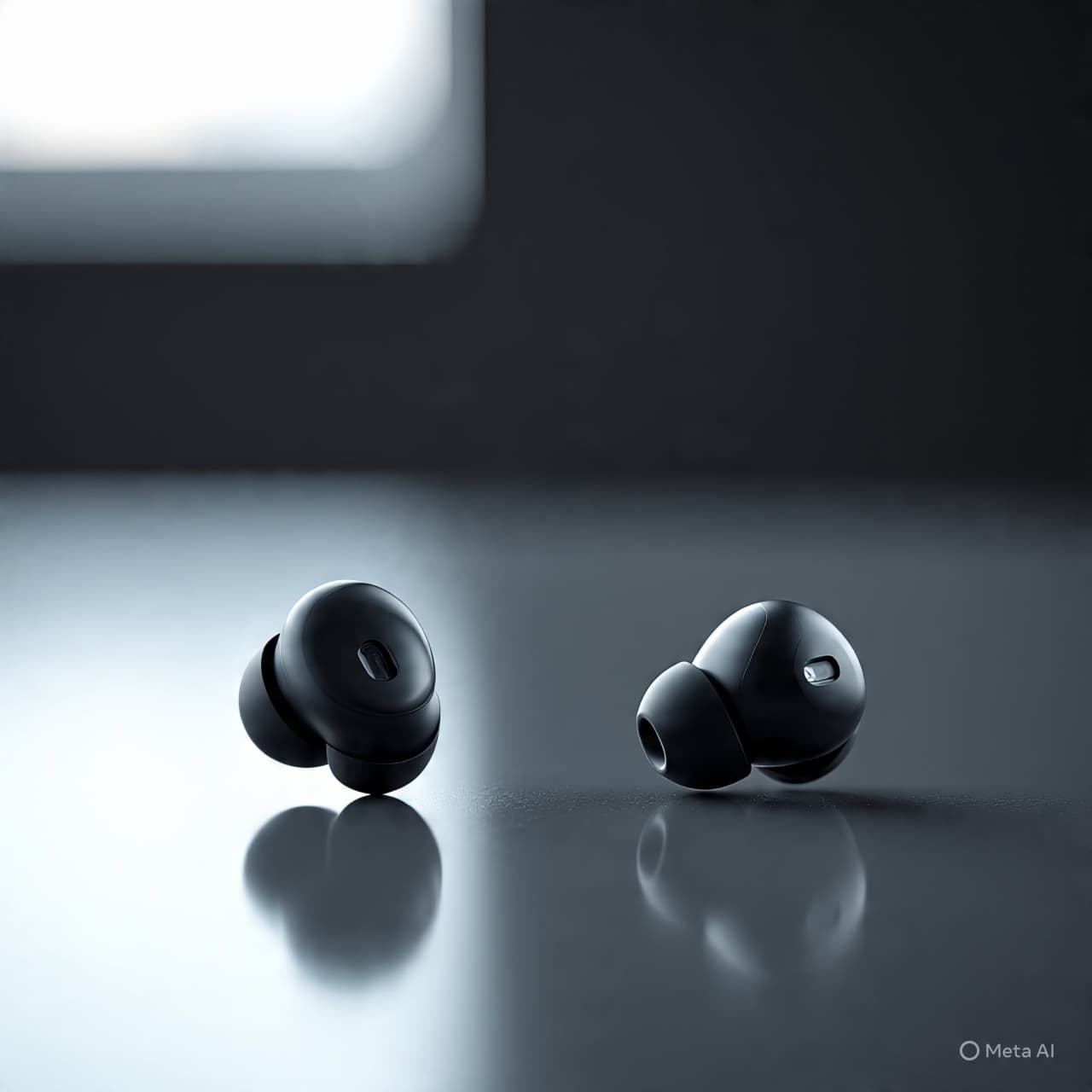
There is a soft moment between senses, a quiet space where one form of awareness begins to dissolve into another. Sound drifts through air, unseen but deeply felt; sight rests in stillness, waiting to become meaning. For centuries, we have separated these experiences — ears for hearing, eyes for seeing, each bound to its own role. But technology, as it often does, now approaches that boundary and begins to blur it.
Reports suggest that Apple is exploring a future version of AirPods that includes tiny built-in cameras — not for photography, not for recording memories, but for perception. Not eyes in the human sense, but sensors. Not vision for art, but vision for context. The goal is not to capture images for users, but to feed visual information into artificial intelligence systems that can understand the world around the wearer.
In this vision of the future, AirPods would no longer exist only as sound devices. They would become environmental interpreters — tools that help machines understand space, motion, direction, and surroundings. These cameras would offer AI a sense of place: where the user is, what direction they face, how their head moves, how sound and space interact. The ear becomes not just a receiver, but a vantage point.
There is something quietly transformative in that idea. The ear, historically a passive gateway, becomes an active sensor. The act of listening becomes entwined with perception itself. The boundary between hearing and seeing softens. Technology stops being something we hold and starts becoming something that subtly observes alongside us.
This concept also fits into a larger evolution of wearables — a shift away from screens and toward ambient intelligence. Devices no longer demand attention; they interpret context instead. They respond not only to commands, but to environments. The future is less about tapping and swiping, and more about presence, posture, motion, and space.
But this evolution is not purely poetic. It carries weight. Cameras, even tiny ones, introduce questions of trust, privacy, and control. When devices begin to “see,” even in limited ways, they change the relationship between humans and technology. Perception becomes data. Environment becomes input. Context becomes computation.
And yet, if designed carefully, such technology may remain almost invisible — not invasive, not intrusive, but quietly supportive. Enhancing spatial audio. Improving gesture awareness. Refining AI responses. Making digital systems more aware of physical reality without demanding human attention in return.
If this future arrives, it will not feel dramatic. There will be no cinematic moment where ears suddenly gain vision. Instead, it will come softly — as better sound, smarter responses, more natural interactions. The kind of change that only becomes visible in hindsight, when we realize the boundary between senses has quietly disappeared.
The idea of AirPods that can “see” is not about spectacle. It is about convergence — sound becoming space, space becoming data, and data becoming awareness. A slow fusion of perception and machine intelligence, resting lightly on the side of the human head.
Not eyes in the side of your head — but a new way for technology to understand the world you already see.
AI Image Disclaimer
Visuals are AI-generated conceptual illustrations.
Sources (Media Names Only — No Links)
Supercar Blondie Tom’s Guide GizChina Entrepreneur Liputan6
Published by Banx Network. This article is part of the Banx decentralized media programme, powered by the BXE token on the XRP Ledger.