
Key Highlights
- Incident:A significant industrial fire occurred at a chemical facility in Southern California.
- Response:Emergency services worked overnight to stabilize a hazardous chemical storage tank.
- Community Impact:Residents faced evacuations and air quality concerns amid the ongoing fire.
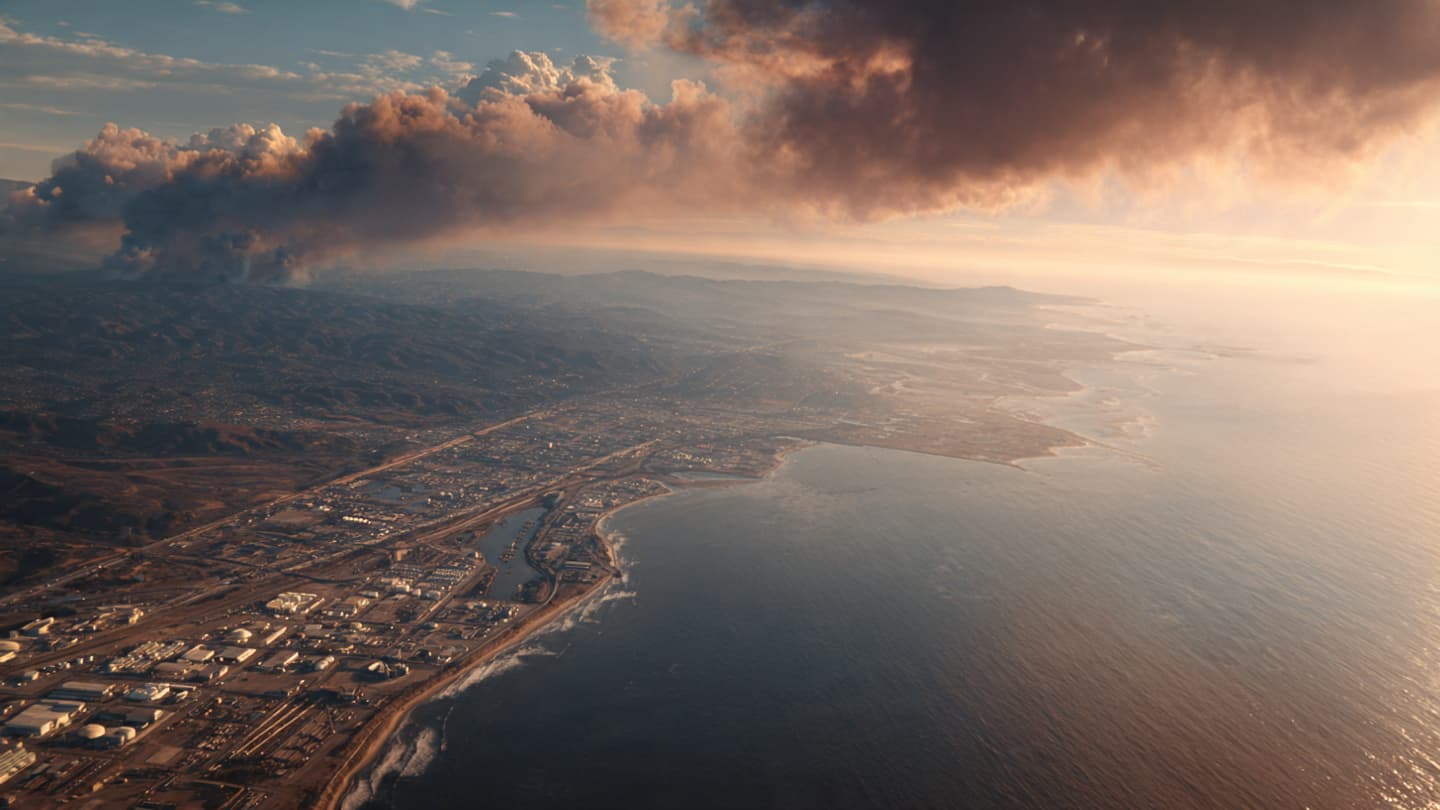
The dawn light revealed a transformed landscape over Southern California, where the remnants of an industrial fire lingered in the air. Smoke had drifted for hours above warehouses and highways, leaving behind a sharp scent of chemicals and burned metal. As the sun rose, the atmosphere shifted from one of emergency alerts and caution to a quieter sense of exhaustion mixed with relief.
Fire officials announced that a damaged chemical storage tank at the heart of the fire was no longer considered an explosion risk. This update eased fears that had prompted evacuations and emergency preparations across nearby communities. For residents who spent the night listening to helicopters overhead and checking evacuation notices on their phones, the news was less a cause for celebration and more a gradual release of tension.
The fire erupted at an industrial chemical facility, where flames and heavy smoke raised immediate concerns about the stability of a large storage tank containing hazardous materials. Authorities feared that heat pressure inside the tank could trigger an explosion, leading to road closures, evacuation warnings, and a broad emergency response involving firefighters, hazardous materials teams, and air-quality officials. Throughout the night, crews worked tirelessly to cool surrounding structures while continuously monitoring the tank for signs of structural failure.
By dawn, officials reported that temperatures around the tank had stabilized enough to reduce the immediate threat. Although the fire continued to burn in parts of the facility, emergency responders described conditions as significantly improved. Air monitoring operations remained active as environmental agencies assessed smoke and chemical exposure risks in nearby neighborhoods.
Incidents like this have become increasingly familiar across California, where industrial infrastructure, wildfire conditions, drought, and urban expansion often intersect. Along highways and industrial corridors, refineries, storage depots, rail yards, and chemical facilities exist alongside residential communities that have grown steadily outward over decades. The boundaries between industry and daily life can feel surprisingly thin, separated at times only by fences or narrow strips of pavement.
Residents described an uneasy night shaped by uncertainty rather than visible catastrophe. Some packed belongings into cars while waiting for further instructions, while others sealed their windows against the smoke drifting across neighborhoods under orange-tinted skies. Schools and businesses in affected areas adjusted operations as authorities warned people to avoid outdoor activity until air conditions improved.
The incident also reignited discussions about industrial safety and environmental preparedness in a state already accustomed to layered forms of risk. California's emergency systems have evolved around earthquakes, wildfires, droughts, and energy disruptions, yet chemical fires carry a different psychological weight — invisible particles moving through the air and uncertainty over exposure.
Firefighters worked through the night beneath floodlights and rotating helicopter beams, using water streams and cooling operations to prevent heat from spreading further through the facility. Officials praised the coordination between local agencies and hazardous materials specialists, emphasizing that containment efforts likely prevented more serious consequences. Investigators are expected to examine what triggered the blaze once conditions are fully stabilized.
Even after the danger recedes, moments like this linger quietly within communities. The memory remains in the smell carried through morning air, the ash settling onto parked cars, and the emergency alerts that interrupted sleep. Industrial accidents often pass quickly through national headlines, but locally they become part of a region's emotional landscape — a reminder of how closely modern life exists beside systems powerful enough to sustain cities and threaten them simultaneously.
As traffic slowly resumed along nearby roads and evacuation zones began shrinking, California moved into the familiar phase that follows emergencies, reflecting on the balance between industrial progress and community safety.
Published by Banx Network. This article is part of the Banx decentralized media programme, powered by the BXE token on the XRP Ledger.



