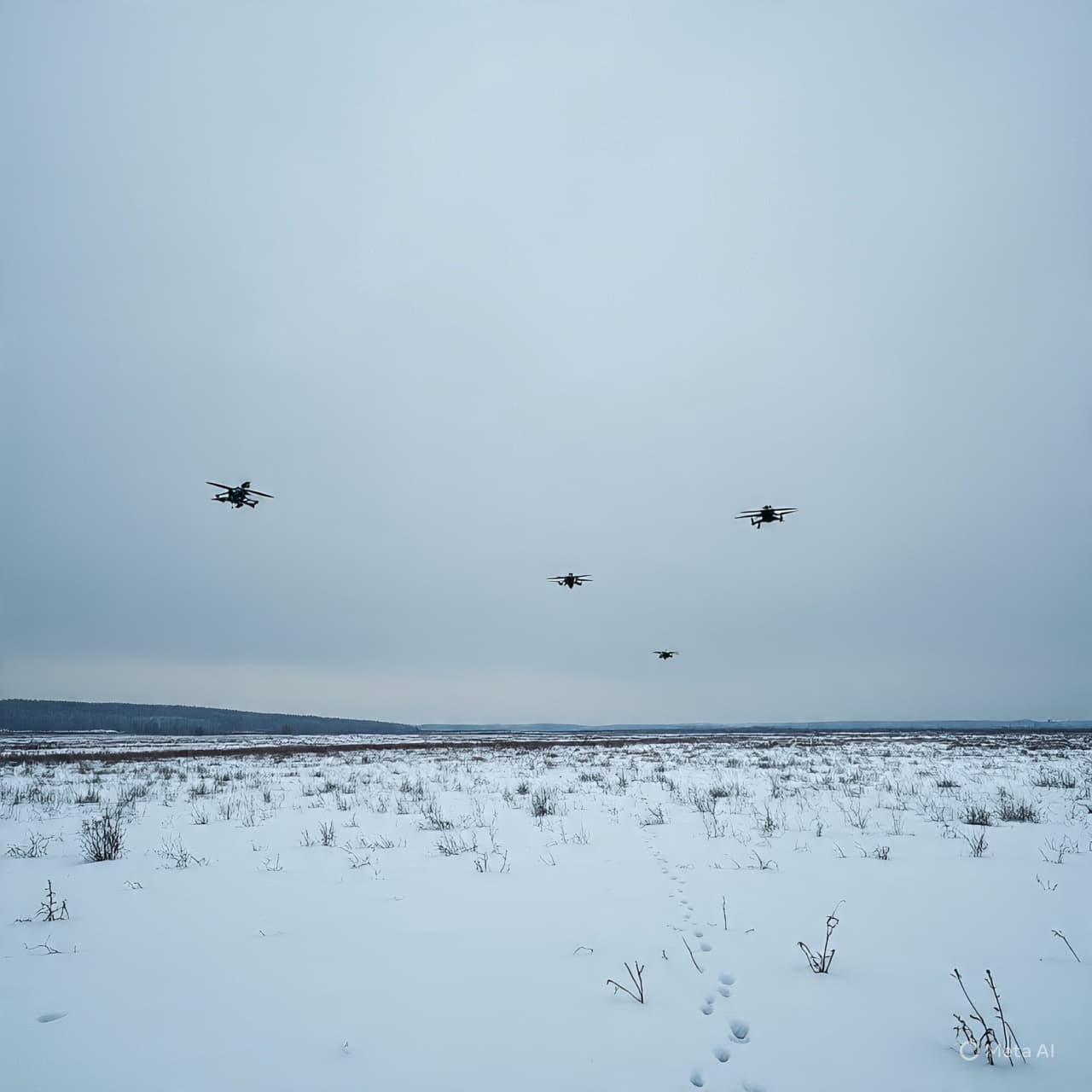
In the pale light before dawn, the fields of eastern Ukraine hold a silence once broken by the rhythm of marching men. Now, that rhythm has changed. It is not the thud of boots that marks the ground but the low hum of machines — drones circling unseen, small tracked vehicles scuttling through frost-bitten soil, and the steady pulse of distant control stations alive with signal. The war that began with trenches and rifles is turning, almost imperceptibly, into one defined by circuitry and code.
Commanders on the front lines speak with a candor born of fatigue. “We don’t have infantry,” they say — not as complaint, but as statement of truth. Years of unrelenting combat have thinned the ranks. What remains is a force compelled to adapt, replacing numbers with machines, resilience with design. Across defensive positions, drones hover like new sentinels, tracing lines invisible to the eye yet vital to survival. They watch, relay, and strike, blurring the distance between observation and action.
On the ground, small robots crawl through minefields and trenches where soldiers once advanced in groups. In cities reduced to their steel frames, remotely guided vehicles deliver supplies and ammunition, crossing roads too dangerous for humans. The familiar figure of the foot soldier is giving way to something quieter — a dispersed web of technology directed by human will but executed by mechanical precision.
For the soldiers who remain, this transformation carries both relief and unease. The machines save lives, but they also redefine courage. To fight now is to guide rather than to march, to command at a distance, to trade exposure for endurance. The act of war has not vanished; it has simply shifted its form. What was once a contest of manpower has become a test of innovation and signal strength.
In Kyiv, the tone of discussion has changed as well. Generals speak of fleets of drones, of automated surveillance, of factories turning out unmanned systems at a pace once reserved for artillery shells. They describe a new front — one not confined to geography, but to the thin, invisible space where data meets danger. For both sides, victory no longer depends only on courage or morale, but on whose code runs faster, whose sensors see farther, whose batteries last longer in the cold.
And yet, beneath all the whirring and glow of technology, the human remains. Every drone that rises does so under the guidance of a hand; every robot that moves forward carries a fragment of human intent. War, reshaped by machinery, still traces its contours through human decision and loss. The faces may be fewer, the footprints fainter, but the weight of each moment endures.
As the conflict enters another year, the fields of eastern Ukraine are no longer defined by lines of infantry or columns of armor. They are a theatre of machines — quiet, unblinking, relentless — carrying the burden once borne by men. It is a new form of war, fought between exhaustion and invention, where silence itself has become the sound of motion.
AI Image Disclaimer
Illustrations were created using AI tools and are not real photographs.
Sources (Media Names Only)
Defense News Reuters Associated Press The Guardian Military Times
Published by Banx Network. This article is part of the Banx decentralized media programme, powered by the BXE token on the XRP Ledger.