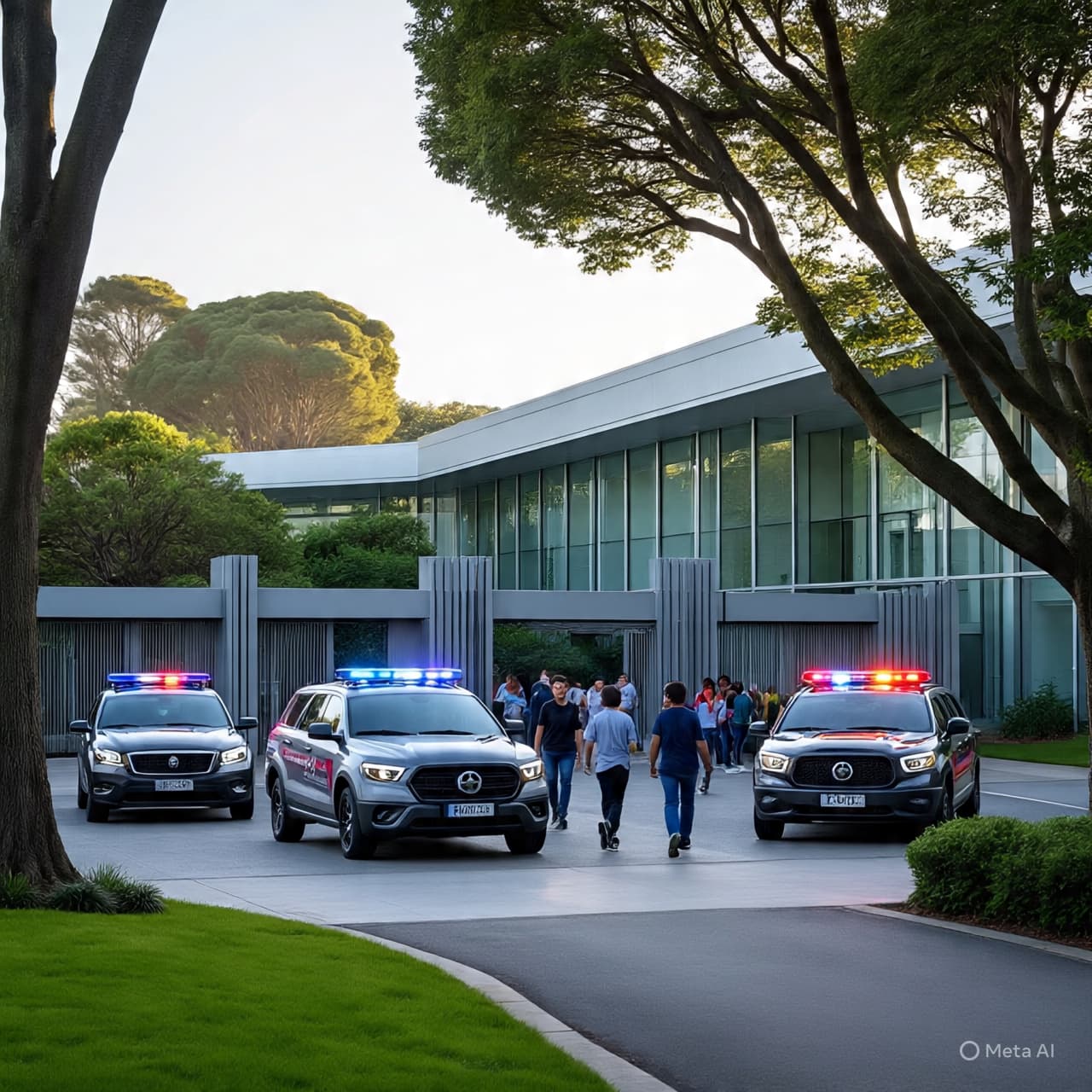
As morning light settled gently over the playing fields of Auckland, the familiar rhythm of a school day began with a quiet undercurrent of watchfulness. Students gathered in small clusters, uniforms catching the breeze, while beyond the gates a different presence stood steady and visible. Patrol cars waited not in alarm, but in precaution — a reminder that even ordinary mornings can carry the weight of unseen tensions.
At the center of the concern is Western Springs College, where police were deployed after threats were made toward students. School leadership confirmed that a group of young people from another school had issued threats late last week. Though no violence occurred on campus grounds, an altercation reportedly unfolded later that afternoon near a bus stop along a nearby arterial road, extending the unease beyond the school perimeter.
In the days that followed, further threatening messages circulated on social media, prompting administrators to coordinate closely with authorities. Police increased their presence at the school as a precautionary measure, emphasizing that the move was intended to deter escalation rather than respond to any active incident. Officials stated that several individuals believed to be involved have been identified, and inquiries remain ongoing.
For families, the situation unfolded not as a dramatic rupture, but as a tightening of awareness. The school advised parents to remind students to remain on campus during school hours and to avoid engaging with external groups. The guidance was practical, measured — the kind of response designed to prevent rather than react.
Incidents like these reflect the complex ways in which digital exchanges can spill into physical spaces. Words typed quickly and shared widely can travel faster than intent, leaving institutions to interpret tone, assess risk, and restore calm. In such moments, the role of visible authority is less about spectacle and more about reassurance — a quiet signal that vigilance does not necessarily mean panic.
By week’s end, the campus remained open, classes continued, and daily routines pressed forward. Police maintained intermittent patrols while investigations progressed behind the scenes. The episode serves as a reminder that safety in modern schools extends beyond classrooms and corridors, shaped as much by online currents as by what unfolds in person.
And so the gates remain open under the same wide Auckland sky, watched not only by teachers and parents, but by a broader community determined to keep ordinary days intact.
AI-generated illustrations are conceptual visuals and not authentic photographs of the event.
Sources
Radio New Zealand New Zealand Herald
Published by Banx Network. This article is part of the Banx decentralized media programme, powered by the BXE token on the XRP Ledger.