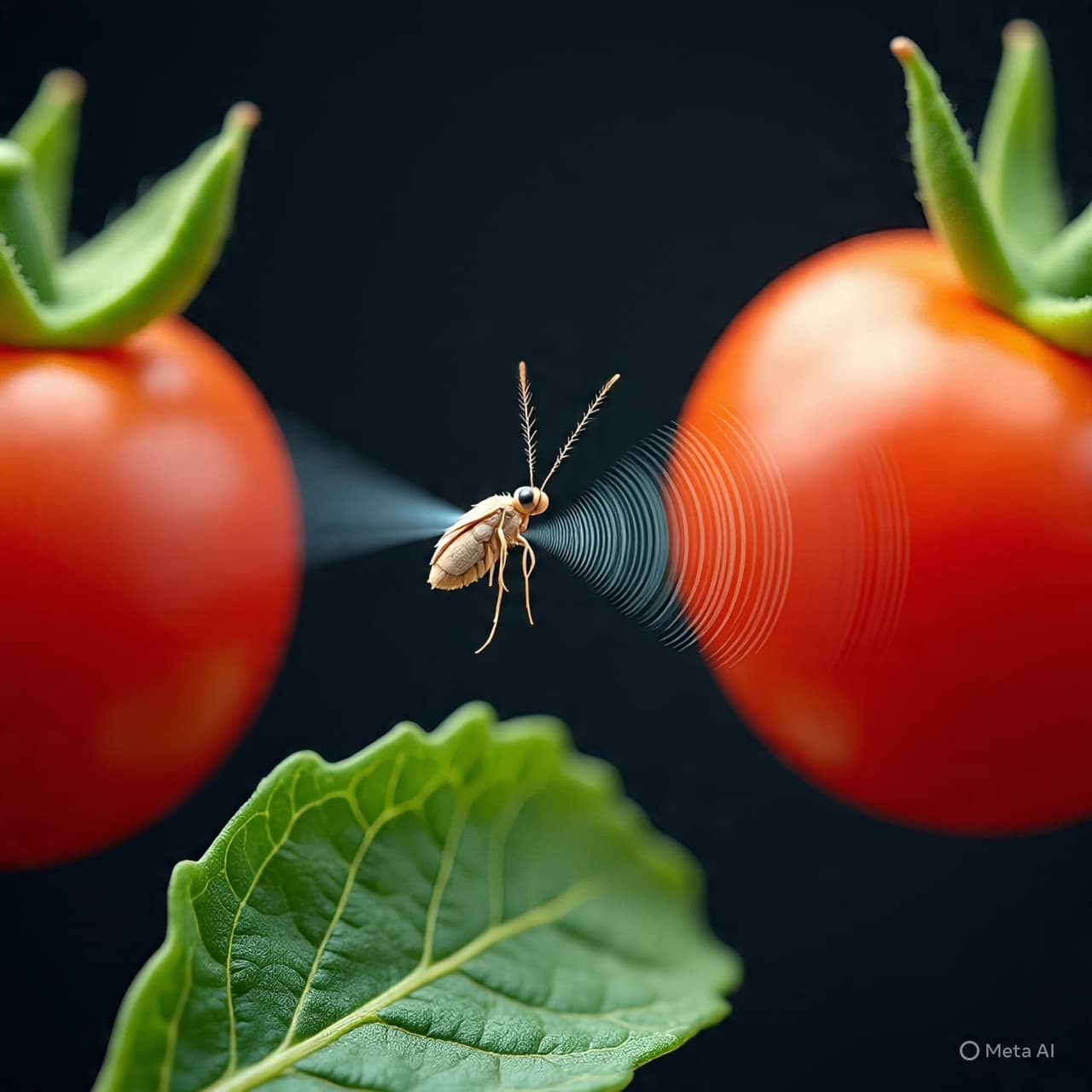
In the quiet hush of a greenhouse at Tel Aviv University, imagine a world where a plant’s distress is not silent but whispered in tones beyond human hearing. Like an old mariner listening for distant storms on the sea, tiny moths tune into these subtle clues — not through scent or sight, but through faint ultrasonic clicks curling through the air. It is a world where plants and insects share a hidden dialogue, an invisible script written in sound that guides life’s choices. Such is the delicate discovery emerging from the intersection of botany and animal behavior, a revelation that invites us to listen differently to the world around us.
In a breakthrough study published in eLife, scientists have documented the first known case of insects actually hearing the sounds of plants — and acting on them. Female moths of the Egyptian cotton leafworm species were observed making crucial decisions about where to lay their eggs based on ultrasonic signals emitted by nearby tomato plants under stress. These high-frequency clicks, inaudible to human ears but picked up by sensitive moth tympanic organs, tell a story of water shortage and plant strain that the insects use to judge a safe nursery for their young.
Researchers led by Prof. Yossi Yovel and Prof. Lilach Hadany designed carefully controlled experiments that isolated this acoustic interaction. In one setup, female moths were given a choice between two silent boxes — one emitting recordings of dehydrated plant sounds, the other quiet. Intriguingly, the moths initially gravitated toward the sound, interpreting it as evidence of plant presence. But when real tomato plants were used and one emitted stress clicks while the other remained silent, the females chose the silent, healthy plant for egg-laying. This suggested the moths weigh these auditory cues alongside their other senses to pick the best habitat for their offspring.
The study also included controls that disabled the insects’ hearing; when the moths could no longer perceive the ultrasonic clicks, their egg-laying choices became random. This confirmed that it is indeed hearing — not smell or sight alone — that influences their behavior. And while male moths also emit ultrasonic sounds during courtship, the females did not show a preference for areas with male calls when laying eggs, underscoring that it is specifically plant sound cues guiding this ecological choice.
This discovery broadens our understanding of ecological communication. For decades, scientists knew that plants could signal danger to each other via chemical vapors and through underground fungal networks. But the idea that plants emit airborne acoustic signals that influence insect behavior opens an entirely new sensory dimension in nature’s dialogue. These ultrasonic cues might act as early warning signs of plant distress in ecosystems, or potentially be harnessed for innovative pest management strategies that guide insects away from vulnerable crops.
Still, this field remains in its infancy. Researchers caution that while this is the first demonstrated case of auditory interaction between plants and insects, myriad other organisms may participate in similar invisible exchanges. As we refine our instruments and listen more closely, this unexpected conversation between roots, leaves, wings, and antennae may reshape our view of life’s interconnected web.
AI Image Disclaimer “Visuals are created with AI tools and are not real photographs.”
Sources (Media Names Only):
Earth.com — mainstream science reporting. Reuters — major international news outlet. Times of Israel — reputable regional news focusing on science. Phys.org — widely respected science news aggregator. NDTV Science — credible science section summary.
Published by Banx Network. This article is part of the Banx decentralized media programme, powered by the BXE token on the XRP Ledger.