Key Highlights
- Casualties:At least four people killed and two injured in a drone strike.
- Target:The Lukoil oil refinery in Volgograd's industrial zone was the primary target.
- Environmental Impact:Elevated particulate levels prompted public health advisories.
VOLGOGRAD — In a significant escalation of the ongoing conflict, at least four individuals were killed and two others injured following a Ukrainian drone strike that targeted an industrial zone in Russia's southern Volgograd region early Friday morning. The attack has raised alarms regarding the safety of critical infrastructure and the potential environmental impact of the ensuing fires.
The drone strike occurred during the early hours, igniting multiple localized fires across the industrial sector. Initially, regional Governor Andrei Bocharov reported no casualties from intercepted drone debris. However, as emergency crews began assessing the damage, officials confirmed that four fatalities had occurred among facility workers at the site.
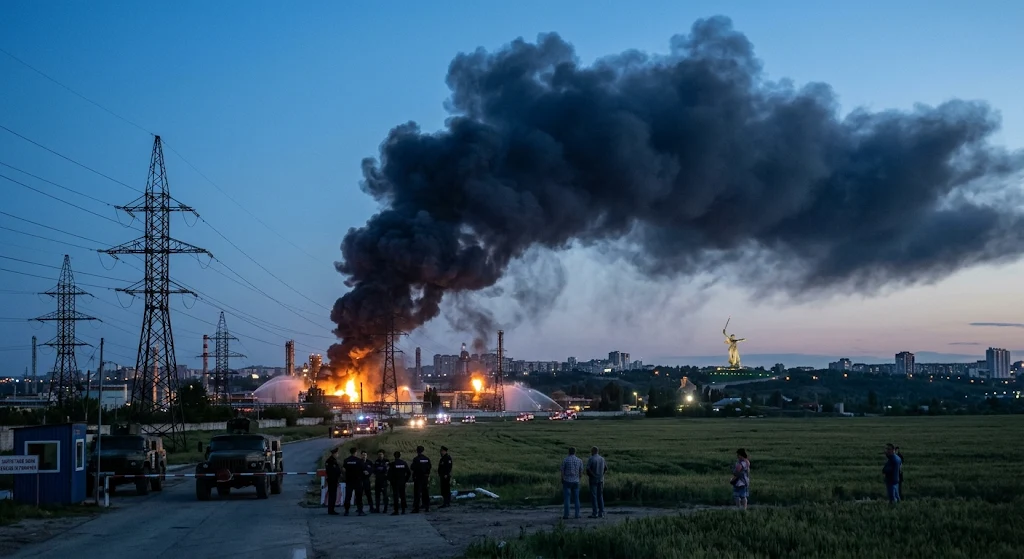
Eyewitness accounts and independent reports identified the Lukoil oil refinery as the primary target of the drone strike. This facility is one of the largest crude processing plants in southern Russia, and the resulting fires prompted emergency response teams to rush to the scene to combat flames threatening high-capacity storage units and industrial machinery.
In response to the attack, Russia's Ministry of Defense reported that air defense systems were heavily engaged overnight, intercepting hundreds of drones across various western and southern regions. Local authorities in Volgograd quickly established security cordons around the affected site, allowing investigative teams and civil defense personnel to secure the facility and assess the damage.
Following the strike, environmental monitoring teams were deployed to the perimeter of the refinery to evaluate air quality levels and assess potential airborne hazards resulting from the burning petroleum products. Initial readings indicated elevated particulate counts in nearby downwind communities, prompting public health advisories that recommended residents keep windows closed and limit outdoor physical activity until the smoke dissipated.
In Moscow, federal energy officials convened an emergency coordination meeting to evaluate the broader impact of the disruption on regional fuel distribution and refining capacity. Industry analysts noted that while the Volgograd refinery plays a critical role in supplying fuel to southern Russian markets, alternative supply routes and strategic reserves are expected to mitigate short-term shortages while damage assessments and structural repairs are underway.
The international community is closely monitoring the situation, with diplomatic missions noting an intensification of long-range drone engagements targeting energy infrastructure across both Ukraine and Russia. Security experts have emphasized that refineries and industrial zones remain highly vulnerable nodes in the ongoing conflict, leading to calls for reinforced perimeter defense grids and enhanced early-warning detection systems around vital industrial assets.
As the situation develops, the implications of this strike could reverberate beyond immediate casualties, affecting energy supply chains and raising concerns about the safety of industrial operations in conflict zones.
Published by Banx Network. This article is part of the Banx decentralized media programme, powered by the BXE token on the XRP Ledger.