

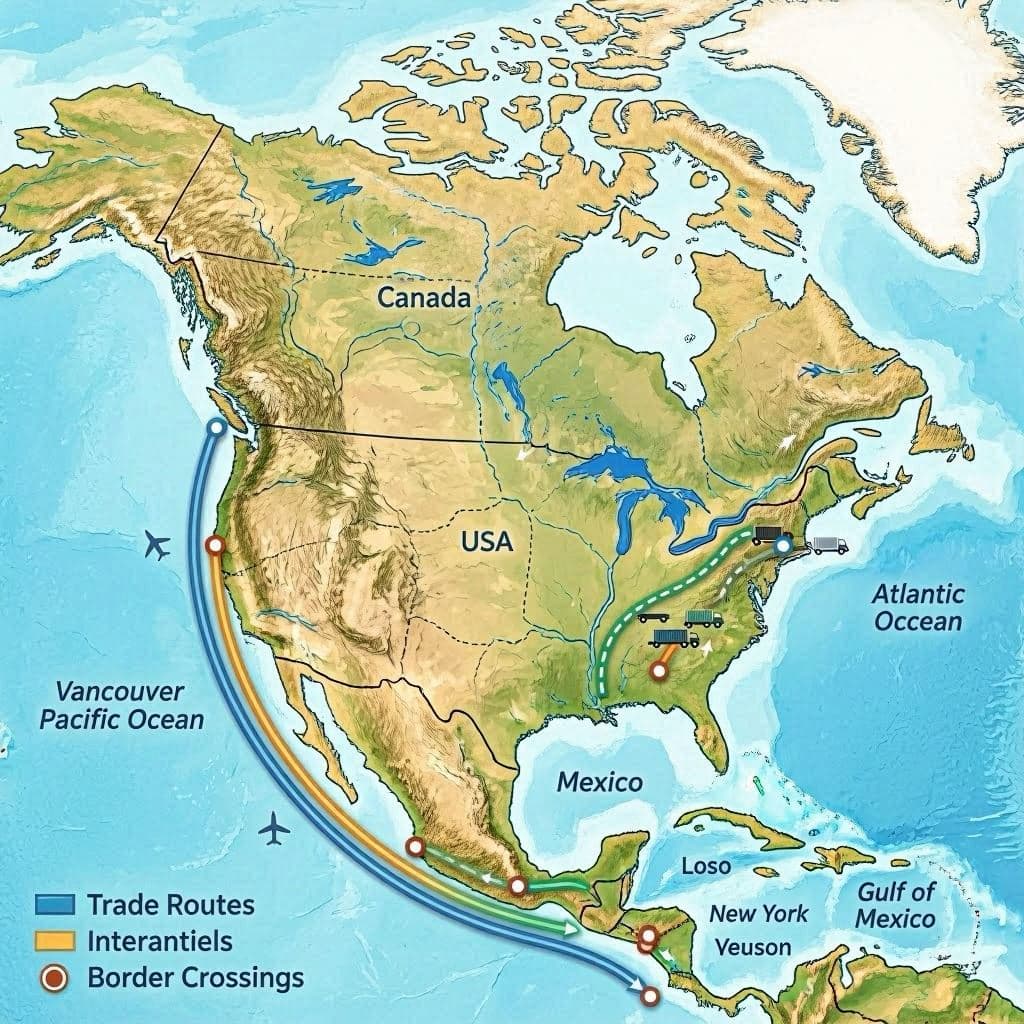
Key Highlights
- U.S. Decision: The U.S. will not support renewal of USMCA at the 2026 review.
- Countdown Initiated:This decision starts a ten-year countdown to the agreement's expiration in 2036.
- Trade Impact:The uncertainty may affect investments in cross-border supply chains.
The United States' recent decision not to support the renewal of the United States-Mexico-Canada Agreement (USMCA) during the upcoming joint review on July 1, 2026, has initiated a significant ten-year countdown toward the agreement's expiration in 2036. According to the rules established under USMCA, the lack of consensus on an extension will trigger annual reviews, leading to a gradual path toward the agreement's final expiration unless the parties reach an agreement before the deadline.
The USMCA, which replaced the North American Free Trade Agreement (NAFTA) in 2020, includes a built-in review cycle every six years and a definitive end date of July 1, 2036. If the U.S. does not confirm an extension this year, the involved parties will shift to yearly consultations instead of securing another 16-year term. While the trade terms will remain in force for the time being, they will operate under an increasing shadow of uncertainty, affecting various sectors reliant on stable trade conditions.
U.S. officials have indicated that the current stance reflects a desire to revisit certain chapters of the agreement, particularly those concerning automotive rules of origin, labor enforcement, and agricultural market access. Both Mexico and Canada have expressed interest in renewing or making incremental adjustments to the agreement, cautioning that prolonged ambiguity could deter long-term investments in cross-border supply chains.
Business groups have highlighted that industries dependent on just-in-time production and regional integration—such as automotive, electronics, and processed foods—are particularly vulnerable to this uncertainty. Any delays or indecision regarding the future of the pact can complicate decisions related to factory operations, parts distribution, and workforce training, all of which require significant time and investment to yield results.
Trade economists have noted that while the decade-long window allows for negotiation, it does not guarantee stability. Instead, it may foster a “wait-and-see” mentality that could hinder efficiency gains and moderate growth within the $1.6 trillion per year regional trade zone. Experienced trade negotiators have pointed out that while sunset clauses were intended to keep the agreement modern and accountable, the absence of early consensus may lead to increased instability.
As the rhythm of annual reviews begins to dominate policy discussions in Washington, Ottawa, and Mexico City, both supporters and critics of the agreement recognize that while the countdown has commenced, there remains an opportunity for renewal or revision before 2036. However, the longer the pause in negotiations, the more costly and disruptive any late-stage adjustments may become.
For now, the message is clear: while the USMCA continues to operate, the clock is ticking, prompting governments and businesses to plan with both flexibility and caution as they navigate the evolving trade landscape.
Published by Banx Network. This article is part of the Banx decentralized media programme, powered by the BXE token on the XRP Ledger.




