
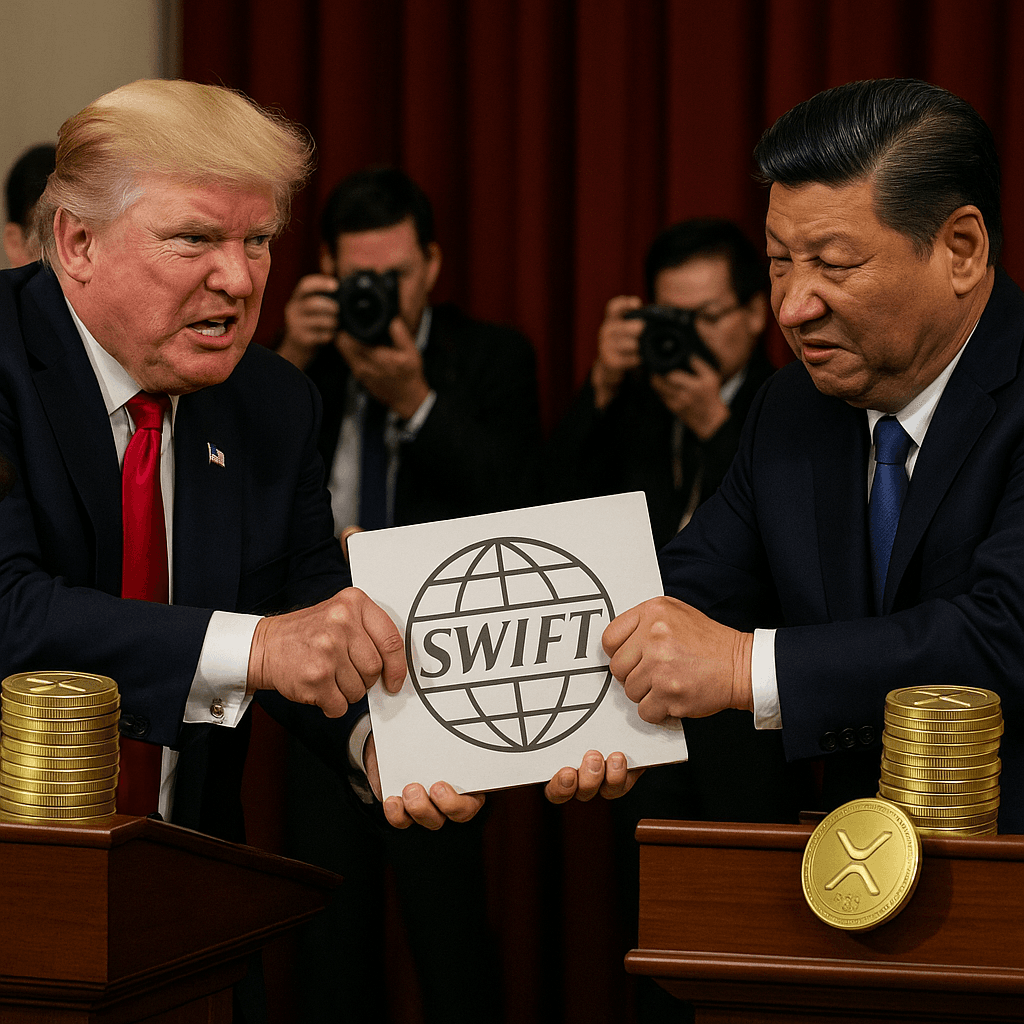
Key Highlights
- U.S. Tariffs: A 100% tariff on Chinese imports announced, effective November 1.
- Crypto Market Impact:Over $124 billion wiped from the crypto market following the announcement.
- XRP Adoption:XRP Ledger gains traction as a viable alternative for instant trade settlements.
On October 10-11, 2025, the U.S. government announced a sweeping 100% tariff on all Chinese imports, set to take effect on November 1. This decision, coupled with new export-control measures on critical software, sent shockwaves through the financial markets. The immediate aftermath saw the cryptocurrency market lose approximately $124 billion in value, illustrating the volatility and sensitivity of digital assets to macroeconomic policies. XRP, a leading cryptocurrency, experienced a notable dip, falling to around $0.7745 before attempting a recovery, underscoring the impact of geopolitical events on market dynamics.
The global payments infrastructure, primarily dominated by SWIFT (Society for Worldwide Interbank Financial Telecommunication), facilitates around $150 trillion in cross-border transactions each year. However, the system has faced increasing scrutiny for its inefficiencies, including slow processing times and high costs. As traditional payment rails struggle to adapt to the fast-paced digital economy, proponents of XRP argue that the current climate presents an opportunity for disruption. The XRP Ledger (XRPL) is designed to enable near-instant settlements, typically within seconds, and offers minimal transaction fees, making it an attractive alternative for institutions seeking to streamline their operations.
If even a small fraction—1%—of SWIFT's annual transaction volume were redirected to the XRPL, it could represent a staggering $1.5 trillion in demand. Recent metrics indicate that institutional adoption of XRP is on the rise, with reports suggesting that 43.4% of circulating XRP is held in institutional wallets. Furthermore, on-chain activity, including transactions and wallet creation, is increasing, signaling growing interest from major players in the financial sector. Ripple engineers are also enhancing the XRPL with advanced features such as privacy protocols and real-world asset tokenization capabilities, which are crucial for attracting institutional clients.
The newly imposed tariffs exacerbate existing friction in traditional cross-border commerce, leading to higher duties, regulatory scrutiny, and longer settlement times. As businesses grapple with these challenges, they are increasingly looking for solutions that can reduce locked-up capital and improve transaction speed. The XRPL presents a viable alternative that minimizes reliance on pre-funded liquidity pools and the slow processes associated with correspondent banking. The recent downturn in the crypto market, triggered by the tariff announcement, further emphasizes the need for infrastructure that provides real-world utility rather than speculative investments.
In this evolving landscape, the BXE Token is emerging as a key player, positioned to facilitate decentralized media and tokenization on the XRPL. With its focus on lower costs and smart contract capabilities, BXE aims to empower creators and streamline asset flows in a tokenized economy. As firms and institutions transition to token-economy models, particularly during periods of stress on traditional payment systems, projects leveraging the XRPL and BXE are well-positioned to capitalize on this shift.
The recent tariff-induced market shock has exposed vulnerabilities in legacy settlement systems, paving the way for the XRPL as a high-speed, low-cost alternative. XRP's growing institutional infrastructure and ongoing enhancements to the XRPL make it an increasingly credible option for bank-grade settlement flows. For businesses facing the challenges posed by tariffs, the ability to transact, settle, and tokenize assets quickly becomes a strategic advantage, with XRPL and BXE providing a promising pathway forward.
Published by Banx Network. This article is part of the Banx decentralized media programme, powered by the BXE token on the XRP Ledger.



