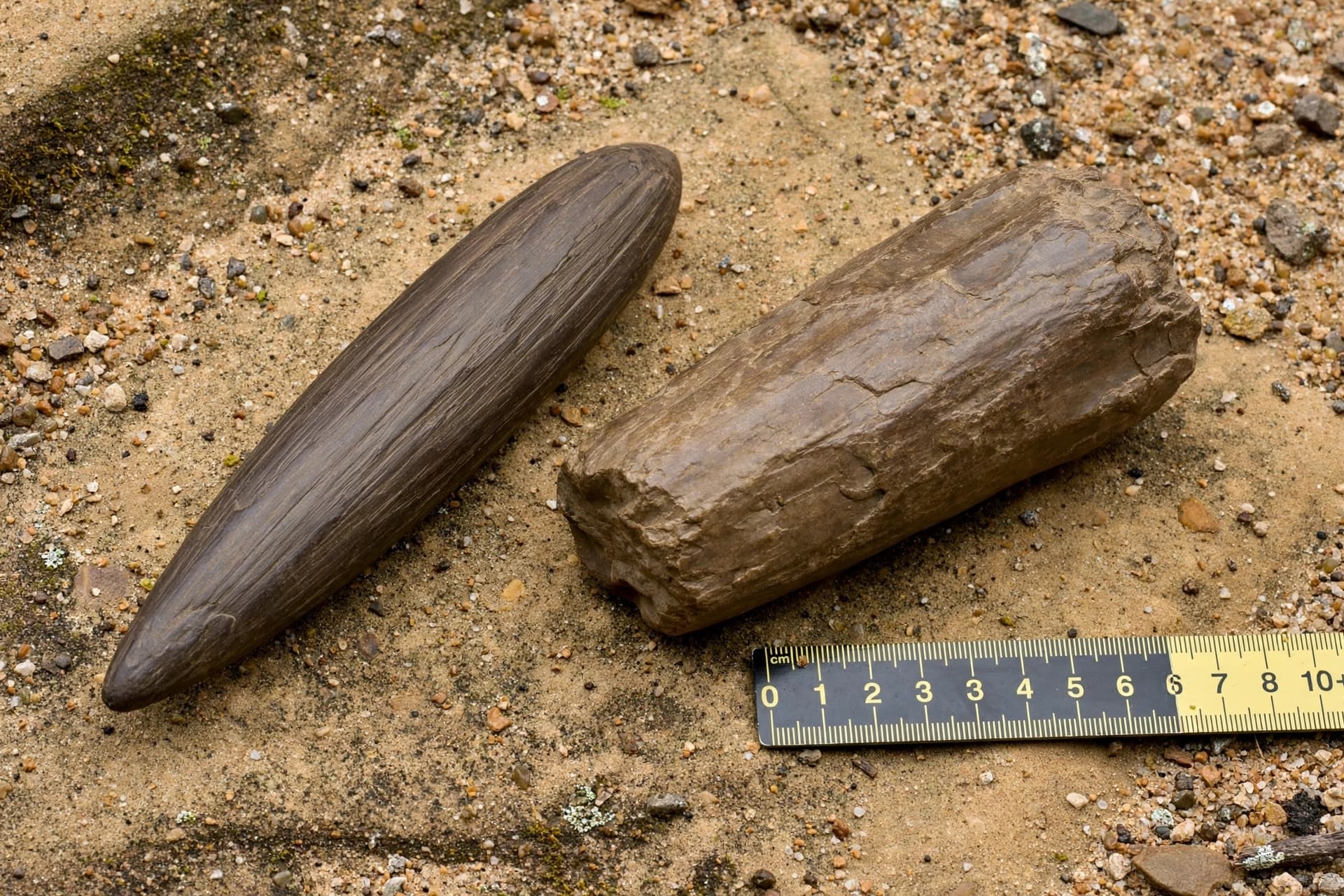
There is a particular kind of wonder that arrives when the familiar suddenly reveals itself as strange—when a shape that has been seen a thousand times, dismissed as ordinary, turns out to be something no one has ever named. In the fossil beds of Wyoming's Bighorn Basin, where belemnite fossils are so common they are affectionately called "squid butts," two specimens stood apart. They were not bullet-shaped and slender like the millions of others pulled from the Sundance Formation. They were round, barrel-like, and thick. They stuck out, as one paleontologist put it, "like a sore thumb" .
This week, an international team of researchers announced the discovery of Wyoteuthis linsterorum, a new genus and species of belemnite—ancient cousins of modern squid and octopus—that lived approximately 160 million years ago when a shallow sea covered what is now Wyoming . The findings were published in the journal Papers in Palaeontology. The species name honors Cliff Linster, a fossil collector who found one of the two known specimens near Ten Sleep and donated it to the Wyoming Dinosaur Center. Linster passed away in June, knowing his discovery was being studied .
What makes Wyoteuthis remarkable is not merely its newness but its proportions. Most Wyoming belemnites measure five to ten centimeters long and one to two centimeters wide. The new species had a rostrum—the hard internal skeleton that is typically the only part to fossilize—about ten centimeters long but up to six centimeters wide, making it the thickest belemnite ever recorded . Researchers estimate the living animal, with arms extended, would have reached around sixty centimeters, roughly the length of a skateboard .
The discovery carries significance beyond its dimensions. The fossils belong to an ancient family of belemnites previously thought to have disappeared millions of years earlier. Their presence in the Sundance Formation suggests the group survived in a refuge in the northeastern Pacific long after researchers believed they had vanished elsewhere . Using computed tomography, the team examined the fossils without damaging them, revealing internal features that confirmed the classification .
Alexey Ippolitov, a belemnite expert now at Victoria University of Wellington, expressed deep surprise at finding a fossil from such a well-studied group that differed so radically from anything known. After more than two centuries of research on belemnites, he said, discoveries like this are exceptionally rare . One possible explanation for the creature's girth, researchers suggest, is that its larger size gave it an advantage when hunting smaller belemnites that shared its waters—modern squid, after all, are hardly picky eaters .
The first specimen was unearthed in the late 1990s by Dr. Burkhard Pohl, founder of the Wyoming Dinosaur Center, who spotted a belemnite much larger than any he had seen. It sat unstudied for years until a second specimen was found by Linster in 2019, providing the evidence needed for formal identification . Jessica Lippincott, a Wyoming paleontologist and co-author, noted that the discovery shows new species are still being found all the time, and that amateur collectors can contribute meaningfully to science .
The fossils now rest in the collection of the Wyoming Dinosaur Center, a reminder that the ordinary can conceal the extraordinary, and that the ground beneath our feet holds stories that take decades—sometimes centuries—to tell.
---
AI Image Disclaimer: The images accompanying this article are AI-generated and intended for illustrative purposes only.
Sources: EurekAlert!, New York Post, Cowboy State Daily
Published by Banx Network. This article is part of the Banx decentralized media programme, powered by the BXE token on the XRP Ledger.