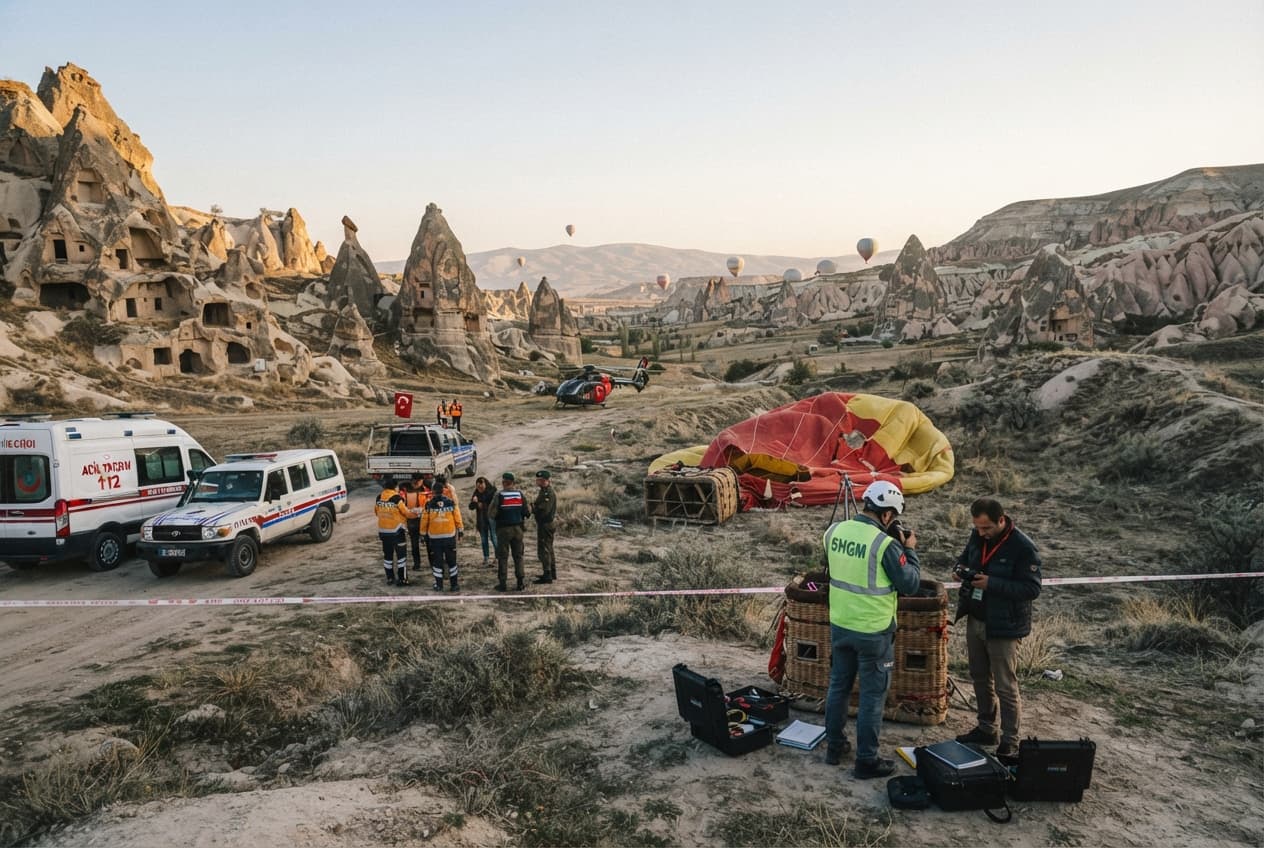
Cappadocia, Turkey—A scenic hot air balloon excursion turned deadly when a hard landing and subsequent fire killed two international tourists during morning valley flights. Regional emergency dispatchers received urgent calls reporting that a sudden wind shear caused the basket to strike a rocky cliff face before igniting. Ground chase crews and medical ambulances rushed across the rugged terrain to reach the remote landing zone in the picturesque volcanic region. Paramedics confirmed that two passengers succumbed to thermal burns and impact trauma, while several others sustained serious injuries.
Preliminary aviation safety findings indicate that unexpected gusts swept across the plateau, forcing the pilot to execute an emergency descent onto uneven ground. The balloon basket scraped against sharp rock formations, rupturing a propane fuel line that instantly sparked a fierce localized fire. Local tourism authorities suspended all commercial balloon flights across the region pending a comprehensive meteorological and equipment review. Hospital administrators in nearby municipal centers reported treating surviving passengers for fractures, smoke inhalation, and severe shock.
Transport ministries and civil aviation regulators faced immediate scrutiny regarding weather monitoring protocols and safety enforcement for commercial adventure tourism. Tour operators expressed deep sorrow over the tragedy while cooperating fully with national investigators examining flight logs and burner maintenance records. Forensic aviation experts cordoned off the landing site, collecting charred fabric panels and ruptured fuel canisters for laboratory stress testing. Consular offices began coordinating with foreign embassies to notify the families of the deceased tourists.
Grieving colleagues and travel companions gathered at regional health facilities to support surviving members of the tour group. Commercial balloon pilot associations defended regional safety records while acknowledging the extreme unpredictability of microclimate wind shifts across the plateau. Prosecutors opened a formal criminal inquiry against the operating company to determine whether pilot error or mechanical failure contributed to the crash. Heavy transport vehicles hauled the deflated balloon envelope and damaged basket away from the rocky canyon floor.
Engineering inspectors continue analyzing the burner assembly and fuel valve seals to verify compliance with national aviation standards. Regional tourism boards announced plans for mandatory advanced weather-tracking equipment installations across all launch sites. Families of the victims are receiving consular assistance as formal repatriation logistics are finalized with local authorities. The popular tourist valley remains closed to aerial excursions while the formal aviation inquiry proceeds.
Published by Banx Network. This article is part of the Banx decentralized media programme, powered by the BXE token on the XRP Ledger.